Best Exercises for Legs Without Weights: Calisthenic Movement Vectors, Progressive Sequencing, and Floor Staging
Foundational Vectors of Calisthenic Lower-Body Training
Building lower-body strength and muscular endurance without external resistance requires a shift in how training intensity is generated. When barbells and dumbbells are absent, progressive overload is achieved through mechanical leverage, tempo control, range of motion manipulation, and unilateral balance. Developing balanced lower limbs demands a comprehensive understanding of human movement planes rather than merely repeating high-repetition air squats. Exploring dedicated movement programming across our workout hub can help contextualize how bodyweight mechanics fit into broader home conditioning regimens.
Why Bodyweight Leg Training Demands Structural Precision
External loads often mask technical inefficiencies by anchoring the lifter to a fixed path of resistance. In contrast, bodyweight calisthenics exposes asymmetries, ankle mobility restrictions, and core bracing deficits. Without added load, every repetition relies on intentional muscular contraction and full joint articulation. Controlling the eccentric phase, eliminating momentum at the transition point, and engaging the stabilizing musculature of the foot and hip ensure that unweighted movements stimulate muscle fibers effectively.
The Four Primary Movement Vectors: Squat, Lunge, Hinge, and Isometric
A balanced lower-body program without weights must address four foundational movement categories:
- Bilateral Knee Flexion and Extension (Squat Vector): Distributes load across both quadriceps and glutes while testing hip and ankle dorsiflexion.
- Unilateral Drive (Lunge and Step Vector): Places primary demand on single-leg stabilization, pelvic alignment, and adductor-abductor coordination.
- Posterior Chain Articulation (Hinge and Bridge Vector): Emphasizes the gluteal complex and hamstrings through hip extension and knee flexion mechanics.
- Isometric and Positional Tension (Sustained Hold Vector): Develops tendon stiffness, muscular endurance, and deep positional control without joint movement.
The Best Exercises for Legs Without Weights by Movement Category
Selecting the best exercises for legs without weights involves matching specific calisthenic variations to the movement vectors that challenge lower-body musculature through mechanical disadvantage.
Quad-Dominant Patterns: Air Squats, Tempo Sissy Squats, and Step Variations
The standard air squat serves as the baseline for lower-body movement, but advancing quad engagement requires shifting leverage:
- Tempo Air Squats with Pauses: Performing squats with a slow eccentric descent and an active pause at the bottom eliminates elastic rebound, forcing the quadriceps to sustain continuous tension throughout the full range of motion.
- Bodyweight Sissy Squats: By driving the knees forward while extending the hips and leaning the torso backward, the load shifts intensely onto the rectus femoris and vastus muscle groups. This movement demands strong knee flexor control and progressive acclimation.
- Elevated Narrow-Stance Squats: Elevating the heels slightly onto a stable surface increases knee travel over the toes, isolating the knee extensors and accommodating limited ankle mobility.
Unilateral Stability and Glute Focus: Bulgarian Split Squats and Reverse Deficit Lunges
Single-leg training maximizes the effective load placed on each limb by handling the full body mass over a narrow base of support:
- Bulgarian Split Squats: Elevating the rear foot onto a bench or low platform directs nearly the entire mechanical load onto the lead leg. A slight forward torso lean emphasizes the gluteus maximus, while a vertical torso shifts focus toward the quadriceps.
- Reverse Deficit Lunges: Stepping backward from a slightly elevated platform increases hip flexion depth, placing the glute and hamstring complex under a greater stretch at the bottom of the movement.
- Skater Squats: Lowering down on one leg while keeping the trailing knee off the floor challenges balance, hip stability, and single-leg drive without requiring rear-foot elevation.
Posterior Chain and Hamstring Bridges: Single-Leg Glute Hinges and Floor Curls
Training the posterior chain without weights can be challenging without dedicated equipment, yet floor-based mechanics provide substantial loading pathways. Integrating targeted posterior chain calisthenics into your routine ensures that the hamstrings and spinal erectors receive adequate stimulus alongside the quads.
- Single-Leg Elevated Glute Bridges: Positioning the working heel on an elevated surface while keeping the pelvis level targets hip extension driven by the glutes and upper hamstrings.
- Towel or Slider Hamstring Curls: Lying supine on a slick surface with heels resting on a towel or friction-reducing pad, initiating hip extension and curling the heels toward the glutes isolates the hamstring flexor function.
- Bodyweight Good Mornings and Single-Leg RDLs: Hinging at the hips with a neutral spine and soft knee bend loads the hamstrings eccentrically while training balance and foot arch engagement.
- Nordic Hamstring Curl Negatives: Anchoring the ankles and lowering the torso slowly toward the ground provides intense eccentric hamstring loading, representing one of the most demanding bodyweight posterior chain exercises available.
Isometric and Dynamic Finishers: Wall Sits and Controlled Calf Raises
Finishing a session with targeted endurance patterns completes the training stimulus:
- Single-Leg Wall Sits: Holding a parallel knee angle against a wall removes the balance demand, allowing for sustained isometric tension across the quadriceps.
- Single-Leg Deficit Calf Raises: Performing calf raises over the edge of a step through full plantarflexion and dorsiflexion targets both the gastrocnemius and soleus, building lower-leg resilience and ankle stability.
- Tibialis Raises: Leaning the back against a wall and lifting the toes toward the shins conditions the anterior compartment of the lower leg, balancing the posterior calf mechanics.
Designing the Best Workout for Legs Without Weights
Constructing the best workout for legs without weights relies on organizing exercises to balance muscular fatigue across opposing movement patterns while managing training volume and density.
Tempo Manipulation and Time-Under-Tension Frameworks
Because external load is fixed to body weight, manipulating repetition tempo becomes the primary lever for adjusting difficulty. Implementing an eccentric tempo of three to four seconds, coupled with a two-second pause at the point of maximum stretch, increases mechanical tension substantially. Structuring workouts with deliberate pacing prevents rushed repetitions and ensures that stability muscles remain active throughout each set. Readers seeking a comprehensive weekly program structure can consult our legs without weights guide for extended split options.
Sample Sequencing: Full-Spectrum Bodyweight Leg Circuit
A well-rounded calisthenic lower-body session balances bilateral strength, unilateral stability, posterior chain recruitment, and isometric control:
- Primary Unilateral Builder: Bulgarian Split Squats (focusing on controlled descent and full extension).
- Posterior Chain Focus: Slider Hamstring Curls or Single-Leg Elevated Glute Bridges.
- Quad-Dominant Compound: Tempo Air Squats with heel elevation or Sissy Squat progressions.
- Hinged Balance Pattern: Single-Leg Romanian Deadlifts focusing on pelvic control.
- Isometric Finisher: Sustained Wall Sit transitioning into bilateral Deficit Calf Raises.
Rest intervals between exercises should be moderate to maintain continuous cardiovascular and muscular demand, allowing sufficient recovery for form maintenance without letting muscle engagement fade.
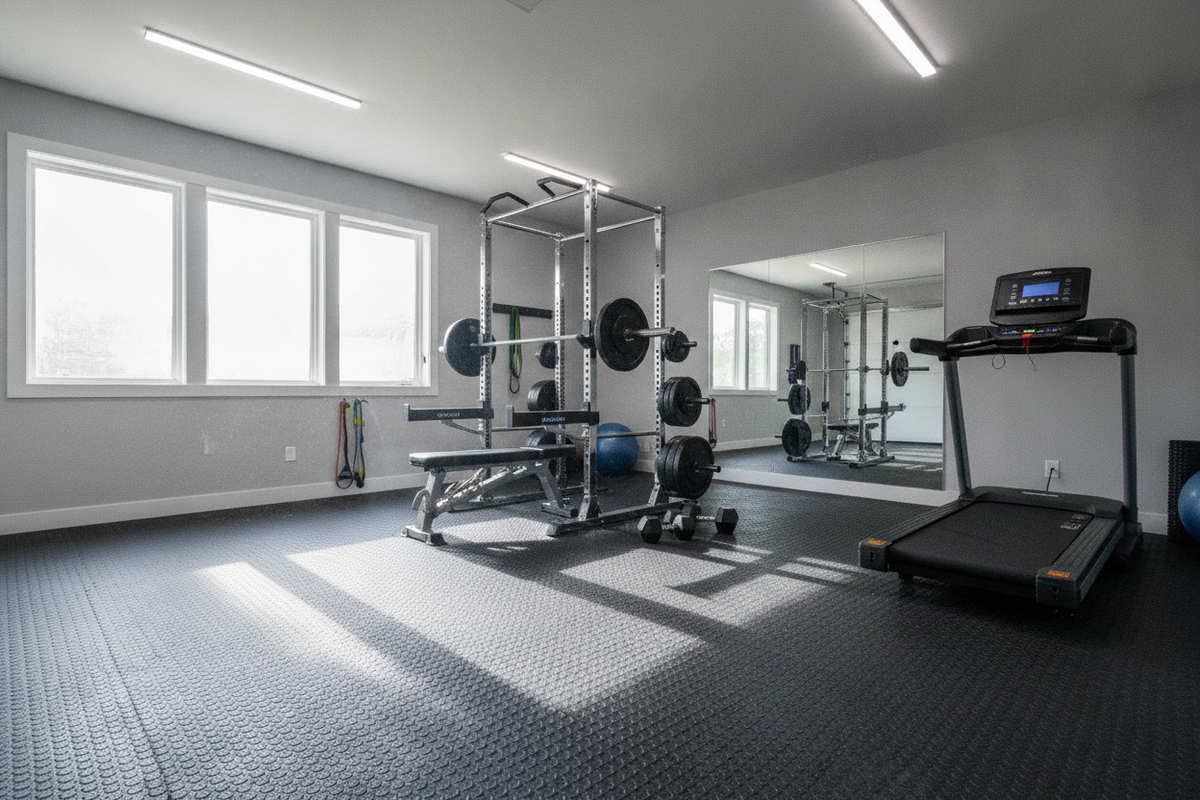
Flooring Mechanics: Traction, Joint Protection, and Surface Staging
Executing high-intensity calisthenic leg workouts requires a dependable physical foundation. Bodyweight training involves dynamic balance, kneeling transitions, and deep single-leg lunges that interact directly with the training surface.
Dynamic Foot Drive and Slip Prevention on Hard Floors
Unilateral exercises such as lunges, skater squats, and split squats generate multi-directional forces against the floor. Bare hardwood, smooth tile, or low-friction laminate surfaces can cause unexpected foot slippage, disrupting balance and reducing the force output of the working limb. Setting up a dedicated high-density workout mat provides the non-slip grip necessary to plant the drive foot firmly, allowing for confident, full-range movement during challenging unilateral sets.
Impact Attenuation for Knee and Ankle Comfort
Many bodyweight leg exercises involve direct contact between the floor and sensitive joint structures. Reverse lunges and split squats require the rear knee to lower close to or gently touch the surface, while floor-based glute bridges and Nordic curls place significant pressure on the knees, pelvis, and ankles. A dense, resilient workout surface provides the firm cushioning needed to dampen pressure points without being so soft that it compromises balance during single-leg standing drills.
Subfloor Protection and Mat Maintenance for Dedicated Home Workouts
Consistent home training can subject residential subfloors to localized wear, friction marks, and sweat accumulation. Large-format, high-density exercise mats protect underlying flooring from moisture and scuffs while establishing an organized, defined workout zone. Regular cleaning with mild soap and water maintains the surface texture and traction properties, ensuring a hygienic and reliable training space for ongoing bodyweight lower-body progression.