Best Commercial Rowing Machines: The Definitive Guide for 2024
Equipping a facility isn't just about filling space; it's about investing in hardware that can survive thousands of kilometers of abuse. When you are looking for the best commercial rowing machines, you are essentially looking for a tank that moves. Whether you are a gym owner outfitting a CrossFit box or a serious enthusiast building a bulletproof home setup, the wrong choice here means constant maintenance tickets and frustrated athletes.
We aren't looking for bells and whistles. We are looking for biomechanical integrity, heavy-duty rails, and monitors that don't glitch when the sweat starts flying.
Quick Summary: What Makes a Rower "Commercial Grade"?
- Drive Mechanism: Nickel-plated steel chains (like Concept2) last longer than nylon belts but require oiling. Belts are quieter but can stretch over years of high volume.
- Monitor Reliability: For commercial use, data accuracy is non-negotiable. Standardize on monitors that support Bluetooth/ANT+ for heart rate connectivity.
- Rail Construction: Look for stainless steel tracks or aluminum monorails with a stainless steel track cover to prevent pitting from seat rollers.
- Maintenance Profile: The best commercial rower allows for easy part replacement (bungees, sprockets) without shipping the whole unit back to the manufacturer.
The Hierarchy of Resistance: Air, Water, and Magnetic
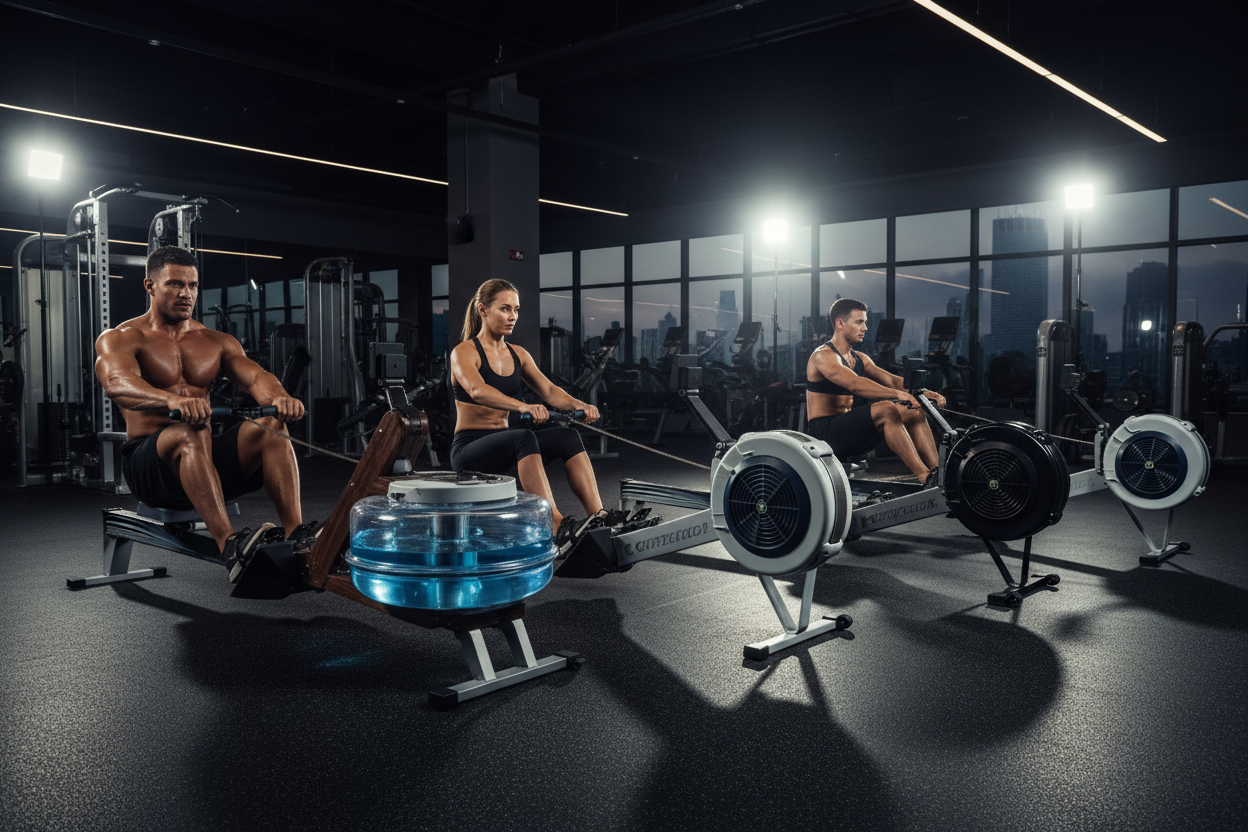
The resistance type dictates the feel of the stroke and the maintenance schedule of the machine.
Air Resistance: The Gold Standard
Air rowers, specifically the Concept2 RowErg, remain the benchmark for competitive rowing. The resistance is exponential: the harder you pull, the harder it gets. From a commercial standpoint, these are workhorses.
They are loud, but that noise provides auditory feedback that athletes actually like. It signifies work. If you find commercial rowing machines for sale that use air resistance, check the damper setting. It should control airflow to the flywheel, not the magnetic resistance, giving the user control over the "drag factor."
Water Resistance: The Aesthetic Choice
Water rowers provide a consistent, smooth load that mimics the actual hydrodynamics of a boat. The catch (the beginning of the stroke) is instant and firm.
However, for a commercial gym floor, water requires maintenance. You must treat the water with purification tablets to prevent algae buildup. While they look premium in a boutique studio, they often lack the standardized data metrics required for competitive events like the CrossFit Games.
Magnetic Resistance: The Silent approach
Magnetic rowers are nearly silent. This is ideal for a gym where rowers are placed near a yoga class or reception area. They provide a consistent resistance that doesn't fluctuate based on fan speed.
The downside? They often lack the dynamic "bite" at the catch that air rowers have. Unless you are buying high-end models like the Hydrow (which combines electromagnetic drag), cheap magnetic rowers can feel linear and sluggish.
Durability Mechanics: Chains vs. Belts
This is the biggest debate in the industry. If you are buying for longevity, you need to understand the trade-offs.
Chains are incredibly durable. They don't fray. However, they are loud and require lubrication. If your gym members sweat heavily, that salt can corrode a chain if it isn't nickel-plated.
Belts (usually Kevlar or nylon) offer a silent, smooth return. They require zero grease. However, in a high-traffic commercial setting, belts can eventually lose tension. Replacing a recoil belt is significantly more annoying than oiling a chain.
The Monitor: Data is Currency
A rower is only as good as the data it provides. In a commercial setting, users want to compare their 500m split times accurately.
If the monitor calculates distance based solely on revolution count without factoring in drag, the data is useless for competition. This is why the PM5 monitor is ubiquitous; it self-calibrates. When browsing commercial rowing machines for sale, avoid generic LCDs that only show "calories" without explaining the calculation formula.
My Personal Experience with Commercial Rowing Machines
I've spent countless hours strapped into various rowers, from pristine boutique studios to gritty garage gyms. There is a specific nuance to the best commercial rowing machines that specs don't tell you: the "Concept2 Tattoo."
I remember training for a 2k test on an older commercial model at a local box. The maintenance guy hadn't wiped the chain in months. About 500 meters in, I felt the grit in the handle return. By the end of the session, I had a streak of black grease across my shin where the chain had slapped against my leg at the catch.
That grease is the reality of commercial gear. If you buy a chain-driven rower, it feels mechanical and raw, which I love, but you will get dirty if you don't maintain it. Conversely, I recently tested a high-end magnetic commercial rower. It was smooth, sure, but I missed that mechanical vibration in the handle. On the air rower, you can literally feel the flywheel spinning down through the handle; it connects you to the machine. On the magnetic one, I felt isolated from the work. For my money, give me the noisy, greasy chain any day—it keeps you honest.
Conclusion
Choosing the right equipment comes down to your demographic. If you serve competitive athletes, stick to air resistance with chain drives. They need the data accuracy and the rugged feel. If you run a luxury health club where silence is golden, opt for high-end magnetic or water rowers.
Don't cut corners on the rail or the monitor. These are the two points of failure that will turn a profitable asset into an "Out of Order" sign.
Frequently Asked Questions
How long do commercial rowing machines last?
A well-maintained commercial rower, particularly an air-resistance model like a Concept2, can last over 10 years or millions of meters. The primary wear parts are the shock cord (bungee), the seat rollers, and the chain, all of which are inexpensive to replace.
Is a water rower better than an air rower for commercial gyms?
Not necessarily. While water rowers are quieter and more aesthetically pleasing, air rowers are generally preferred for commercial gyms due to their lower maintenance (no water treatment required) and standardized data metrics which allow members to compete against each other fairly.
Do commercial rowers require power outlets?
Most air and water rowers are self-powered; the monitor runs on batteries or generates power from the flywheel movement. However, high-end magnetic rowers or those with large HD touchscreens (like Peloton or Hydrow commercial units) will require a standard electrical outlet.