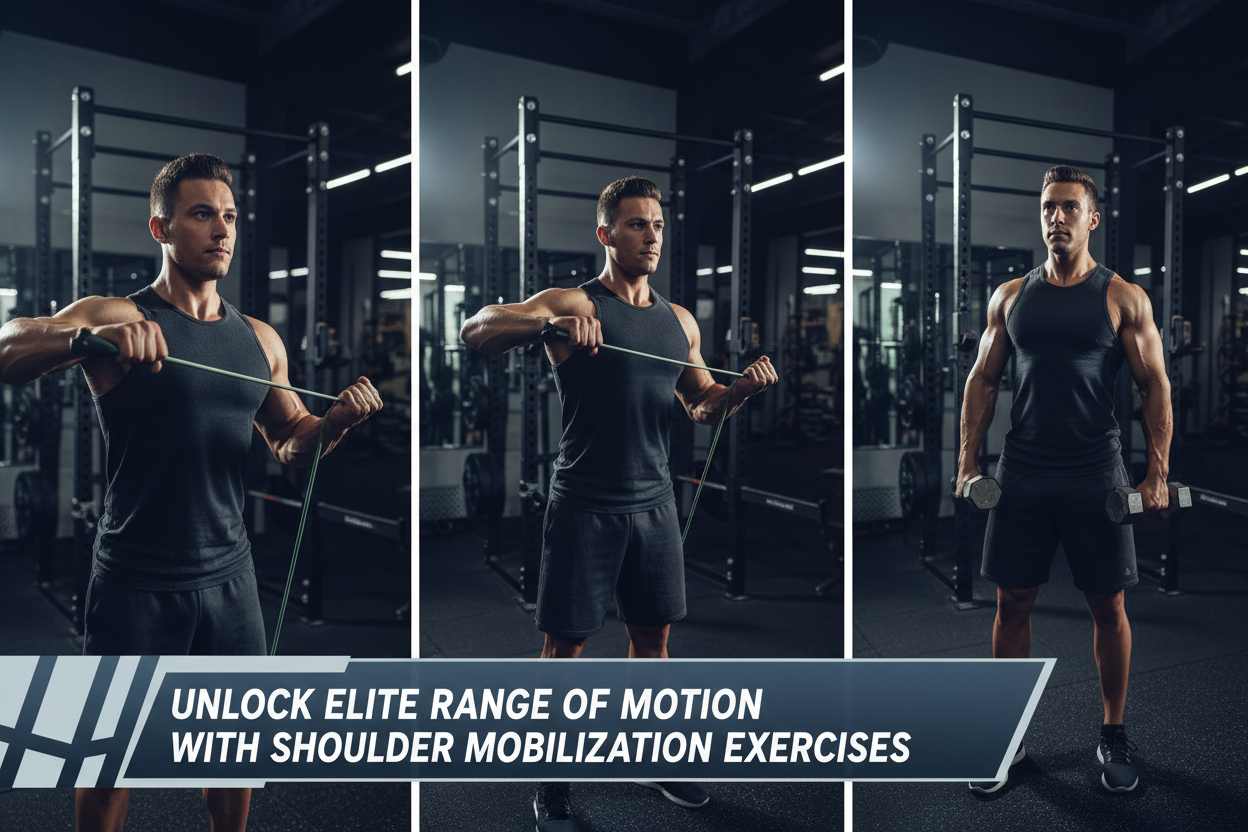
Unlock Elite Range of Motion With Shoulder Mobilization Exercises
You cannot strengthen a range of motion you do not possess. If your overhead press feels stuck or you feel a sharp pinch when reaching for the top shelf, the issue likely isn't a lack of muscle—it's a lack of mechanics. Most lifters and desk workers confuse flexibility (passive stretching) with mobility (active control). To fix the stiffness permanently, you need specific, targeted shoulder mobilization exercises.
This guide moves beyond basic static stretching. We are looking at how to re-engineer the joint capsule, improve tissue quality, and reclaim the overhead position you were born with.
Key Takeaways
- Mobility vs. Flexibility: Mobility is flexibility plus strength. You need to control the joint, not just flop into it.
- The Thoracic Connection: You cannot fix shoulder mobility without addressing a stiff upper back (thoracic spine).
- Consistency Beats Intensity: Performing daily shoulder exercises at 50% intensity is better than one intense session per week.
- Loaded Stretching: To make changes stick, you must load the tissues at their end range.
- Scapular Rhythm: The shoulder blade must move freely for the arm to move correctly.
Why Is Shoulder Mobility Important?
Your shoulder is a ball-and-socket joint designed for immense freedom of movement. However, modern life—hunched over keyboards and phones—locks the thoracic spine and rolls the shoulders forward. When you try to exercise on top of this dysfunction, you grind the joint.
Proper shoulder joint mobility ensures that the ball sits centered in the socket. This prevents impingement, rotator cuff tears, and chronic neck pain. For athletes, shoulder mobility and strength go hand-in-hand. A mobile joint allows for better force transfer. If you can't get your arms fully vertical during a snatch or overhead press, your lower back often compensates by arching, leading to injury elsewhere.
The Mechanics: How to Get Shoulder Mobility
To understand how to gain shoulder mobility, you must treat the shoulder complex as a system, not a single part. The system includes the thoracic spine, the scapula (shoulder blade), and the glenohumeral joint (the actual shoulder).
If your shoulder blade is stuck (glued to your ribcage), your arm gets jammed. Therefore, the best stretches to improve shoulder flexibility actually start with the upper back and shoulder blade movement.
Core Routine: Daily Shoulder Exercises
Perform these movements as a warm-up or a standalone recovery session. These are designed to lubricate the joint and improve neural control.
1. Thoracic Spine Extensions (Peanut/Foam Roller)
Before touching the shoulder, we free the spine. Lie on a foam roller or two lacrosse balls taped together (a "peanut") placed just below your neck.
Keep your ribs down and hips on the floor. Extend backward over the roller. Do not let your lower back arch. This targets the stiffness that prevents true overhead reaching.
2. Banded Shoulder Dislocates
This is the gold standard for shoulder and chest flexibility exercise. Hold a resistance band or PVC pipe with a wide grip. Keep your elbows locked straight.
Raise the band over your head and behind your back until it touches your lower back/glutes. Then return to the front. This takes the joint through full flexion and extension. As you improve, narrow your grip.
3. Scapular Wall Slides
Stand with your back against a wall. Press your heels, butt, upper back, and head against the wall. Now, try to press your forearms and backs of your hands against the wall in a "W" shape.
Slide your arms up into a "Y" shape without letting your lower back arch or your arms pop off the wall. This teaches your body how to increase arm flexibility while maintaining a neutral spine.
Shoulder Mobility Exercises for Athletes & Weightlifting
If you lift heavy, you need "loaded mobility." This convinces the nervous system that the new range of motion is safe to use under tension.
1. The Weighted Dead Hang
Grab a pull-up bar. Let your body hang completely loose. Relax your lats and let your shoulders rise to your ears. This decompresses the shoulder capsule and stretches the lats, which often limit overhead mobility.
Hold for 30-60 seconds. This is crucial for weightlifters who need a solid overhead lockout.
2. Butcher's Block Stretch
Kneel in front of a bench or box. Place your elbows on the edge, holding a PVC pipe or dowel in your hands. Rock your hips back toward your heels and drop your head between your arms.
Bend your elbows to bring the dowel toward your upper back. This targets the triceps and lats simultaneously, opening up the overhead position.
Advanced Shoulder Stretches and Extension
We often neglect what happens behind us. Poor shoulder extension mobility limits your ability to do dips, muscle-ups, or even reach for your wallet comfortably.
The Crab Reach
Sit on the floor, hands behind you, fingers pointing away. Bridge your hips up into a tabletop position. Reach one arm up and over across your body while driving the hips high. This is a dynamic shoulder mobilization exercise that builds strength at the end range.
My Personal Experience with Shoulder Mobilization Exercises
I spent the first five years of my lifting career ignoring mobility. I thought if I just benched more, the stiffness would work itself out. It didn't. It culminated in a sharp, electric-shock sensation in my front deltoid every time I lowered a barbell.
The turning point wasn't a surgery, but a lacrosse ball. I remember the first time I really dug into my infraspinatus (the back of the shoulder blade) with that ball against a wall. It was nauseatingly painful—a deep, dull ache that referred right to the front of my shoulder. But the moment I stepped away and raised my arm, the "catch" was gone.
Another reality check was the PVC pipe dislocates. The first time I tried them, my elbows involuntarily bent, and my left shoulder clicked loudly—a gritty, popping sound like stepping on dry leaves. It took three months of doing 20 reps every single morning before I could keep my arms straight. That specific, gritty feeling of breaking up scar tissue and adhesion is uncomfortable, but it's the only way I regained a pain-free overhead press.
Conclusion
Building elite mobility doesn't happen overnight. It is a biological adaptation. You are remodeling tissue. Whether you are looking for shoulder mobility exercises weightlifting specific or just want to fix your posture, the secret is frequency.
Do the wall slides daily. Hang from the bar after every workout. Treat your mobility work with the same respect you treat your heavy sets, and your shoulders will remain healthy for decades.
Frequently Asked Questions
How often should I do shoulder mobilization exercises?
Ideally, you should perform light mobilization daily. The shoulder joint relies on movement to circulate synovial fluid (joint lubricant). A 5-minute routine every morning is more effective than a 30-minute session once a week.
Is shoulder mobility the same as flexibility?
No. Flexibility is the ability of a muscle to lengthen passively (gravity or a partner pushing you). Mobility is the ability to actively move your joint through a range of motion with control. You need mobility, not just flexibility, to lift weights safely.
Can I do these exercises if I have a shoulder injury?
If you are currently in acute pain or recovering from surgery, consult a physical therapist first. While mobilization is generally good for rehab, aggressive stretching on an inflamed joint can make things worse. Start with gentle, unloaded movements.