Best At Home Workout Regimen: Beating Plateaus With Microcycles
I see it happen all the time. You start working out in your living room, knocking out sets of 15 push-ups and goblet squats. For the first few months, the muscle growth and fat loss are incredibly rewarding. Then, suddenly, the mirror stops changing. You are sweating just as much, your heart rate is up, but your progress has flatlined. This is the classic home workout plateau.
Finding the best at home workout regimen is not about squeezing a massive commercial cable tower into a 10x10 spare bedroom. It is about changing how you program the equipment you already own. After building and testing dozens of home gyms for my clients, I have found that the secret to continuous, long-term progress outside of a commercial facility is Daily Undulating Periodization (DUP).
By shifting your focus between heavy strength, moderate hypertrophy, and active recovery throughout the week, you force your body to constantly adapt. Let's break down exactly how to structure this microcycle approach to keep your muscles guessing and your joints healthy.
Quick Takeaways
- Doing the same exercises for the same reps every day causes your body to adapt and stop growing.
- Daily Undulating Periodization (DUP) rotates your rep ranges (e.g., 3-5, 8-12, 15+) to break through plateaus.
- You do not need heavy barbells to build strength at home; resistance bands and mechanical disadvantage push-ups work perfectly.
- Tracking your total weekly volume is critical for ensuring long-term progressive overload in any home environment.
Why Your Current Home Routine is Stalling Out
When you perform the exact same movements with the exact same weight day after day, your body experiences what exercise scientists call the repeated bout effect. Essentially, your nervous system becomes highly efficient at the movement. Efficiency is great for running a marathon, but it is the enemy of muscle growth and strength gains.
Most people default to 3 sets of 10 for every exercise they do in their living room. Once you can easily complete 3 sets of 10 with your 30-pound dumbbells, the stimulus is no longer strong enough to cause micro-tears in the muscle fibers. Your body has no reason to expend energy building new tissue. This is why the best home exercise routines must have variance built directly into their weekly structure.
Instead of just trying to add more reps ad infinitum—which eventually just turns your workout into a cardio session—you need to manipulate intensity. By dedicating specific days to specific physical adaptations, you prevent your central nervous system from burning out while simultaneously attacking different muscle fiber types. This keeps the stimulus fresh and forces your body to keep laying down new muscle tissue.
The Science of Daily Undulating Periodization (DUP) at Home
Daily Undulating Periodization might sound like a complex textbook term, but it is incredibly straightforward in practice. Traditional periodization keeps you in a specific rep range for weeks or months at a time. DUP changes the rep range and intensity every single time you train a muscle group.
For example, if you train legs three times a week, Monday might be heavy, low-rep squats (focusing on mechanical tension). Wednesday shifts to moderate-weight, higher-rep lunges (focusing on metabolic stress). Friday becomes a light, explosive jump squat day (focusing on power and endurance). This constant shifting creates the ultimate framework for the best home fitness routine because it maximizes the utility of limited equipment.
When you are shifting from heavy, grinding reps to explosive, dynamic movements, your training environment needs to be safe and supportive. Jumping around on a hardwood floor or a thin yoga mat is a fast track to shin splints and knee pain. I always have my clients lay down a large exercise mat for home gym use before starting a DUP protocol. It provides the dense, shock-absorbing foundation required to safely land plyometrics and firmly plant your feet during heavy resistance band deadlifts.
By undulating your volume and intensity, you allow certain energy systems to recover while taxing others. Your fast-twitch muscle fibers can rest while your slow-twitch fibers do the heavy lifting on endurance days. This means you can train more frequently without overtraining.
Structuring the Best At Home Workout Regimen
To put this into practice, we are going to use a three-day microcycle. This template consistently ranks among the best home workout routines because it is adaptable to whatever equipment you currently have in your garage or living room. You will run these three distinct workouts consecutively, take a rest day, and then repeat.
Day 1: High Tension Strength Focus
Your first workout of the microcycle is all about maximum mechanical tension. We are aiming for the 3 to 6 rep range. Because you might not have a 300-pound barbell at home, we have to get creative with leverage and heavy resistance bands.
If you are doing push-ups, elevate your feet on a chair and place a heavy resistance band across your back. The goal is to make the movement so difficult that you physically fail by the fifth or sixth rep. For lower body, think Bulgarian split squats holding your heaviest dumbbells, pausing for two seconds at the bottom of each rep to eliminate momentum.
Rest periods on this day should be long—around 3 to 4 minutes between sets. You want your central nervous system fully recovered so you can produce maximum force on every single set. This day builds the dense, myofibrillar muscle tissue that gives you a hard, powerful look.
Day 2: Metabolic Hypertrophy Focus
Day 2 is the classic bodybuilding day. We are targeting the 8 to 15 rep range with moderate weight. The primary driver of muscle growth here is metabolic stress—that burning sensation and the resulting muscle pump.
Rest periods drop to 60 to 90 seconds. You want blood pooling in the muscle. This is where you utilize supersets and drop sets. For example, you might do 12 dumbbell floor presses immediately followed by 15 resistance band flyes. If you have the space and budget, integrating at home exercise machines like a compact functional trainer or a leg extension/curl attachment makes hitting these higher rep ranges incredibly efficient, as you can easily pin-select the exact weight needed for failure at 15 reps.
Focus on a deep stretch and a hard squeeze at the top of every movement. Don't rush the eccentric (lowering) portion of the lift. Take a full three seconds to lower the weight to maximize time under tension.
Day 3: Active Recovery & Mobility
After a heavy strength day and a high-volume hypertrophy day, your tissues need care. Day 3 is not about sitting on the couch; it is about active recovery. We want to drive nutrient-rich blood into the muscles without causing further damage.
This means light bodyweight movements, deep stretching flows, and mobility work. I usually program 15 to 20 minutes of dynamic animal flows, yoga-inspired holds, and band dislocates. Having a dedicated 6x8ft exercise mat gives you the necessary space to roll out, stretch, and move freely without feeling cramped or slipping on sweat.
Keep your heart rate in Zone 1 or 2. Break a light sweat, mobilize your hips and thoracic spine, and prep your nervous system to tackle the heavy strength day that cycles back around tomorrow.
Essential Equipment for Scaling Your Microcycles
As you run this DUP program over several months, your baseline strength will skyrocket. To ensure this remains the best workout routine at home, you will eventually need to scale your equipment. Bodyweight and light bands will only take your heavy strength days so far.
My go-to recommendation for clients is a set of adjustable dumbbells ranging from 5 to 52.5 lbs (or up to 80 lbs if you are advanced). This single purchase covers your heavy pressing days and your lighter isolation days without requiring a massive footprint. Pair that with a high-quality adjustable bench that offers incline and decline angles, and you have unlocked dozens of new exercise variations.
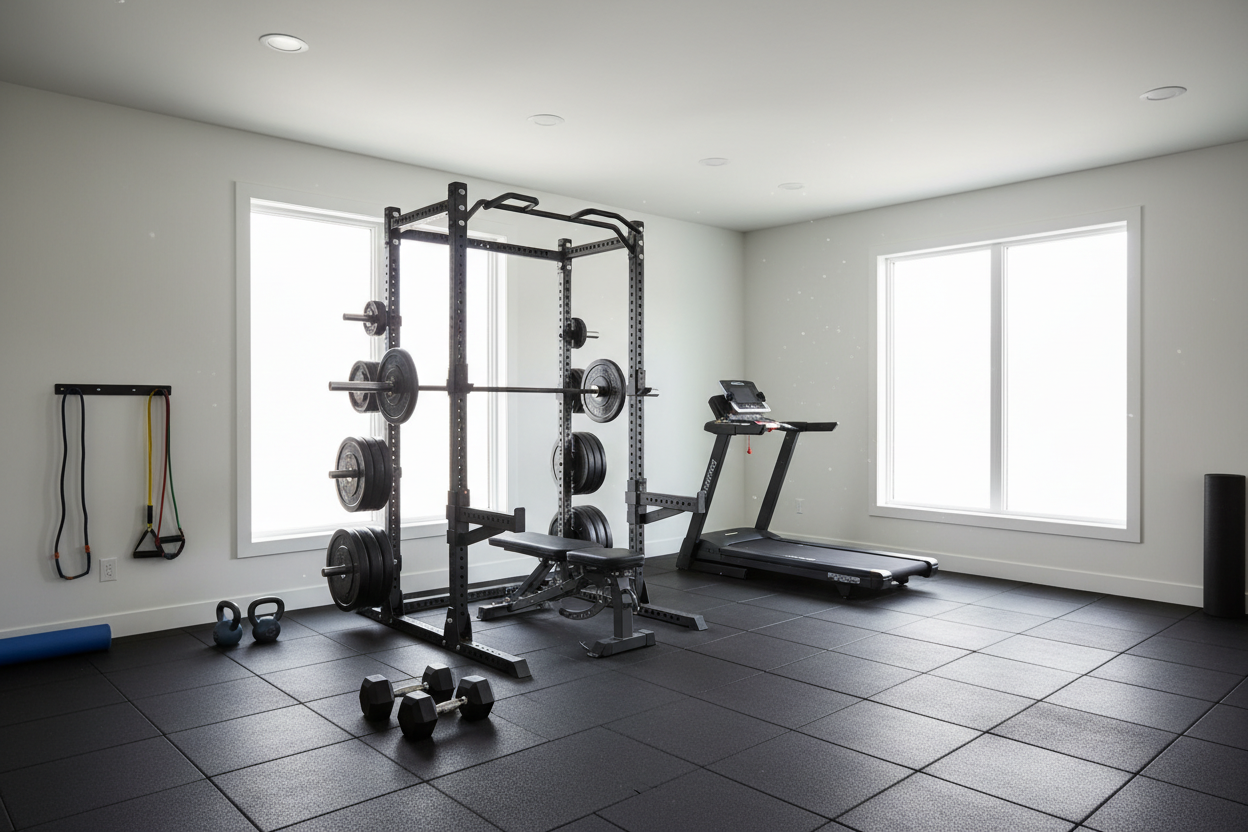
Once you max out heavy dumbbells, it is time to look at larger investments. Adding best at home workout machines like a half-rack with a lat pulldown attachment allows you to safely perform heavy barbell squats and heavy vertical pulling. The beauty of the DUP system is that it scales perfectly with your equipment. You can run the exact same heavy/light/moderate microcycle with a pair of 10-pound dumbbells or a fully equipped garage gym.
Tracking Progress and Advancing the Routine
The final piece of the puzzle is tracking. You cannot manage what you do not measure. To keep this the best workout routine for at home, you must log your workouts. I recommend a simple notebook or a tracking app on your phone.
Write down the exercise, the weight used, and the exact reps achieved. Next week, when that specific microcycle day rolls around, your goal is to beat your previous numbers. This could mean adding 5 pounds to the bar, squeezing out one extra rep, or completing the same sets with 15 seconds less rest.
If you hit the top end of your rep range (e.g., you easily hit 6 reps on your heavy day), it is time to increase the resistance. Progressive overload, combined with the undulating rep ranges, guarantees that your home workouts will continue producing results for years to come.
My Experience Testing DUP at Home
When I design programs for my remote clients, I test them myself first in my own 12x12 garage setup. A few months ago, I ran this exact 3-day DUP microcycle using only a set of 5-52.5 lb adjustable dumbbells, a flat bench, and some heavy loop bands.
The physical results were excellent—I broke through a stubborn plateau on my overhead press within three weeks. However, there is one practical downside to this setup. On the hypertrophy days, when I needed to quickly drop weight for a metabolic rest-pause set, adjusting the dials on the dumbbells took about 3 to 4 seconds per side. It doesn't sound like much, but when you are trying to keep strict 10-second rest intervals, fiddling with equipment can break your focus. If you use adjustable dumbbells, I highly recommend setting up your bands as your drop-set backup so you can transition instantly without turning dials.
Frequently Asked Questions
How many days a week should I work out at home?
For a DUP microcycle, training 4 to 5 days a week is optimal. You can run the Heavy, Hypertrophy, Recovery cycle continuously, taking a full rest day whenever your body feels excessively fatigued.
Can I build muscle at home without heavy weights?
Yes, absolutely. Muscle growth is driven by mechanical tension and metabolic stress. If you lack heavy weights, you can increase tension by manipulating leverage (like doing one-arm push-ups) or slowing down the eccentric phase of the movement to 4-5 seconds.
How long should a home DUP workout take?
If you stay strict with your rest periods, your heavy strength days should take about 45-50 minutes, hypertrophy days around 35-40 minutes, and active recovery days just 15-20 minutes.