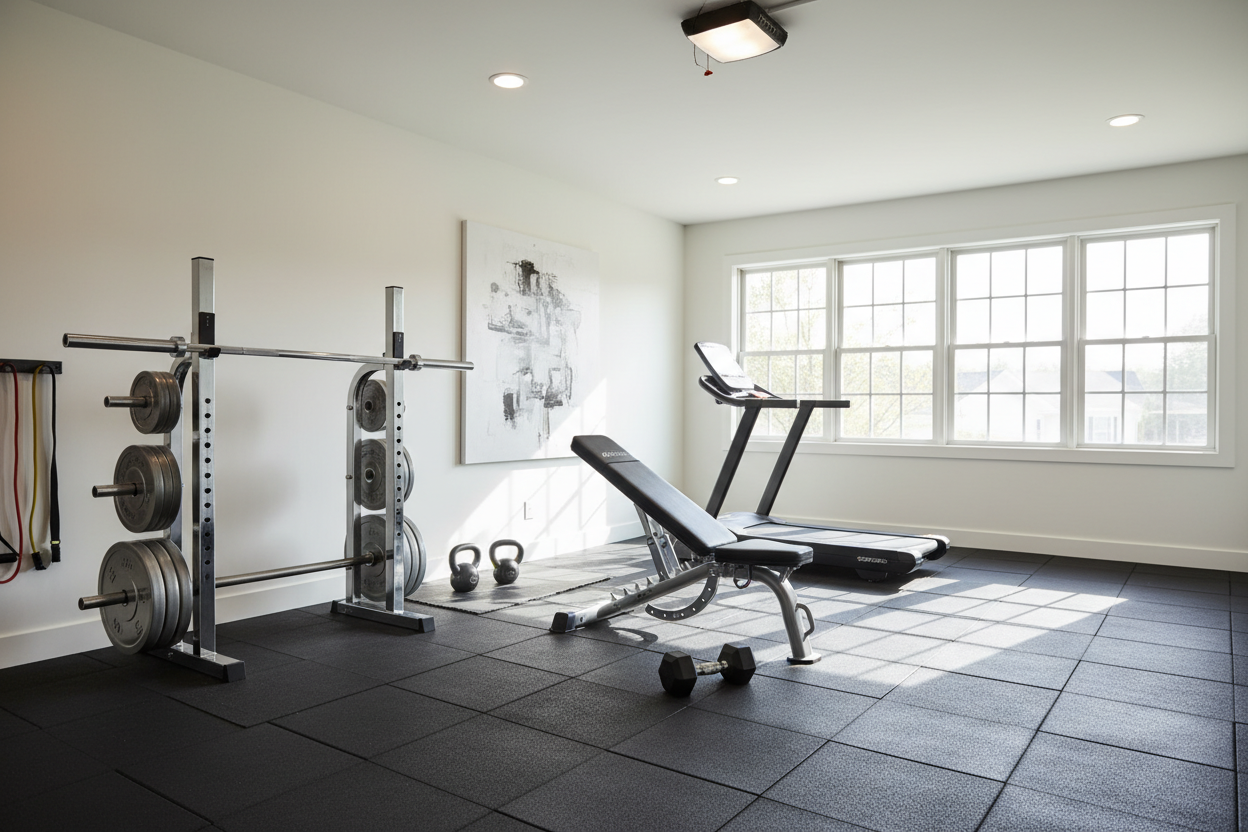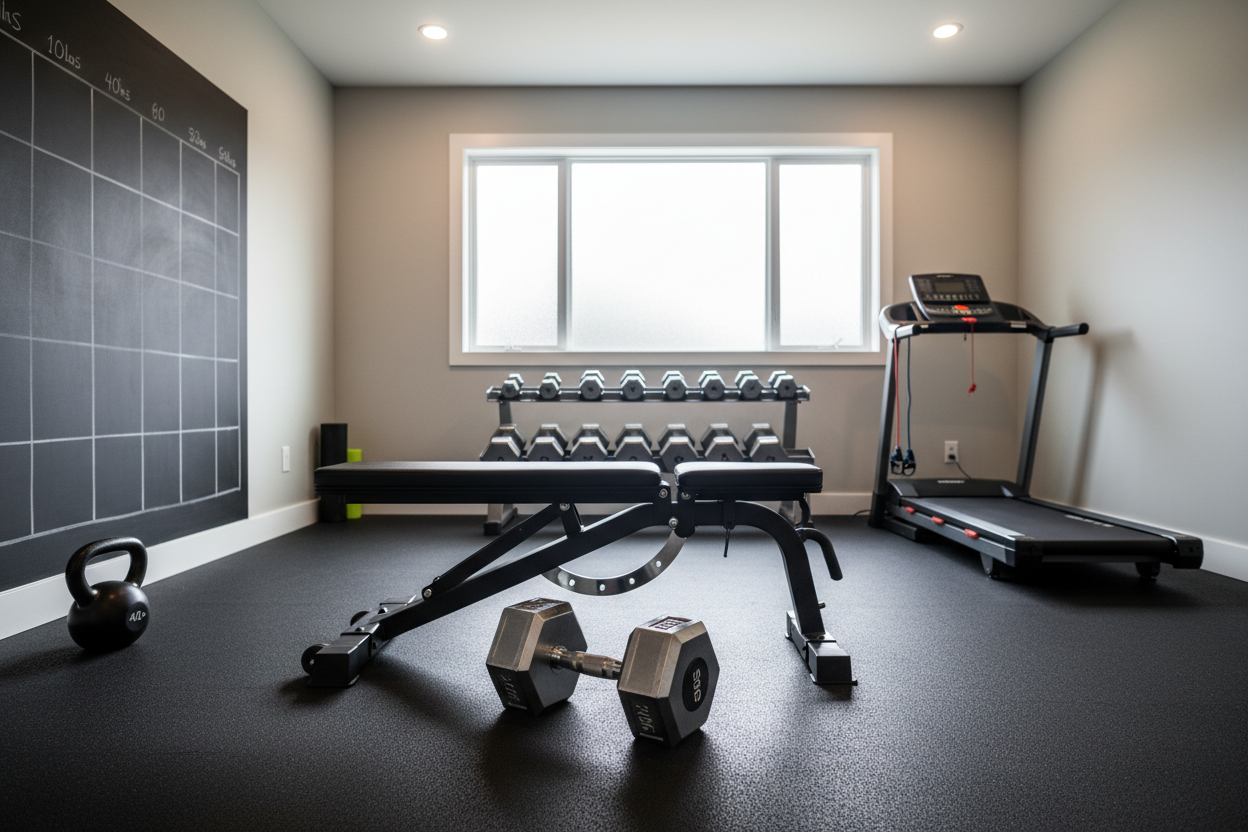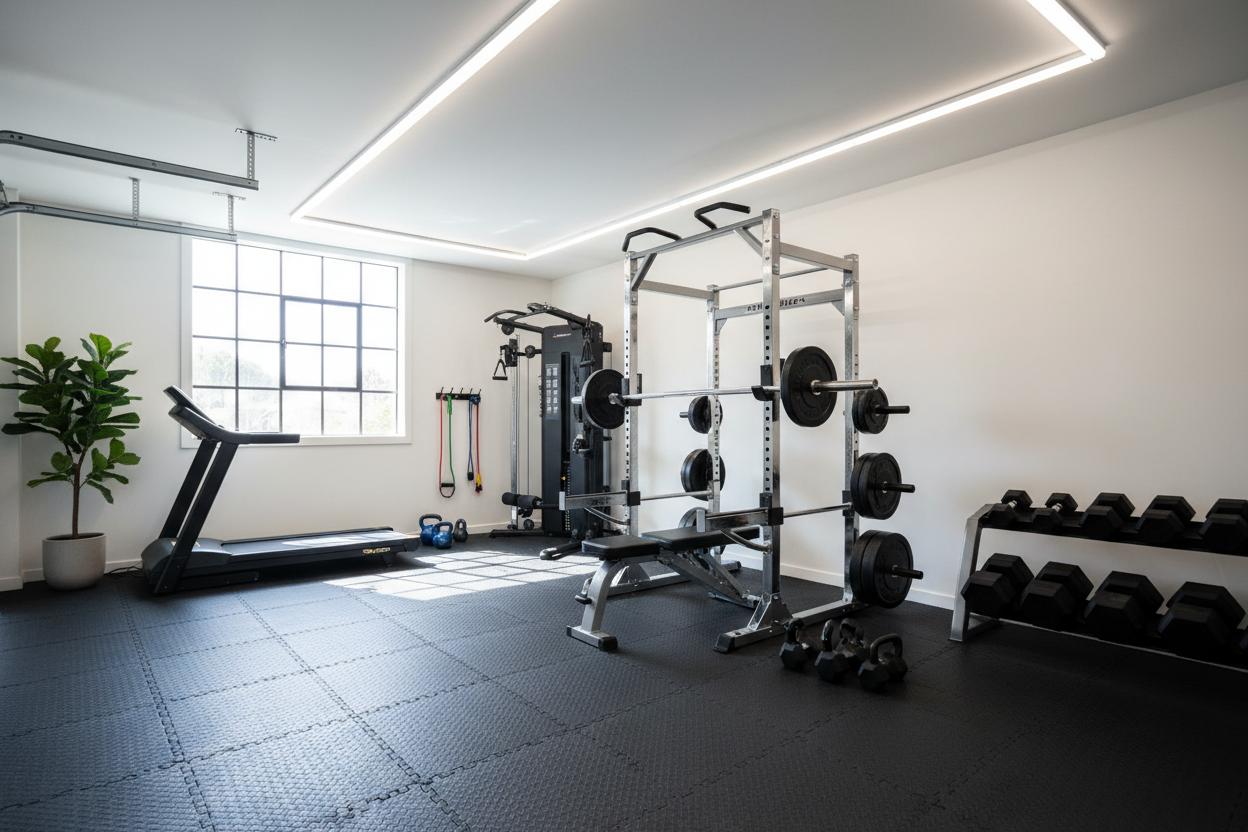
Best At Home Exercise Program: Blending Free Weights & Machines
Remember when gym closures forced everyone into their living rooms to do endless push-ups and jumping jacks? I had clients doing 500 air squats a day just to feel a burn. While calisthenics are great in a pinch, relying solely on bodyweight eventually leads to a hard plateau. Finding the best at home exercise program means moving past that limitation and building a setup that actually allows for progressive overload.
Moving Beyond Basic Bodyweight Routines
When you first start training in a spare bedroom, push-ups and lunges feel incredibly taxing. But muscles adapt quickly. Within a few months, a set of 20 bodyweight squats turns into a cardiovascular session rather than a muscle-building exercise. To trigger real hypertrophy, you need external resistance.
I have audited dozens of home setups, and the most common mistake is stopping at a pair of 10-pound dumbbells and a flimsy yoga mat. You end up doing high-rep endurance work every single day, which burns calories but fails to stimulate dense muscle growth. A true commercial-gym experience at home requires a hybrid modality. You need the stabilization challenge of free weights combined with the heavy, isolated load of machine training.
Quick Takeaways for a Hybrid Home Routine
- Combine free weights for core stabilization with machines for heavy, safe isolation.
- Invest in dense, shock-absorbing flooring to protect your joints and your subfloor.
- Adjustable dumbbells (ranging from 5 to 52.5 lbs) are the most space-efficient starting point.
- A 4-day upper/lower split prevents overtraining while maximizing muscle protein synthesis.
Why the Best At Home Workout Programs Are Hybrid
The philosophy behind the best at home workout programs is simple: combine different training modalities to target both muscular hypertrophy and endurance without frying your central nervous system. Free weights like dumbbells and kettlebells force your stabilizing muscles to work overtime. When you perform a standing dumbbell overhead press, your core is fully engaged just to keep your spine aligned.
However, free weights have limitations when you train alone. Pushing a heavy barbell bench press to absolute failure without a spotter is dangerous. This is where machines shine. A functional trainer or a plate-loaded chest press allows you to safely push your muscles to total exhaustion. By blending these two modalities, you get the functional strength of free weights and the high-load safety of machines.
A hybrid approach also keeps staleness at bay. Doing the exact same dumbbell routine three days a week gets boring. Swapping a dumbbell row for a heavy seated cable row changes the resistance profile, hits the lat muscles from a new angle, and keeps your mind engaged in the training.
Step 1: Laying the Groundwork for High-Intensity Training
Before you even look at cast iron plates or cable pulleys, you have to address the floor. Proper shock absorption and grip are non-negotiable prerequisites. I cannot tell you how many clients have wrecked their hardwood floors or developed severe knee pain from doing plyometric lunges on bare concrete.
If you are swinging a 40-pound kettlebell or performing multi-directional agility drills, a standard 3mm foam mat will slide right out from under you. You need a large exercise mat for home gym use to cover enough surface area for dynamic, multi-directional movements. A dense, high-quality mat absorbs impact noise, which keeps your downstairs neighbors happy and prevents joint degradation over time.
I always start my clients by mapping out their floor plan. A 6x8ft exercise mat is the ideal baseline size for a dedicated lifting and plyometric zone. It provides enough space to step back for walking lunges or sprawl out for burpees without constantly repositioning your equipment. Once the foundation is solid, you can safely bring in the heavy iron.
Step 2: Integrating Free Weights and Floor Work
With your flooring sorted, the next step is structuring the free weight and core segments of your routine safely. I highly recommend investing in adjustable dumbbells. A set that scales from 5 to 52.5 pounds fits into a 2x2 foot corner and replaces an entire rack of traditional weights. Pair these with a single moderately heavy kettlebell (around 35 pounds for men, 26 pounds for women) for explosive hip-hinge movements.
Your floor work should focus on mobility and core stability. Movements like Turkish get-ups, Russian twists, and dead bugs require a comfortable but firm surface. For secondary spaces in your house, or if you have a dedicated stretching and mobility zone, a 6x4ft yoga mat offers the perfect amount of cushion for spinal support during heavy core sessions.
When programming free weights, stick to compound movements. Goblet squats, Romanian deadlifts, and dumbbell bench presses give you the most return on your time investment. Aim for 3 to 4 sets of 8 to 12 reps, focusing on a slow, controlled eccentric (lowering) phase.
Step 3: Adding Heavy Hardware to Your Home Workout Plans
Eventually, your legs and back will outgrow 50-pound dumbbells. When you are mapping out the best home workout plans for the long haul, you must strategically select larger equipment to handle maximum loads. You do not need a dozen single-station machines like a commercial gym. Instead, look for versatile hardware.
Incorporating the best at home exercise machines—like a dual-stack functional trainer or a high/low pulley system—allows you to perform lat pulldowns, triceps pushdowns, and cable crossovers. These constant-tension exercises are incredible for isolating muscles and forcing growth after your heavy free-weight compounds are done.
I recently tested a plate-loaded functional trainer for my own garage gym. The ability to load up 200 pounds for low rows completely transformed my back training. However, I will be honest about the downside: the assembly took me six hours, and the machine dominates a massive 6x6 foot footprint. It is a serious commitment. But if you have the space and are ready to expand into a multi-station setup, investing in the best at home workout machines turns a spare room into an elite training facility.
Structuring Your Weekly Training Split
Having the right gear is only half the battle; knowing how to use it matters just as much. I usually put my home-gym clients on a 4-day Upper/Lower split. It balances heavy lifting days with adequate active recovery.
Here is a practical sample schedule:
- Day 1: Upper Body (Free Weights Focus). Dumbbell bench press, bent-over dumbbell rows, overhead shoulder press, and dumbbell bicep curls.
- Day 2: Lower Body (Machine & Floor Focus). Goblet squats, cable pull-throughs (using your functional trainer), walking lunges, and plank variations on your mat.
- Day 3: Active Recovery. Light stretching, mobility work, or a brisk 30-minute walk.
- Day 4: Upper Body (Machine Focus). Seated cable rows, lat pulldowns, machine chest press, and triceps cable pushdowns.
- Day 5: Lower Body (Heavy Free Weights). Dumbbell Romanian deadlifts, Bulgarian split squats, kettlebell swings, and calf raises.
This structure ensures every muscle group is hit twice a week, blending the stabilization of free weights with the heavy isolation of machines.
Frequently Asked Questions
Do I need machines to build muscle at home?
Not immediately. You can build a significant amount of muscle using just adjustable dumbbells and bodyweight. However, as you get stronger, machines provide a safer way to lift heavier loads to failure without needing a spotter.
How heavy should my adjustable dumbbells be?
For most beginners to intermediates, a set that goes up to 50 or 52.5 pounds per hand is plenty. Advanced lifters focusing on heavy presses and rows should look for sets that expand up to 80 or 90 pounds.
Will dropping weights damage my floor?
Yes, dropping heavy cast iron or urethane weights directly on hardwood or tile will crack the subfloor. Always use a high-density, large exercise mat to absorb the impact and distribute the force.
Conclusion: Consistency Beats Complexity
Building an elite home gym and running a hybrid routine does not happen overnight. The ultimate success of this program relies on sticking to the fundamentals: prioritizing progressive overload, mixing your modalities, and utilizing an environment built for performance. By laying down the right flooring, starting with versatile free weights, and eventually graduating to heavy cable machines, you create a training space that leaves absolutely no room for excuses. Lock in your 4-day split, track your lifts, and watch your home workouts rival any session at a commercial facility.