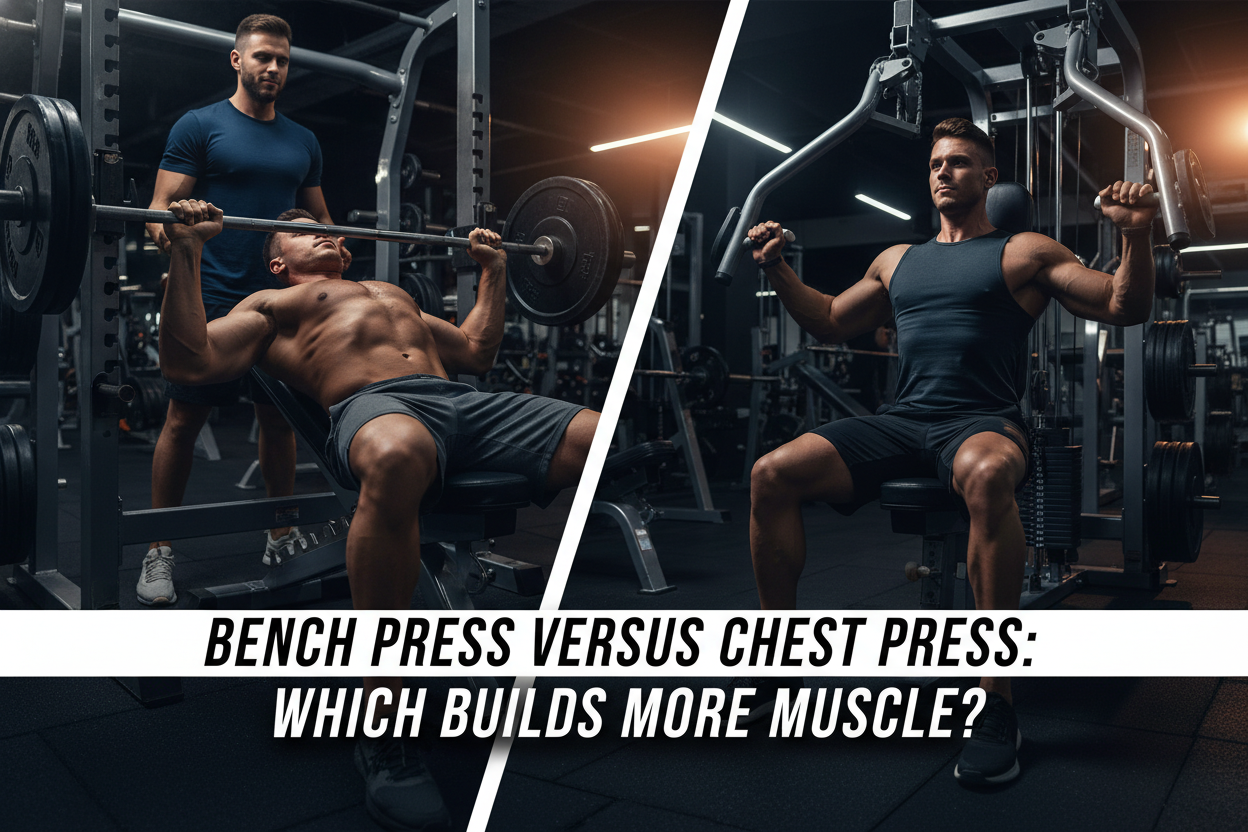
Bench Press Versus Chest Press: Which Builds More Muscle?
Walk into any gym on a Monday, and you’ll see the same battle playing out. On one side, a line forms for the flat bench. On the other, the seated machines are occupied by lifters looking for a pump without the peril. This brings us to the ultimate showdown: bench press versus chest press.
Many lifters assume these movements are interchangeable. They aren't. While both target the pectorals, the stimulus, muscle recruitment, and risk profiles differ drastically. Choosing the wrong one for your specific goal—whether it's raw strength or pure hypertrophy—can stall your progress for months.
Key Takeaways: Quick Summary
- Stabilization: The barbell bench press requires significant stabilizer muscle activation (shoulders, triceps, core); the chest press machine removes this requirement.
- Weight Translation: You cannot lift the same amount on a barbell as you can on a machine. The chest press vs bench press weight difference is due to mechanical advantage and lack of stabilization needs.
- Safety: Chest press machines allow you to train to failure safely without a spotter. Bench pressing to failure without help is dangerous.
- Functionality: The bench press is a functional, compound movement superior for athletic performance. The chest press is a hypertrophy tool superior for isolating the pecs.
The Barbell Bench Press: The King of Compound Movements
The standard barbell bench press is often called the king of upper body exercises for a reason. It is a true compound lift. When you unrack that bar, you aren't just using your chest.
Muscles Worked Beyond the Chest
Unlike the machine, the free weight bench press forces your central nervous system (CNS) to work overtime. You are engaging your front deltoids, triceps, and even your lats and legs to create a stable base. If you are asking, "is bench press the same as chest press?" mechanically speaking, the answer is no.
The barbell demands a fixed path of motion controlled entirely by you. This develops "real world" pushing strength and coordination that machines simply cannot replicate.
The Chest Press Machine: Isolation and Hypertrophy
The chest press (often a seated machine) takes stability out of the equation. Whether you are using a selectorized stack or a plate-loaded hammer strength machine, the path of motion is fixed.
Why Bodybuilders Love the Machine
Is chest press good for muscle growth? Absolutely. Because you don't have to balance the weight, you can focus entirely on the contraction of the pectoral muscles. This is crucial for hypertrophy (muscle growth).
You can push a seated chest press vs bench press much closer to true muscular failure. If your muscles give out on a machine, the handles just go back to the starting position. If they give out on a bench, the bar lands on your neck.
Comparing the Two: The Critical Differences
Let's break down the specific nuances of bench press vs machine training so you can decide which fits your program.
1. Weight Differences and Difficulty
A common question is: is chest press harder than bench? Generally, no. The bench press is harder because of the stability requirement. Furthermore, the chest press vs bench press weight difference is deceptive. Due to pulleys, friction, and leverage, 100 lbs on a machine stack rarely equals 100 lbs of free weight resistance.
2. Range of Motion and Joint Stress
The barbell bench press machine (often referring to a Smith Machine) or a standard seated press often locks you into a specific groove. For some, this is safer. For others, this fixed path can irritate the shoulder joints because it doesn't account for your unique biomechanics. The barbell allows you to adjust your elbow tuck and touch point, though it requires more skill to master.
3. Asymmetrical Development
When looking at mts chest press vs chest press (MTS refers to Iso-Lateral machines where arms move independently), the machine wins for correcting imbalances. On a barbell, your dominant side can easily take over. On an iso-lateral machine, the left side cannot help the right.
My Training Log: Real Talk
I remember the specific moment I realized the numbers don't translate. I had spent six months exclusively using a plate-loaded Hammer Strength chest press because of a minor wrist tweak. I got strong on it—loading up three plates (135 lbs) per side for reps.
I walked over to the flat bench thinking I was good for at least 225 lbs. I was wrong. I unracked 225, and the bar wobbled violently immediately. My stabilizers had atrophied relative to my prime movers. I had to strip the weight down to 185 lbs just to stop the bar from drifting toward my neck.
The machine had given me a false sense of security regarding my raw strength. However, I also noticed that during my "machine-only" phase, my actual pec definition improved significantly because I could grind out those last 3 reps without the fear of being crushed. Now, I use the barbell to build the strength foundation and the machine to burn it out at the end. That gritty friction feeling of the machine cables at the end of a workout is now my signal that the muscle is truly toasted.
Conclusion
So, is the chest press machine the same as bench press? No. They are different tools for different jobs. If you want to be strong, athletic, and coordinate your entire body, the barbell bench press is non-negotiable. If your goal is strictly aesthetic, or you are training around an injury, the chest press machine is a powerful ally.
For the best chest press results, stop viewing them as enemies. Use the bench press at the start of your workout when you are fresh, and use the chest press machine afterward to safely take your muscles to failure.
Frequently Asked Questions
Is chest press the same as bench press for muscle gain?
They both build the pecs, front delts, and triceps. However, the bench press is better for overall upper body mass and strength due to high muscle recruitment. The chest press is often better for isolating the pecs specifically, as it removes the need to stabilize the load.
Is chest press easier than bench press?
Yes, the chest press is generally considered easier to perform. It requires less technical skill, balance, and coordination. This makes it beginner-friendly, whereas the bench press has a steeper learning curve to ensure safety and proper form.
What is the weight difference between bench press and chest press?
There is no perfect conversion formula, but most lifters can lift significantly more weight on a chest press machine than a barbell. This is because machines provide stability and often use lever systems that reduce the actual load you are lifting compared to gravity acting on a free weight.