Beginners Free Weight Routine: The Three-Weight Strategy
I remember a client staring at a twenty-foot long dumbbell rack in her local gym, completely frozen. She wanted to lift, but the sheer volume of choices—from tiny 5-pound chrome bells to 100-pound iron monsters—sent her running right back to the treadmill. That is the exact opposite of what a beginners free weight routine should achieve. Strength training does not require a master's degree in biomechanics or a mathematically complex spreadsheet. It just requires a solid, simple starting point.
When I build home gyms for clients, I always strip away the excess. You do not need twenty pairs of dumbbells to get strong. By classifying all exercises into just three manageable weight categories, we can entirely eliminate the intimidation factor. This 'Three-Weight' strategy gives you a clear, actionable path to follow from day one.
Quick Takeaways
- Limit yourself to just three weights: a light pair, a medium pair, and one heavy dumbbell.
- Focus on foundational movement patterns (squats, hinges, pushes, pulls) rather than isolating single muscles.
- Protect your joints and floors with high-density, slip-free matting before lifting a single pound.
- Progressive overload happens naturally when your 'heavy' weight eventually becomes your 'medium' weight.
Why Your Beginners Free Weight Routine Feels Intimidating
Walking into a gym and trying to piece together a weightlifting beginner workout on the fly is a recipe for decision fatigue. You see people doing complex, twisting cable exercises and assume that is what you need to do. The truth is, a basic weight lifting plan for beginners must remove the guesswork to be effective. When you have too many options, you spend more time choosing weights than actually lifting them.
This paralysis by analysis is why so many people abandon their novice lifting program within the first two weeks. You might pick up a 15-pound dumbbell for a bicep curl, realize it is too heavy, swap it for a 10-pounder, and then feel completely lost when moving to squats. A structured lifting workout plan for beginners solves this by establishing strict parameters. We want to restrict your choices so you can focus purely on your form and the mind-muscle connection.
In my experience testing dozens of home gym setups, the most successful clients are the ones who start with a highly restricted equipment list. By limiting your options, you force yourself to master the basics. A simple weight workouts for beginners template is far superior to a complex one because consistency builds muscle, not variety. You just need a system that tells you exactly what to grab and when to grab it.
The Three-Weight Strategy for Simple Strength Training
The core concept of this simple strength training for beginners is what I call the Three-Weight Strategy. Instead of buying a massive rack of dumbbells or trying to memorize a complex gym weight workout for beginners, you only need to identify three specific loads: a light pair, a medium pair, and one single heavy dumbbell. That is it. This setup forms the foundation of your novice weightlifting program.
Why only three? Because every foundational human movement falls into one of these categories when you are just starting out. Your smaller upper body muscles (like the shoulders and triceps) will use the light pair. Your larger upper body muscles (like the back and chest) will use the medium pair. Your powerful lower body muscles (the quads, glutes, and hamstrings) will use the single heavy dumbbell for compound movements.
This strategy transforms an otherwise overwhelming beginner gym strength training routine into an easy weight lifting workout. You never have to guess which weight to pick up. If the program calls for an overhead press, you automatically grab your light pair. If it calls for a goblet squat, you grab your single heavy bell. It is an incredibly efficient way to structure a basic lifting plan.
One honest downside to the three-weight system is that your lower body strength will likely outpace your upper body rapidly. That single heavy dumbbell you use for squats will eventually feel too light, meaning you will have to invest in a heavier bell down the road. However, for the first three to six months of your training, this restricted setup is the absolute best weight lifting routine for beginners.
Defining Your Light, Medium, and Heavy Loads
Finding your specific three weights requires a quick, safe testing session. You want to establish these baselines before starting your actual weight room routine. For your 'light' pair, find a weight you can press over your head for 10 to 12 repetitions with perfect form. For most absolute beginners, this is usually between 5 and 10 pounds per hand.
Your 'medium' pair should be a weight you can comfortably row toward your chest for 10 reps. Typically, this falls between 15 and 20 pounds. Finally, your 'heavy' weight is a single dumbbell that you can hold at chest level while squatting. A 25 to 35-pound dumbbell is a great starting point here. This simple weight training test ensures you are lifting safely and effectively from day one.
Prepping Your Space for an Easy Weight Lifting Workout
Before you dive into your easy lifting workouts, you need to prepare your physical environment. I have seen too many clients try to do their easy weight lifting workouts for beginners on slippery hardwood floors or plush living room carpets. Both are dangerous. Hardwood offers no shock absorption for your joints, and plush carpet creates an unstable surface that can compromise your ankle and knee alignment during heavy squats.
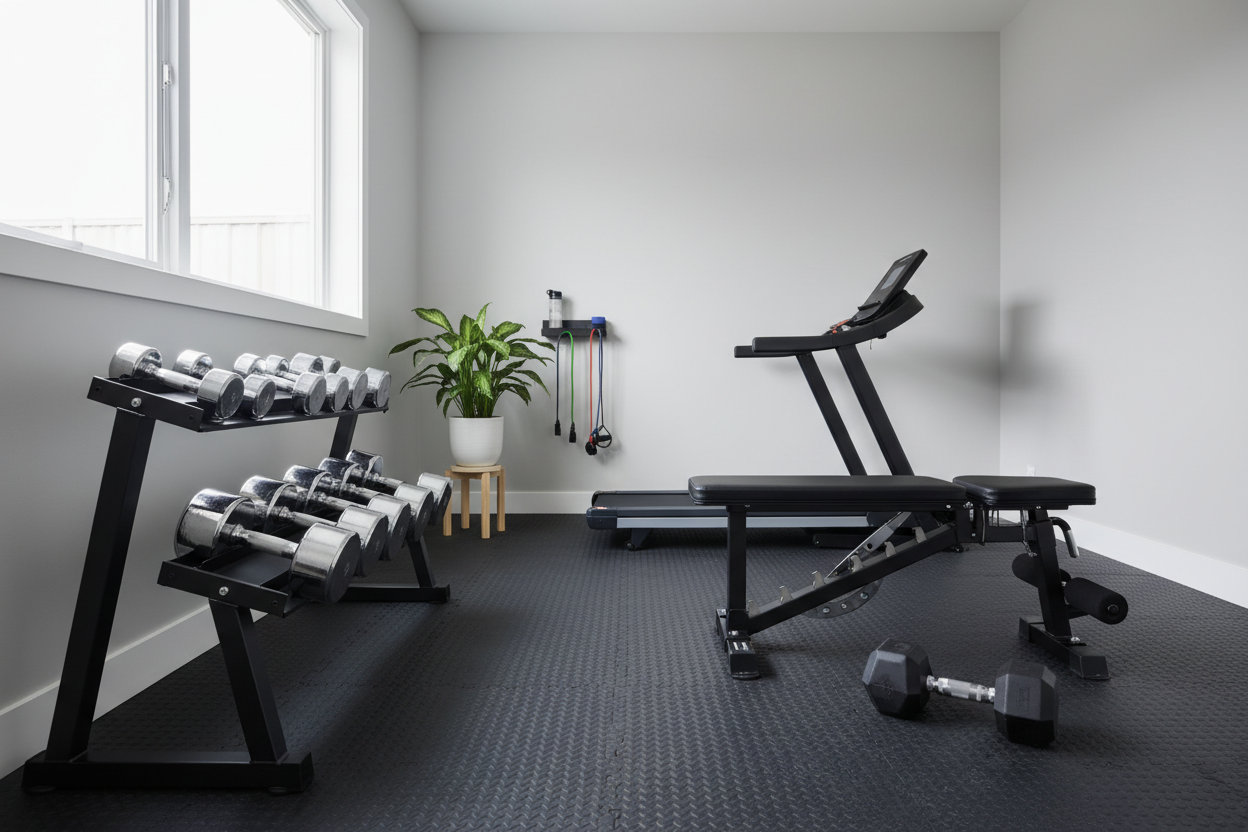
You need a dedicated, stable foundation. For a standard room setup, I always recommend laying down a 6x8ft exercise mat gym flooring. It provides enough space to step, lunge, and lie down comfortably while protecting your home's flooring from dropped dumbbells. This high-density surface mimics the feel of a professional gym floor, which is crucial for maintaining proper form during a strength training guide for beginners.
If you are working with a tighter space, like a small apartment or a cramped home office, a 6x4ft exercise mat is a fantastic, space-saving alternative. It still gives you that essential non-slip grip and joint protection without dominating the room. Setting up this physical boundary also helps mentally; when you step onto the mat, your brain knows it is time to work. A proper floor setup is the unsung hero of any good weight workouts for beginners.
The Core Movements of Your Novice Lifting Program
Now that your space is prepped and your three weights are selected, it is time to look at the actual movements. The best beginners weight training routine completely ignores isolation exercises like bicep curls and triceps kickbacks. Instead, we focus entirely on compound movements. Compound exercises recruit multiple muscle groups at the same time, giving you the best return on your time investment.
Your routine will be broken down into upper body and lower body patterns. We aim for 3 sets of 8 to 12 repetitions for each exercise. If you can only do 8 reps, that is fine. Once you can easily complete 12 reps across all three sets, you know you are getting stronger. This straightforward progression is what makes it an easy weight lifting workout to track and maintain.
Rest is just as important as the lifting itself. Take 60 to 90 seconds of rest between each set. Do not rush. This is a strength training at gym for beginners protocol, not a breathless cardio session. The goal is to let your muscles recover enough to lift the weight with perfect, controlled form on the next set.
Lower Body: Goblet Squats and Romanian Deadlifts
The goblet squat is arguably the king of weight lifting moves for beginners. Grab your single 'heavy' dumbbell and hold it vertically against your chest with both hands. Keep your chest up, push your hips back, and squat down until your elbows touch the inside of your knees. Drive through your whole foot to stand back up. This movement builds incredible leg and core strength simultaneously.
Next is the Romanian Deadlift (RDL). Grab your 'medium' pair of dumbbells. Stand tall, keep a slight bend in your knees, and push your hips backward as if you are trying to close a car door with your glutes. Let the weights slide down the front of your legs until you feel a deep stretch in your hamstrings, then squeeze your glutes to stand back up. These two movements alone create a highly effective lower body simple strength training for beginners routine.
Upper Body: Overhead Presses and Dumbbell Rows
For your upper body, we start with the overhead press to build shoulder and triceps strength. Sit on a bench or sturdy chair and grab your 'light' pair of dumbbells. Start with the weights at shoulder height, palms facing forward. Brace your core and press the weights straight up until your arms are fully extended. Lower them back down with control. This is a staple in any weight workout routine for beginners.
To balance the pressing, we use the dumbbell row. Grab your 'medium' pair of dumbbells. Hinge forward at the hips (similar to the RDL position) keeping your back perfectly flat. Let your arms hang down, then pull your elbows up toward the ceiling, squeezing your shoulder blades together at the top. This builds the postural muscles in your back, completing your easy weight lifting circuit.
Progressing Your Beginner Gym Strength Training Routine
Eventually, there will come a day when your 'heavy' weight feels like a 'medium' weight. You will easily hit 3 sets of 12 reps on your goblet squats, and your heart rate will barely spike. This is a massive victory! It means your basic lifting plan has worked and your body has adapted. When this happens, it is time to progress.
You can start by simply bumping all your weights up a category. Your old medium pair becomes your new light pair, and you purchase a new, heavier dumbbell for your lower body work. However, if you find yourself consistently maxing out free weights, it might be time to look into the best strength training equipment to expand your home gym's capabilities, such as an adjustable bench or a barbell set.
If you have joint concerns or want to safely push your leg strength without balancing heavy dumbbells, transitioning to the best weight training machines is a logical next step. Machines provide a fixed path of motion, allowing you to load up the weight safely. Knowing what is a good beginner weight lifting routine is just the first step; knowing how to evolve it ensures you keep seeing results for years to come.
Frequently Asked Questions
How many days a week should I do this beginner routine?
For absolute beginners, three days a week is the sweet spot. Aim for Monday, Wednesday, and Friday. This gives your central nervous system and muscles a full 48 hours to recover between sessions, which is when the actual muscle growth and strength adaptations occur.
How long should this workout take?
A simple weight training session using the three-weight strategy should take no longer than 30 to 40 minutes, including a brief warm-up. If it is taking longer than an hour, you are likely resting too long between sets or adding unnecessary exercises to the program.
When do I know it is time to increase my weights?
Use the 'two-for-two' rule. If you can perform two more repetitions than your target (e.g., 14 reps instead of 12) on your final set for two consecutive workouts, it is time to increase the load. This ensures you are progressing safely without rushing the process.