Beginners Fitness Programme: Why Space Beats Sets
I have watched countless clients excitedly buy dumbbells, resistance bands, and a fresh pair of sneakers, only to quit three weeks later. The problem usually is not their motivation or their genetics. The problem is their living room. When you have to shove your coffee table sideways, kick the dog's toys out of the way, and unroll a dusty mat just to do a push-up, you have already lost. A successful beginners fitness programme does not start with picking the perfect exercises. It starts with eliminating every single barrier between your couch and your first rep.
As a personal trainer who has built and tested dozens of home gyms, I can tell you that space always beats sets and reps. If your workout environment requires assembly, you are relying on willpower just to get to the starting line. Willpower is finite. By day fourteen, your brain will convince you that watching television is a better use of your evening.
Quick Takeaways
- Dedicate a permanent 6x4 or 6x8 footprint that never gets packed away.
- Friction is the enemy of habit; remove setup time completely.
- Choose gear that requires zero assembly before your workout.
- Master a ready-state routine before worrying about heavy loads.
The Hidden Trap in Every Beginners Fitness Programme
When I start with a new client, I ask them to walk me through their exact setup routine at home. Most describe a stressful ten-minute chore of rearranging furniture, finding their shoes, and hunting down the right resistance band. This pre-workout ritual creates massive psychological friction. When you are exhausted after a nine-hour shift, the thought of moving a heavy oak coffee table is enough to make you skip the workout entirely.
Most routines fail because they are designed for commercial gyms where the space is already optimized for movement. At home, you are fighting against an environment built for relaxation. The hidden trap is treating your workout like an event that requires preparation. If you have to unroll, inflate, or rearrange anything, your setup is fundamentally broken.
The secret to early consistency is immediate execution. You need to be able to drop your work bag, step into a designated zone, and start moving within ten seconds. Your environment dictates your habits. If your living room is set up for watching TV, you will watch TV. If a corner of your home is permanently set up for lifting, you will lift.
Step 1: Claiming Your Permanent Workout Footprint
Your first assignment has nothing to do with lifting weights. You need to claim a permanent piece of real estate in your home. I tell my clients to find a corner of their bedroom, basement, or home office that measures at least 6x4 feet, though 6x8 feet is ideal. This space must remain untouched by daily life. No laundry baskets, no office chairs, no kids' toys.
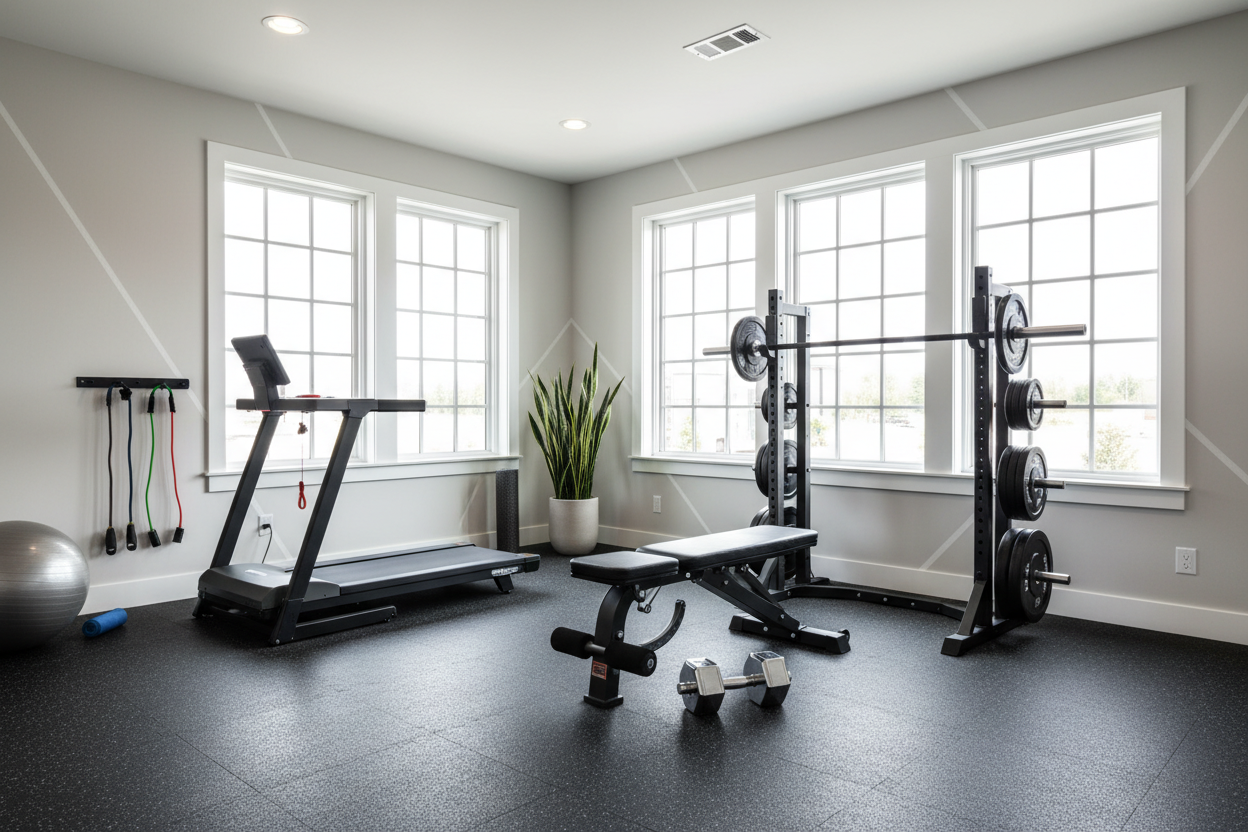
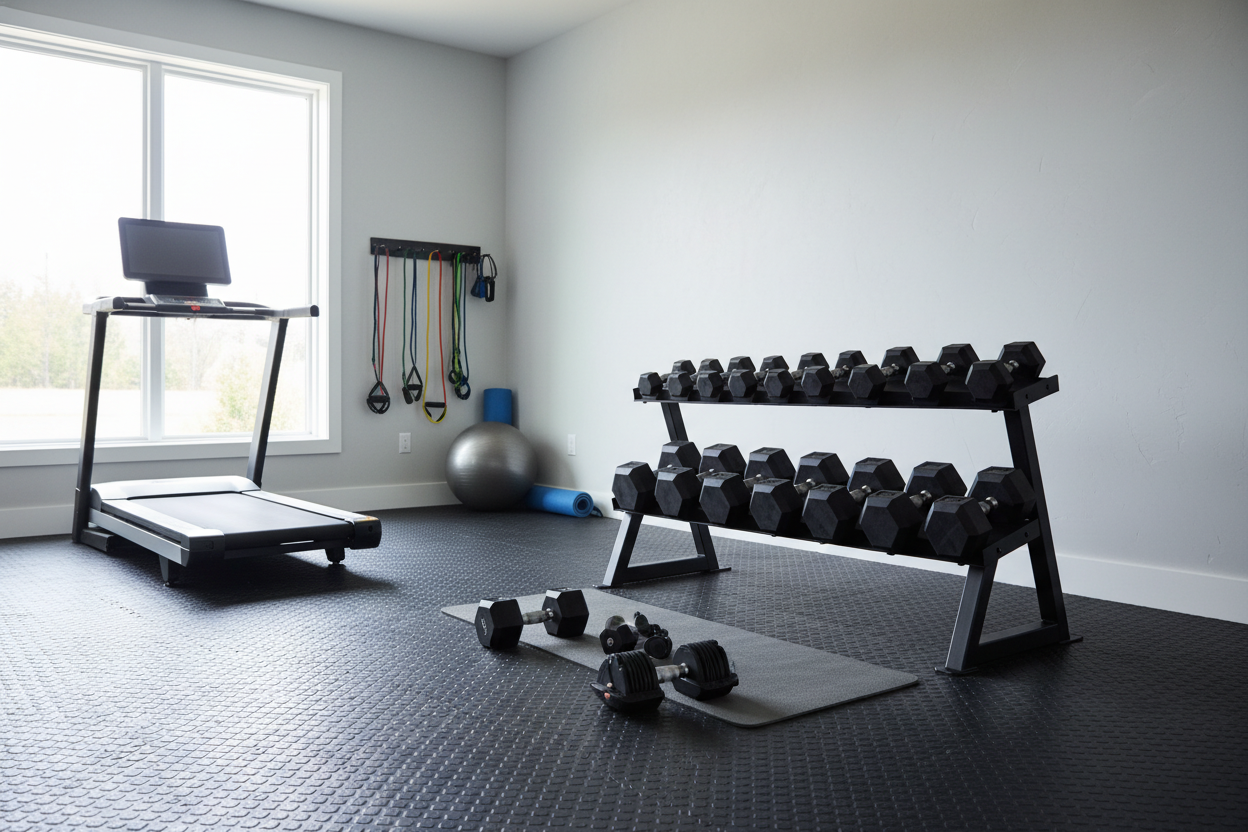
Once you identify this area, anchor it visually. Do not rely on a flimsy roll-up mat that spends most of its life in a closet. Instead, lay down a heavy-duty foundation that stays flat 24/7. When you invest in proper gym flooring for home workout spaces, you create a psychological boundary. The moment your feet touch that surface, your brain recognizes that it is time to train.
I learned this the hard way in my own apartment. I used to work out on my living room rug, slipping around and constantly worrying about sweat stains. It was not until I laid down a permanent 7-millimeter thick mat behind my couch that my routine stuck. The visual cue of that black rectangle triggered my habit loop automatically. It was always there, staring at me, waiting.
This permanent footprint absorbs impact, protects your joints during plyometrics, and dampens the noise of dropping weights, which is crucial if you have downstairs neighbors. More importantly, it completely eliminates the setup phase. Your gym is always open.
Step 2: Selecting Frictionless Equipment
When outfitting your new space, avoid the trap of buying complicated, multi-station machines. Absolute novices do not need cable crossovers or a wall of hex dumbbells. You need gear that requires zero assembly and lives permanently on your workout footprint.
Start with a pair of adjustable dumbbells. I highly recommend a set that ranges from 5 to 52.5 pounds. They take up less than two square feet of space and allow you to scale your routine for months. Keep them resting at the edge of your mat. Next, grab a single kettlebell, usually 16kg for men and 8kg for women, and a high-quality resistance band.
If you are unsure where to start your search, take a look at some of the best home fitness equipment available that fits a minimalist philosophy. The goal is accessibility. If you have to screw on collars or string up pulleys before a set of curls, you will eventually stop doing curls.
In my experience testing dozens of home setups, the equipment that gets used most is the equipment that is already out. Storing gear in a closet is a death sentence for consistency. Let your dumbbells sit on the floor. Let your kettlebell act as a doorstop. Make your tools visible and instantly accessible.
Step 3: The 'Ready-State' Fitness Beginner Workout
Now that your space is locked in and your gear is ready, it is time to move. A true ready-state routine is designed to be executed the exact second you step onto your footprint. No overthinking. No scrolling through your phone for inspiration.
Here is a highly effective fitness beginner workout that hits every major muscle group using just your bodyweight and a single pair of dumbbells. Perform this circuit three times a week.
First, start with goblet squats. Hold one dumbbell vertically against your chest and squat until your elbows touch your knees. Aim for 3 sets of 10 to 12 reps. This builds foundational leg strength and core stability.
Next, move to floor presses. Lie flat on your back and press your dumbbells straight up. This is a safer alternative to the bench press and requires nothing more than the floor beneath you. You will quickly realize why having more space than a standard exercise mat is beneficial when you are spreading your arms out with weights. Do 3 sets of 10 reps.
Follow that with dumbbell rows. Hinge at the hips, keep your back flat, and pull the weights to your pockets. 3 sets of 12 reps per side. Finally, finish with a 30-to-45-second plank to lock in your core strength.
This routine takes roughly 25 minutes. It requires zero machine adjustments and no waiting for someone else to finish their set. If you need visual demonstrations of these exact movements, you can explore our workout hub to see proper form in action.
Step 4: Scaling Workout Programs Beginners Can Sustain
After three to four months of consistent training on your home mat, you will notice a shift. The 25-pound dumbbells that used to feel heavy will start flying up. Your resting heart rate will drop. Most importantly, stepping onto your workout footprint will feel like an automatic habit rather than a daily chore.
This is the critical juncture where you need to scale your intensity. The most effective workout programs beginners transition into involve progressive overload. You can achieve this at home by slowing down your reps, adding pause sets, or investing in heavier adjustable dumbbells. I often have clients increase their time under tension, taking three full seconds to lower the weight during a squat, to maximize muscle growth without needing heavier plates.
Eventually, you might outgrow your home setup, and that is a massive victory. When you have built an unbreakable habit of training three days a week, transitioning to a commercial facility becomes much easier. You will not be intimidated because you already know how your body moves. If you decide to make that jump, having an ultimate beginner workout strategy for navigating a large gym floor will keep your momentum going.
Over the past six years, I have personally tested dozens of home gym configurations in spaces ranging from tiny studio apartments to full two-car garages. I recently spent three months exclusively using a 5-52.5 lb adjustable dumbbell set paired with a heavy-duty 7mm mat. The sheer convenience of rolling out of bed and lifting within 60 seconds was incredible for my consistency. However, I will be honest about one downside: heavy deadlifts are tough to replicate without an Olympic barbell. But for building a foundational habit, the tradeoff is absolutely worth it.
Frequently Asked Questions
Do I really need a permanent space if my apartment is small?
Yes. Even a dedicated 4x4 corner that never changes is better than a larger space that requires ten minutes of furniture moving. Friction kills habits.
How heavy should my first set of dumbbells be?
Adjustable dumbbells ranging from 5 to 50 pounds are ideal. If buying fixed weights, a 10-pound pair and a 20-pound pair will cover most upper and lower body movements for a novice.
Can I build muscle with just a mat and a kettlebell?
Absolutely. By manipulating tempo, increasing repetitions, and reducing rest times, a single kettlebell can provide enough stimulus to build significant strength and muscle mass during your first year of training.