Beginner Full Body Workout at Gym: Foundational Lift Systems, Routine Blueprints, and Floor Staging
Stepping onto the commercial gym floor for the first time can feel overwhelming. With rows of unfamiliar selectorized machines, bustling free-weight sections, and various functional training zones, novice lifters often struggle to determine where to begin. Executing a beginner full body workout at gym facilities provides an organized, repeatable framework that demystifies the training environment. Rather than isolating individual body parts across numerous days, a structured full-body blueprint trains major foundational movement patterns in balanced, manageable sessions.
Why a Full Body Routine Is Ideal for Gym Beginners
For individuals establishing a consistent fitness habit, choosing an easy beginner full body workout offers distinct logistical and physiological advantages over complex multi-day body-part splits.
Movement Efficiency and Skill Acquisition
Resistance training is fundamentally a motor skill. Movement patterns such as squatting, hinging, pressing, and pulling require neuromuscular coordination. By engaging these multi-joint movement patterns multiple times per week in a full body beginner workout gym setting, lifters reinforce proper mechanics and lifting cadence more frequently than they would on an infrequent body-part rotation.
Balancing Training Stimulus and Recovery
Novice lifters generally require moderate training volume per session to stimulate strength and conditioning adaptations. Spreading foundational compound lifts across non-consecutive training days allows adequate muscular and connective tissue recovery between workouts, helping lifters maintain technical consistency without accumulating excessive local muscular fatigue.
Core Movement Patterns of an Easy Beginner Full Body Workout
A well-rounded full body workout plan beginner framework relies on fundamental movement categories rather than an exhaustive list of isolated exercises. Focusing on these core categories creates a balanced strength base across the entire body.
- Lower Body Squat Pattern: Movements such as goblet squats, leg presses, or bodyweight box squats build quadriceps, gluteal, and core engagement while reinforcing upright torso mechanics.
- Lower Body Hinge Pattern: Variations like Romanian deadlifts with dumbbells or kettlebell deadlifts target the posterior chain, including hamstrings, glutes, and lower back stability.
- Upper Body Horizontal Push: Dumbbell bench presses, machine chest presses, or standard push-ups develop the chest, anterior shoulders, and triceps.
- Upper Body Horizontal Pull: Seated cable rows, supported chest rows, or one-arm dumbbell rows recruit the upper back, latissimus dorsi, and biceps.
- Upper Body Vertical Push and Pull: Dumbbell overhead presses and lat pulldowns balance shoulder stability and back width.
- Core Bracing and Anti-Rotation: Planks, bird-dogs, and cable Pallof presses encourage trunk stiffness without requiring aggressive spinal flexion.
Structuring Your Beginner Full Body Workout Plan
Establishing the best full body workout routine for beginners requires a clear, repeatable weekly blueprint that balances exercise variety with progressive mastery.
Sample Three-Day Training Template
A standard schedule alternates training days and rest days (such as Monday, Wednesday, and Friday). This structure allows each session to touch upon every primary kinetic chain while emphasizing distinct primary lifts.
- Session A: Goblet Squat (3 sets of 8–10 repetitions), Dumbbell Flat Bench Press (3 sets of 8–10 repetitions), Seated Cable Row (3 sets of 10–12 repetitions), Standing Dumbbell Overhead Press (2–3 sets of 10 repetitions), and Standard Plank (3 holds).
- Session B: Dumbbell Romanian Deadlift (3 sets of 8–10 repetitions), Lat Pulldown (3 sets of 10–12 repetitions), Incline Dumbbell or Machine Press (3 sets of 8–10 repetitions), Walking Lunges or Step-Ups (2–3 sets per leg), and Cable Pallof Press (3 sets per side).
Understanding how compound lifts integrate across weekly training frequencies is explored in detail within our full body routine guide.
Navigating Free Weights, Cables, and Selectorized Machines
When starting a full body workout for beginners at the gym, lifters should feel empowered to blend equipment types. Selectorized machines offer fixed movement paths that allow beginners to build baseline strength and mind-muscle connection with minimal stabilization demands. As technical comfort grows, introducing dumbbells and cable systems challenges stabilizer muscles and enhances dynamic joint control.
For additional program frameworks and progressive lifting mechanics, explore our comprehensive workout resource.
Gym Station Setup, Flooring Traction, and Equipment Protection
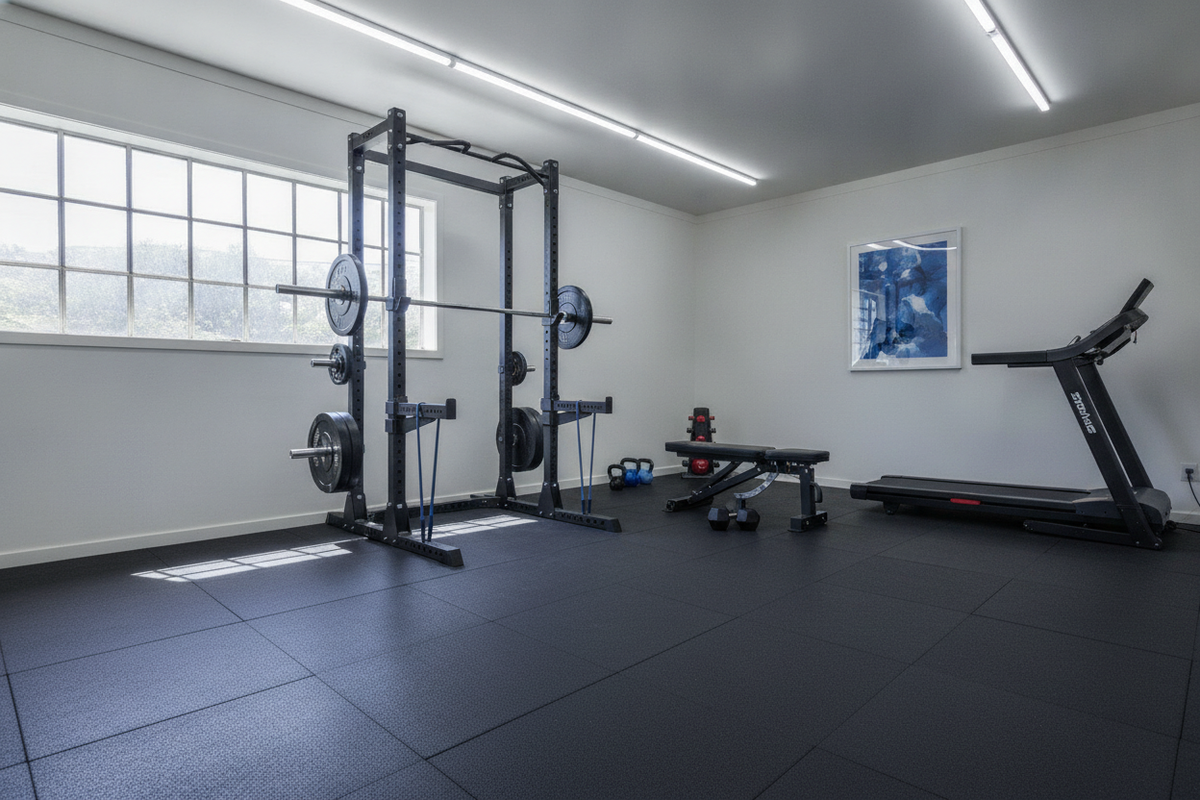
Executing exercises with control requires paying close attention to the surrounding lifting environment. Whether training in a commercial facility or staging a personal workout area, stable footing and organized equipment management are essential for a successful session.
Establishing a Stable Footing and Non-Slip Base
Compound exercises such as squats, overhead presses, and lunges demand firm ground contact. Soft or slippery surfaces can compromise ankle stability and lead to uneven force distribution. Lifters should seek firm, non-slip rubber flooring or high-density mats that do not compress excessively underfoot, providing a reliable foundation for force transfer.
Dumbbell and Barbell Staging on Protective Surfaces
When setting up a circuit or alternating between exercises, free weights should be placed deliberately on durable, impact-absorbing surfaces rather than dropped onto bare subfloors. When practicing foundational bodyweight progressions or dumbbell circuits away from crowded commercial platforms, a dedicated gym workout product provides reliable joint cushioning and equipment protection during floor transitions.
Preventing Equipment Drift and Floor Wear
Stationary benches, step platforms, and kettlebells can shift during active sets if placed on dusty or slick surfaces. Positioning equipment on textured, high-traction flooring prevents unwanted sliding, protecting both the facility's underlying subfloor and the lifter's movement path.
Common Novice Execution Errors and How to Avoid Them
Even with an effective novice full body workout blueprint, certain common habits can hinder steady development if left unaddressed.
- Overcomplicating Exercise Variety: Frequently switching movements makes it difficult to track technical progress. Sticking with a core collection of foundational exercises for several consecutive weeks allows motor patterns to solidify.
- Prioritizing Load Over Tempo: Adding weight prematurely often leads to rushed repetitions and compromised body alignment. Emphasizing a controlled eccentric lowering phase and a deliberate pause reinforces joint stability.
- Neglecting Rest Between Sets: Rushing through sets without adequate rest turns strength training into cardiovascular conditioning, reducing the mechanical quality of subsequent repetitions. Resting one to two minutes between working sets preserves movement quality.
By establishing stable floor stations, mastering foundational movement patterns, and adhering to a structured schedule, any beginner can step onto the gym floor with confidence and build a durable athletic foundation.