Back of the Leg Workout: Posterior Chain Progressions, Movement Frameworks, and Home Floor Staging
A well-structured back of the leg workout targets the posterior chain—the muscular network responsible for hip extension, knee flexion, upright posture, and athletic power. While quad-dominant exercises like squats frequently take center stage in general lower-body programming, dedicating focused volume to the hamstrings, glutes, and calves creates balanced lower-limb development and supports joint integrity throughout dynamic movements.
Structuring a complete back leg workout requires an understanding of biomechanics, exercise variety, and a supportive training environment. By pairing hip-dominant hinges with isolated knee flexions and solid ground staging, you can build a comprehensive routine suited for commercial gyms or home training spaces.
Anatomy of the Posterior Leg: Biomechanical Foundations
The posterior lower body consists of interconnected muscle groups working across multiple joint axes. Understanding their primary actions helps ensure each movement pattern receives adequate stimulus in your training cycle:
- The Hamstrings: Composed of the biceps femoris, semitendinosus, and semimembranosus. Because the hamstrings cross both the hip and knee joints (with the exception of the short head of the biceps femoris), they perform two primary actions: extending the hips backward and flexing the knees upward toward the glutes.
- The Gluteal Complex: Primarily the gluteus maximus, which acts as the prime mover in powerful hip extension and external rotation, stabilizing the pelvis during both bilateral and unilateral exercises.
- The Calves: Made up of the gastrocnemius and the underlying soleus. The gastrocnemius crosses the knee joint and assists in knee flexion alongside ankle plantar flexion, whereas the soleus works purely at the ankle joint.
Core Movement Categories for a Balanced Back Leg Workout
A balanced workout for back legs should not rely solely on one movement type. To fully engage all fibers of the posterior chain, incorporate exercises across several distinct mechanical categories.
Hip Hinge Variations for Upper Hamstrings and Glutes
The hip hinge is the bedrock of posterior chain strength. Unlike a squat, which involves significant knee bend, a hinge maximizes hip flexion while keeping the shins relatively vertical. This shifts mechanical tension directly onto the upper hamstrings and glutes.
Key variations include the Romanian deadlift (RDL), good mornings, and single-leg RDLs. When executing a hinge, focus on pushing the pelvis backward toward the wall behind you while maintaining a neutral spine and active abdominal bracing. When programming heavy hinges, integrating back-friendly leg exercise strategies helps reduce lumbar strain while keeping mechanical tension squarely on the hamstrings.
Knee-Flexion Movements for Mid-to-Lower Hamstring Isolation
Because the hamstrings are dual-action muscles, hip extension exercises alone do not fully recruit the knee-flexion fibers. Dedicated knee-flexion work is essential for comprehensive development.
In a home or free-weight setting without specialized selectorized machines, knee flexion can be trained using floor sliders, stability balls, or resistance bands anchored to a stable post. Lying prone leg curls with bands or eccentric sliding floor curls isolate the hamstrings through their distal attachments without placing compressive loads on the spine.
Calf and Lower Leg Mechanics
To finish the posterior line, lower leg training must target both the gastrocnemius and soleus muscles through controlled plantar flexion. Perform straight-leg calf raises to load the gastrocnemius under full stretch, and include seated or bent-knee calf raises to emphasize the soleus. Emphasize a full pause at the bottom of each repetition to eliminate elastic recoil and maximize muscular tension.
Sample Back and Leg Workout Routine Frameworks
Whether you train with minimal equipment or a full suite of free weights, structuring your session with an intentional exercise order ensures optimal performance and fatigue management. For those seeking comprehensive lower-body splits that balance anterior and posterior muscle groups, exploring structured leg workout routines provides a complete periodization model.
Home Bodyweight and Band-Focused Progression
This routine emphasizes continuous tension, unilateral control, and high motor-unit recruitment without heavy loading:
- Glute Bridge with Isometric Hold: 3 sets of 12 to 15 reps, holding the top contraction for two seconds to activate the glutes and upper hamstrings.
- Single-Leg Romanian Deadlift (Bodyweight or Light Dumbbell): 3 sets of 10 to 12 reps per leg, prioritizing balance, hip levelness, and foot stability.
- Slider Hamstring Curls (Supine on Mat): 3 sets of 8 to 12 reps, maintaining a raised bridge while controlling the extension and curl phases.
- Standing Band-Resisted Calf Raises: 3 sets of 15 to 20 reps with a controlled two-second eccentric descent.
Dumbbell and Free-Weight Hypertrophy Structure
Designed for progressive overload and muscle building, this back and leg workout routine pairs compound hip extensions with isolated knee flexions:
- Dumbbell Romanian Deadlifts: 4 sets of 8 to 10 reps with a three-second lowering phase.
- Barbell or Dumbbell Hip Thrusts: 3 sets of 10 to 12 reps with shoulders supported on a stable bench.
- Prone Banded Hamstring Curls: 3 sets of 12 to 15 reps to failure on peak contraction.
- Elevated Deficit Calf Raises: 4 sets of 12 reps holding a moderate dumbbell, achieving a deep stretch at the bottom.
Optimizing Floor Staging and Ground Stability for Posterior Training
Proper floor staging is a frequently overlooked element in posterior chain training. Movements like heavy deadlifts, hip thrusts, and single-leg balance hinges require reliable ground connection and traction. When performing standing hinges, pressing through a stable three-point foot tripod (heel, base of the big toe, and base of the pinky toe) creates an unbroken chain of tension from the floor up to the hips.
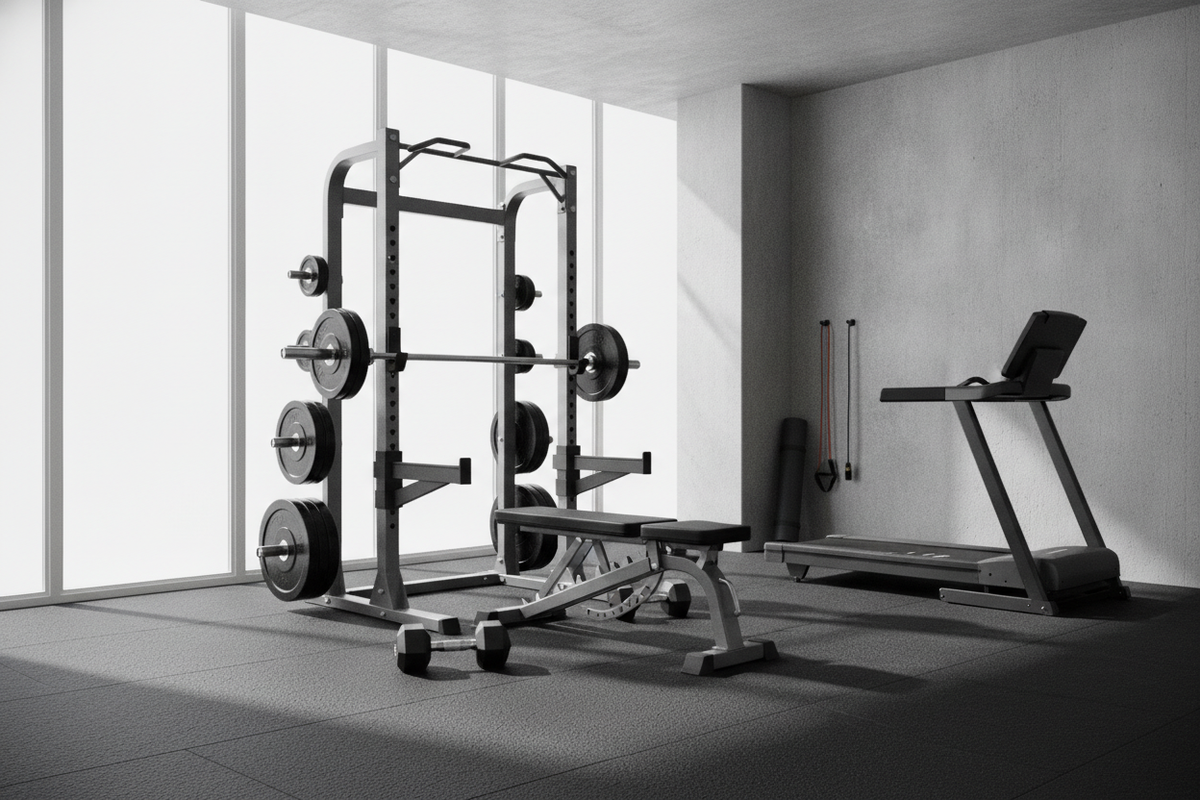
Performing floor-based hamstring curls, hip thrusts, and heavy deadlifts requires a stable, high-density large home workout mat that prevents traction loss and cushions contact points. Dense flooring protects subfloors from dropped free weights and prevents sliding during dynamic bridge variations. Discover more exercise templates, equipment staging tips, and movement progressions across our centralized workout resources.
Common Technical Mistakes and Movement Modifications
To get the most out of your posterior chain training while minimizing joint fatigue, avoid these common technical pitfalls:
- Hyperextending the Lumbar Spine: At the top of a deadlift or hip thrust, trainees often arch their lower backs rather than finishing the movement by contracting the glutes. Cue yourself to tuck the pelvis slightly and keep the ribcage locked down over the pelvis.
- Allowing Knees to Drift Forward During Hinges: If your knees bend excessively during an RDL, the movement shifts into a partial squat, reducing the stretch on the hamstrings. Keep your shins nearly perpendicular to the floor throughout the descent.
- Rushing the Eccentric Phase: The eccentric (lowering) portion of leg curls and hinges creates significant mechanical stimulus for the hamstrings. Lower the weight under control for two to three seconds on every repetition.
- Losing Foot Contact: Rolling onto the outer edges of the feet during single-leg exercises destabilizes the hip. Maintain even pressure across the entire sole of the foot to keep the kinetic chain properly aligned.