At Home Workout For Beginner Success: The Static-First Method
I remember getting a frantic text from a new client at 11 PM. She was trying to follow a high-intensity interval training video in her cramped apartment living room, slipped on her hardwood floor during a modified burpee, and tweaked her knee. She felt defeated before she even really started. What she actually needed was a safe at home workout for beginner levels that didn't require jumping around a tiny, unforgiving space.
I told her to turn off the video and just stand still. Literally. When you are just starting out, mastering how to hold your body in space is infinitely more valuable than rushing through sloppy repetitions. I call this the static-first method. It bridges the gap between doing nothing and doing full dynamic movements, allowing your joints and nervous system to catch up.
If you are looking for an effective fitness regime for beginners at home, you do not need complex choreography or heavy weights right away. You need stability, proper muscle engagement, and a routine that builds confidence instead of anxiety.
Quick Takeaways
- Start with isometric (static) holds to build joint stability and establish a strong mind-muscle connection.
- Clear a dedicated 6x6 foot space with a non-slip surface to protect your knees and wrists.
- Focus on time-under-tension before counting repetitions.
- Gradually transition from holding a pose to moving through it over a 30-day period.
Why Static Holds Are the Best Starting Point
Most beginners exercise at home by immediately trying to mimic what they see online: fast squats, rapid push-ups, and explosive lunges. The problem is that your muscles might be ready for the effort, but your tendons and ligaments are not. Tendons take significantly longer to adapt to physical stress than muscle tissue does. Forcing them into fast, repetitive motions is a fast track to tendonitis.
By focusing on static holds—also known as isometric exercises—you are utilizing time-under-tension. You hold a specific posture, like the bottom of a squat or the top of a glute bridge, for 20 to 45 seconds. This forces the targeted muscles to fire continuously without grinding the joints through a full range of motion.
When I design an exercise program at home for beginners, I always prioritize this neurological adaptation. Your brain needs to learn how to communicate with your glutes, core, and quads before you ask them to dynamically move your body weight up and down. Mastering these basic exercises for beginners at home ensures that when you finally do start moving, your form is locked in and your joints are protected.
Preparing Your Space for Joint Stability
Before you attempt any home workouts for beginners, you have to address your environment. Isometric holds require you to press hard into the floor to generate tension. If you are doing this on a sweaty hardwood floor or a shifting area rug, your hands and feet will slide. This instantly breaks your muscular tension and puts dangerous sheer force on your joints.
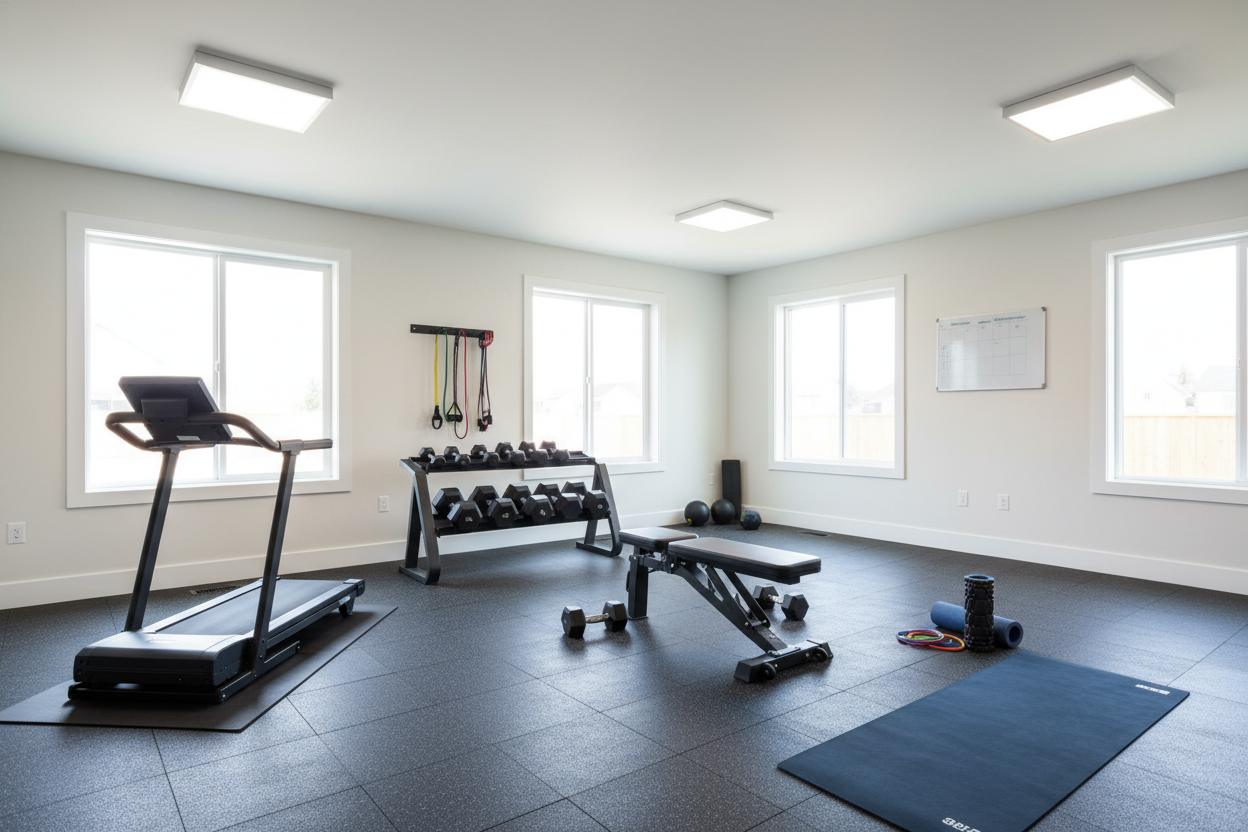
You need a space roughly 6x6 feet wide. I highly recommend investing in a proper foundation. A basic yoga mat is often too thin and tends to bunch up under your feet when you apply horizontal force. Instead, look for a thicker, more stable large exercise mat for home gym setups. You want a surface that grips the floor on the bottom and grips your sneakers on the top.
Once your flooring is sorted, clear away any coffee tables or sharp furniture edges. When you are pushing your muscles to failure on a static hold, your legs will eventually shake and give out. You need a safe landing zone when gravity inevitably wins.
The 4-Step Static-to-Dynamic Progression
This routine is designed to be the ultimate at home beginner workout routine. For each step, you will first perform the static hold to exhaust the muscle and stabilize the joint. Immediately after, you will perform a few slow, controlled dynamic repetitions of the same movement.
Step 1: The Isometric Hinge (Glute Bridge Hold)
If you sit at a desk all day, your glutes are likely dormant. To wake them up, lie on your back with your knees bent and feet flat on your mat. Drive through your heels and lift your hips toward the ceiling. Now, hold this top position.
Squeeze your glutes as hard as you can. Do not let your lower back arch; keep your ribs pulled down. Hold this for 30 seconds. You should feel a deep burn in your backside and hamstrings. Once the 30 seconds are up, lower your hips to the floor and immediately perform 10 slow, dynamic glute bridge repetitions. This is one of the most effective, easy beginner exercises at home to fix lower back pain and build hip strength.
Step 2: The Supported Squat (Wall Sit to Box Squat)
Squats are notorious for causing knee pain if done incorrectly. To build quad endurance and knee tracking stability, find a sturdy wall. Slide your back down until your knees are at a 90-degree angle, as if you are sitting in an invisible chair. Press your lower back flat against the wall.
Hold this wall sit for 30 to 45 seconds. Keep your hands off your thighs. Once your legs are burning and shaking, stand up carefully. Turn around and face a chair or your couch. Perform 8 controlled box squats, sitting all the way down onto the surface before standing back up. This easy workout for beginners at home ensures your knees stay safe while your legs get stronger.
Step 3: The Core Brace (Plank to Push-Up)
You cannot do a proper push-up without a rigid core. Get down on your forearms and toes. Squeeze your quads, clench your glutes, and pull your belly button toward your spine. Hold this forearm plank for 20 to 30 seconds. Your entire body should be vibrating with tension.
Drop to your knees. Place your hands slightly wider than shoulder-width apart. Because your elbows and knees bear the brunt of this transition, having a high-density 6x4ft yoga mat exercise mat makes a massive difference in comfort. From your knees, perform 5 to 8 modified push-ups. Lower your chest to the floor with control, keeping that exact same core tightness you just built during the plank.
Structuring Your First 30 Days
Consistency beats intensity every single time. For your first 30 days, I want you to perform this static-to-dynamic circuit three days a week. Monday, Wednesday, and Friday is a perfect schedule, giving your central nervous system 48 hours to recover between sessions.
During weeks one and two, your focus is entirely on the static holds. Try to increase your hold times by 5 seconds each workout. Do not worry about increasing the dynamic repetitions yet. The goal of this beginners exercise program at home is to build an unbreakable foundation.
By weeks three and four, you will notice the static holds feel significantly easier. Your muscles will stop shaking so violently. Now, you can start decreasing the static hold time slightly while adding more dynamic repetitions. For example, drop the wall sit to 20 seconds, but increase your box squats from 8 to 15 reps. If you want to see how this fits into a larger picture, reviewing the best at home workout programs can help you plan your next month of training.
My Personal Experience Testing the Static-First Method
I didn't just read about this method; I tested it rigorously in my own 400-square-foot apartment during a particularly brutal winter when I couldn't get to the gym. I set up my space, grabbed a pair of 5-52.5 lb adjustable dumbbells, and decided to strip my own training back to basics.
I will be completely honest with you: the biggest downside to this method is that it can feel incredibly boring at first. Staring at the paint on your wall while your thighs scream during a 45-second wall sit isn't exactly thrilling. However, after logging over 1,000 reps of static-to-dynamic transitions over two months, my nagging patellar tendonitis completely vanished. I didn't even touch the adjustable dumbbells until month two. The bodyweight tension was more than enough to force adaptation.
Advancing When You Feel Ready
How do you know when it is time to drop the static holds and move into a traditional dynamic routine? Your body will give you clear signals. You will be able to hold a strict forearm plank for 60 seconds without your hips sagging. Your knees will no longer wobble or cave inward when you perform a bodyweight squat.
When you hit these milestones, you have officially graduated from basic indoor workouts for beginners. You have built the necessary joint integrity to handle continuous movement. At this point, you are ready to transition into a more demanding 45 minute workout routine that incorporates weights, varied tempos, and different planes of motion.
Frequently Asked Questions
How long should a beginner workout at home last?
When you are just starting, 20 to 30 minutes is the sweet spot. Anything longer usually leads to form breakdown and extreme fatigue, which increases your risk of injury.
Do I need dumbbells or resistance bands for this routine?
No. The static-first method relies entirely on manipulating your own body weight and gravity. Master your bodyweight before you ever add external load.
Is it normal to shake violently during static holds?
Absolutely. That shaking is your nervous system rapidly firing motor units trying to figure out how to stabilize your body. As your neurological efficiency improves over a few weeks, the shaking will naturally decrease.