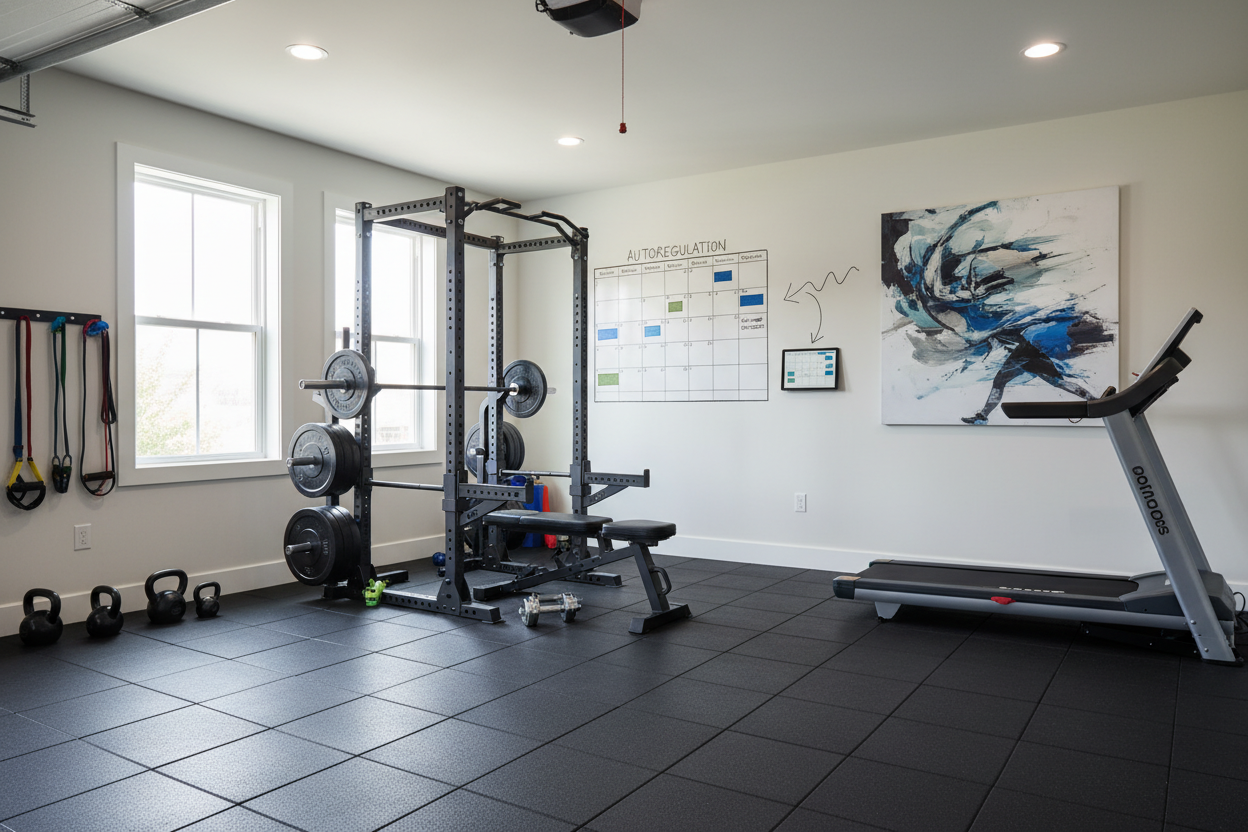
At Home Workout Calendar: Scheduling by Energy, Not Days
I vividly remember standing in my cramped apartment living room at 8 PM after a brutal 10-hour shift. My spreadsheet told me it was heavy leg day. My central nervous system told me absolutely not. I stared at my dumbbells, skipped the session entirely, ordered takeout, and felt guilty for the next three days. That exact scenario is how a traditional at home workout calendar destroys your consistency. When you train where you sleep, life inevitably interrupts rigid Monday-Chest/Tuesday-Back splits.
As a personal trainer who has built and tested dozens of home gym setups for clients, I see this pattern constantly. People try to copy and paste commercial gym routines into their living rooms. It does not work. Instead of forcing a schedule that ignores your daily reality, I teach my clients the Traffic Light system—an energy-matched autoregulation approach that guarantees you make progress without burning out.
Quick Takeaways
- Abandon rigid day-of-the-week schedules that trigger guilt when you miss a session.
- Use a Traffic Light system (Green, Yellow, Red) to match daily workouts to your actual energy levels.
- Keep your physical workout space permanently set up to remove friction on low-energy days.
- Track your consistency by logging the habit of movement, not just the heavy lifts.
Why Rigid Schedules Fail in a Home Environment
There is a massive psychological difference between training in a commercial facility and training in your garage or living room. When you drive to a gym, the environment forces you into a specific mindset. The music, the equipment, and the people all provide external motivation. At home, the couch is five feet away, the dog needs walking, and your downstairs neighbors might complain if you drop a 50-pound dumbbell.
Strict schedules fail here because they lack flexibility. If your plan dictates a heavy back workout on Tuesday, but you slept poorly and had a stressful workday, you are highly likely to skip it. Once you miss Tuesday, Wednesday becomes a makeup day. Thursday's planned recovery is ruined, and by Friday, the entire week feels like a failure. This all-or-nothing mindset is the number one reason home trainees quit.
I have tested everything from basic resistance bands to fully loaded racks in tight spaces. The equipment rarely matters as much as the programming. You need a home workout calendar that adapts to you, rather than forcing you to adapt to it. Autoregulation is the answer. It means listening to your body's biofeedback—soreness, sleep quality, stress levels—and adjusting the day's physical demand accordingly. It keeps you moving forward, even when life tries to pull you backward.
The Traffic Light At Home Workout Calendar
Autoregulation sounds like complex sports science, but it boils down to trusting your daily energy fluctuations. Instead of assigning specific muscle groups to specific days of the week, you categorize your routines into three buckets: Green, Yellow, and Red. You wake up, assess your physical and mental state, and pick the corresponding workout.
This shifts the goal from hitting a specific lift to simply maintaining the habit of daily movement. The beauty of this system is that you never actually fail a workout. If you planned to lift heavy but wake up exhausted, you do not skip the session; you just downgrade to a Red day. You still get the psychological win of completing a workout, which is crucial for long-term adherence.
The one honest downside to this system is that it takes a few weeks to trust your own judgment. Beginners sometimes use Red days as an excuse to be lazy. However, once you calibrate your internal energy meter, this system is practically bulletproof. Let's break down exactly how to program your Green, Yellow, and Red days for maximum results.
Green Days: High-Intensity & Strength Focus
Green days happen when you wake up feeling fully rested, mentally sharp, and physically recovered. Your central nervous system is primed, making this the time to tackle high-intensity intervals or heavy resistance training. You want to focus on compound movements that recruit multiple muscle groups and demand high neurological drive.
I usually program heavy lower body work or intense metabolic conditioning here. Grab your 5-52.5 lb adjustable dumbbells and push your sets into the 8-12 rep range, leaving only one or two reps in reserve. If you prefer bodyweight training, this is the perfect time for a 13 min toned butt legs workout that spikes your heart rate and challenges your muscular endurance. The goal on a Green day is to leave it all on the floor and stimulate actual muscle growth and cardiovascular adaptation.
Yellow Days: Maintenance & Movement
You will spend most of your time in the Yellow zone. These are moderate-energy days. You aren't exhausted, but you don't have the aggressive drive required for heavy deadlifts. The focus here shifts to steady-state cardio, core stabilization, and lighter functional movements. You want to keep your heart rate in the 65-75% max range.
This is where floor work shines. You will be doing planks, bird-dogs, and unilateral balance exercises. Because you spend so much time on the ground during Yellow days, having a large exercise mat for home gym use is critical. A standard thin yoga mat won't cut it when you are grinding through 45 minutes of core work; you need something with at least 7mm of high-density padding to protect your knees and spine. Treat Yellow days as the bridge that maintains your fitness between your heavy Green sessions.
Red Days: Active Recovery & Mobility
Red days are for the mornings you wake up feeling like you were hit by a truck. Maybe you slept four hours, or maybe your legs are destroyed from a previous Green day. In a rigid schedule, this is the day you quit. In the Traffic Light system, this is the day you focus entirely on joint health and active recovery.
The rule is simple: you still show up to your workout space, but the intensity drops near zero. You swap the weights for a stretching workout at home hip mobility routine. Spending 15 minutes opening up tight hips and mobilizing your thoracic spine does wonders for your recovery. More importantly, it keeps the physical habit of your daily routine intact. You log the session, check the box, and walk away feeling better than when you started.
Setting Up Your Tracking Space
A major key to making this calendar work is your physical environment. If you have to spend ten minutes moving coffee tables and unrolling mats every time you want to train, you will skip your workouts. Friction is the enemy of consistency. You need a dedicated, permanent setup that visually cues your brain it is time to work.
I always advise clients to upgrade their base layer first. Installing high-quality gym flooring for home workout spaces, like a 6x8 ft heavy-duty mat, defines the boundary of your gym. It dampens the noise of dropping weights, protects your floors, and allows you to transition instantly from standing to floor work. Keep a whiteboard or a printed calendar on the wall right next to this space. Visually tracking your Green, Yellow, and Red days with colored markers provides a massive psychological boost and keeps you accountable to the system.
Building Your First 14-Day Energy Template
To start, wipe your current schedule clean. For the next 14 days, your only goal is to wake up, assess your energy on a scale of 1 to 10, and pick a color. If you are an 8 or above, it is a Green day. If you are between 4 and 7, it is a Yellow day. Anything a 3 or below is a Red day.
Log the color on your wall calendar immediately after your session. Over two weeks, you will start to notice patterns. Maybe you naturally lean toward Green days on Tuesdays and Saturdays, while Thursdays are almost always Red. This data allows you to loosely anticipate your week without locking you into a rigid framework.
Remember, the goal of training at home is to enhance your life, not add another source of stress to it. By matching your routines to your natural energy fluctuations, you protect your central nervous system, prevent burnout, and finally build a sustainable fitness habit that lasts year-round.
Frequently Asked Questions
What if I have too many Red days in a row?
If you log more than three Red days consecutively, it is usually a sign of outside lifestyle stress. Look at your sleep quality, hydration, and nutrition. If those are dialed in, force a light Yellow day to see if getting your blood flowing actually wakes up your nervous system.
Do I still need to track progressive overload?
Yes. On your Green days, you should still track your sets, reps, and weights to ensure you are getting stronger. The Traffic Light system dictates when you do the heavy work, but you still need to push the intensity when the green light is on.
Can I mix Green and Yellow workouts?
Absolutely. A common approach is to do 20 minutes of heavy Green day lifting followed by 15 minutes of Yellow day core maintenance. Listen to your body and adjust the volume as needed.