Arm Workouts and What Muscles They Work: The Anatomical Guide
You walk into the gym, grab a pair of dumbbells, and start curling. It’s the universal sign of "arm day." But if you have been lifting for months and your sleeves still feel loose, the issue isn't usually a lack of effort. It is a lack of anatomical understanding.
To build truly impressive arms, you cannot just move weight from point A to point B. You need to understand the mechanics of arm workouts and what muscles they work to target the specific heads of the biceps and triceps. Mindless lifting leads to plateaus; precision leads to growth.
Key Takeaways
- Triceps Rule Size: The triceps comprise about two-thirds of your upper arm mass; neglect them, and your arms will look small regardless of how many curls you do.
- Angles Matter: Changing your shoulder position (elbows behind body vs. overhead) dictates which head of the bicep or tricep takes the load.
- Don't Forget the Brachialis: This muscle sits underneath the biceps. Training it pushes the bicep up, creating a wider arm appearance.
- Forearms Complete the Look: Grip strength and forearm development are crucial for aesthetic balance and heavy lifting stability.
The Anatomy of Arm Size
Before we look at the exercises, you have to know what you are actually trying to stimulate. The arm is not just two muscles; it is a complex system of heads and insertion points.
The Triceps (The Mass Builders)
If you want big arms, prioritize the back of the arm. The triceps brachii has three heads:
- Long Head: The inner part of the horseshoe. It crosses the shoulder joint, meaning it is best activated when the arm is raised overhead.
- Lateral Head: The outer part of the horseshoe. This gives the arm that sweeping look from the side.
- Medial Head: Located lower near the elbow, mostly used for stability and lockout strength.
The Biceps (The Peak)
The biceps brachii is smaller than the triceps but gets all the glory. It has two heads:
- Long Head: Situated on the outside. This is responsible for the "peak" when you flex.
- Short Head: Situated on the inside. This adds thickness and width to the front of the arm.
Arm Workouts for Different Muscles
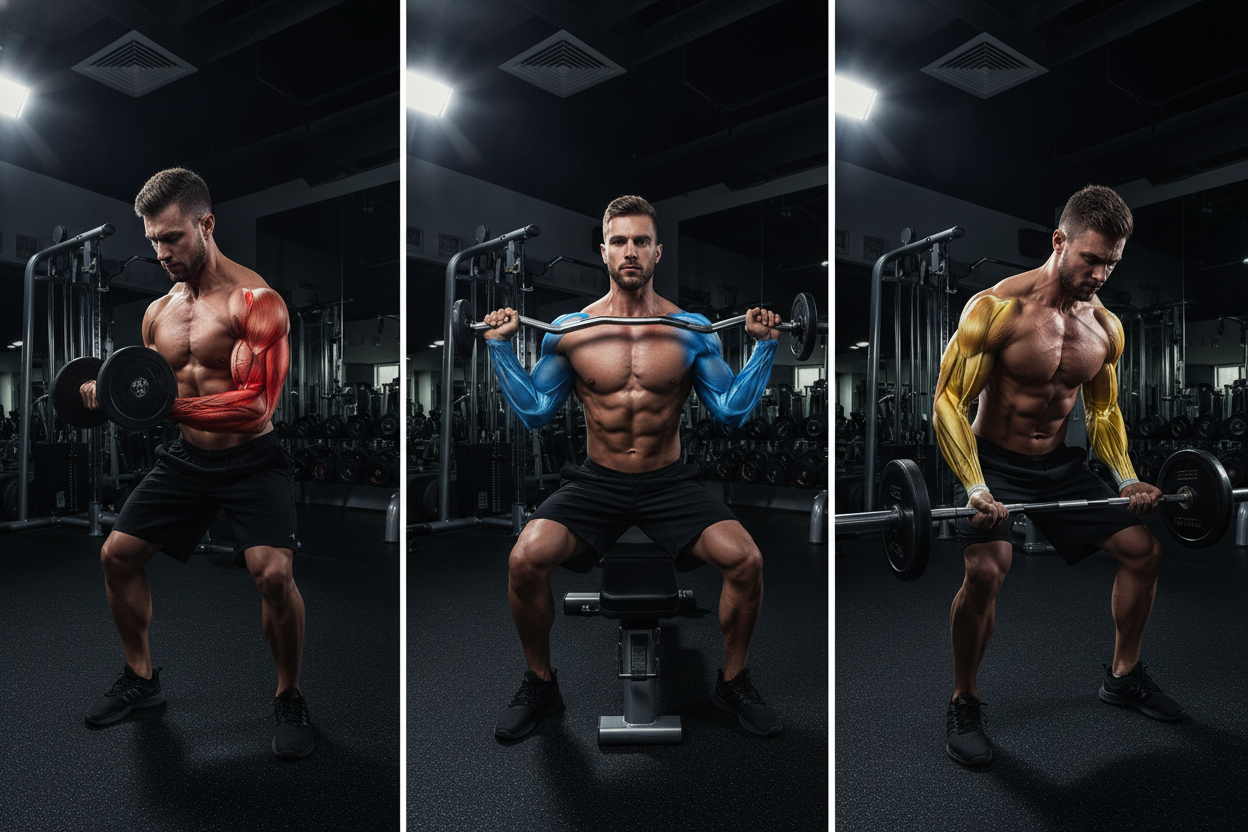
Now that we know the landscape, let's map the movements. Here is how specific exercises target these distinct areas.
Targeting the Triceps Long Head
Because the long head crosses the shoulder joint, you must put it under a deep stretch to recruit it fully. Standard press-downs won't cut it here.
The Fix: Overhead Dumbbell Extensions or Skull Crushers (French Press). When you lower the weight behind your head, you stretch the long head, forcing it to contract harder during the concentric (lifting) phase.
Hitting the Triceps Lateral Head
This is the "ego" muscle that looks great in a t-shirt. It activates best when your arms are by your sides.
The Fix: Rope Pushdowns or Weighted Dips. The key here is keeping your elbows pinned to your ribs. If your elbows flare out, you shift tension to the chest and shoulders.
Building the Bicep Peak (Long Head)
To target the long head, you need to extend the shoulder (move the elbows behind the body) or internally rotate the grip.
The Fix: Incline Dumbbell Curls. By laying back on an incline bench, your arms hang behind your torso. This stretches the long head, making it work harder to initiate the curl. Narrow-grip barbell curls also shift the focus here.
Thickening the Bicep Short Head
The short head works hardest when the arms are in front of the body.
The Fix: Preacher Curls or Spider Curls. With your elbows supported in front of you, the long head becomes slack (active insufficiency), forcing the short head to take the brunt of the load.
The Hidden Muscle: Brachialis
This is the secret weapon for arm workouts for different muscles. The brachialis lies deep beneath the biceps. When it grows, it pushes the bicep up like a jack.
The Fix: Hammer Curls. By using a neutral grip (palms facing each other), you largely disengage the biceps brachii and place the tension squarely on the brachialis and the brachioradialis (forearm).
Common Mistakes That Kill Gains
The Wrist Curl Error: When doing bicep curls, many lifters curl their wrists toward their face at the top. This takes tension off the bicep and puts it on the forearm flexors. Keep your wrists neutral or slightly bent back to keep the tension on the upper arm.
Elbow Drift: During tricep pushdowns, if your elbows drift forward and back, you are using your lats to move the weight. Lock the elbow in space as if there is a metal rod running through it.
My Personal Experience with Arm Workouts
I learned the hard way that heavy weight does not equal big arms. For years, I was obsessed with heavy barbell curls. I could swing up 135lbs, but my arms looked flat.
The turning point for me was the "Skull Crusher"—but not the way most people do them. I remember the specific, nagging ache I used to get in my elbow tendons when I lowered the bar to my forehead. It felt like a toothache in my elbow. I realized my form was garbage; my elbows were flaring out like chicken wings.
I dropped the weight by half. I started lowering the bar behind my head, not to my forehead, allowing for a deep, uncomfortable stretch in the tricep meat near the armpit. The burn was completely different. It wasn't joint pain anymore; it was a tearing sensation in the muscle belly. That slight adjustment—focusing on the stretch rather than the ego lift—is when my t-shirts finally started getting tight. It’s humbling to curl 25lb dumbbells when the guy next to you is swinging 50s, but the tape measure doesn't lie.
Conclusion
Understanding arm workouts and what muscles they work transforms your training from guesswork to engineering. You aren't just "hitting arms"; you are specifically targeting the long head for peak, the lateral head for width, or the brachialis for thickness. Drop the ego, master the anatomy, and the growth will follow.
Frequently Asked Questions
What is the single best exercise for arm mass?
If you could only do one, the Close-Grip Bench Press is superior. It allows for the heaviest loading of the triceps (which make up the bulk of the arm) while still involving the stabilizers.
How often should I train arms?
Arms are smaller muscle groups and recover faster than legs or back. For most natural lifters, training them directly twice a week with 6-10 sets per session is the sweet spot for hypertrophy.
Why do my forearms hurt when I curl?
This is usually due to gripping the bar too hard or curling the wrists. Try using an EZ-bar to reduce wrist strain, or focus on a "thumbless" grip to reduce forearm activation during bicep movements.