Apartment Workouts: The Stealth-Tension Training Guide
I remember living in a pre-war third-floor walk-up where the floorboards creaked if I just looked at them wrong. I wanted to train at 5:30 AM before my personal training clients, but every time I did a burpee, I could practically hear my downstairs neighbor dialing the landlord. That was the moment I realized traditional high-impact training wasn't going to cut it. I needed to rethink apartment workouts entirely.
If you are exercising in an apartment, you know the anxiety of a noise complaint can ruin a session before you even break a sweat. But you don't need gravity and impact to build muscle or burn fat. You just need a smarter approach to tension.
Quick Takeaways
- Swap impact for tension: Replace jumping with sliding and deep isometric holds.
- Friction is your friend: Use towels or furniture sliders on hard floors to create brutal resistance.
- Dampen vibrations: A dense, large-format mat is non-negotiable for floor work and structural noise reduction.
- Time under tension: Slow down your reps to 4-second eccentrics to maximize muscle fatigue without heavy weights.
The Reality of Exercising in an Apartment
Most fitness programs assume you have a garage gym with thick rubber stall mats or a concrete basement. They program jump squats, heavy deadlifts, and high-knees. But when you try to execute that kind of workout in apartment spaces, reality hits hard. Every landing sends a shockwave through the ceiling below you.
If you want to exercise in apartment settings without becoming the building villain, you have to shift your mindset. You don't need to bounce off the floor to elevate your heart rate or tear down muscle fibers. By removing the explosive phase of a movement and replacing it with continuous, grinding muscle contraction, you get the exact same physiological response in complete silence.
What is the Stealth-Tension Method?
Over years of programming for clients in cramped city studios, I developed what I call the Stealth-Tension Method. It relies on two primary mechanics: sliding friction and deep isometric holds.
Instead of jumping off the floor, you drag yourself across it. If you have hardwood or laminate floors, a pair of cheap furniture sliders (or just two dish towels) turns your living room into a friction-based resistance machine. When you pull your legs in for a slider mountain climber, you force your core and hip flexors to fight the drag of the floor for the entire range of motion. There is zero impact, but the burn is immediate.
The second component is the paused isometric hold. We kill momentum entirely. When you drop into a squat, you don't bounce out of the bottom. You hold the deepest position for three full seconds, letting the muscle fibers fully recruit, before slowly pressing back up. These stealth apartment exercises strip away the noise but multiply the time under tension. You end up recruiting more motor units because you can't rely on the stretch reflex to bounce you out of the hole.
Building Your Silent Foundation
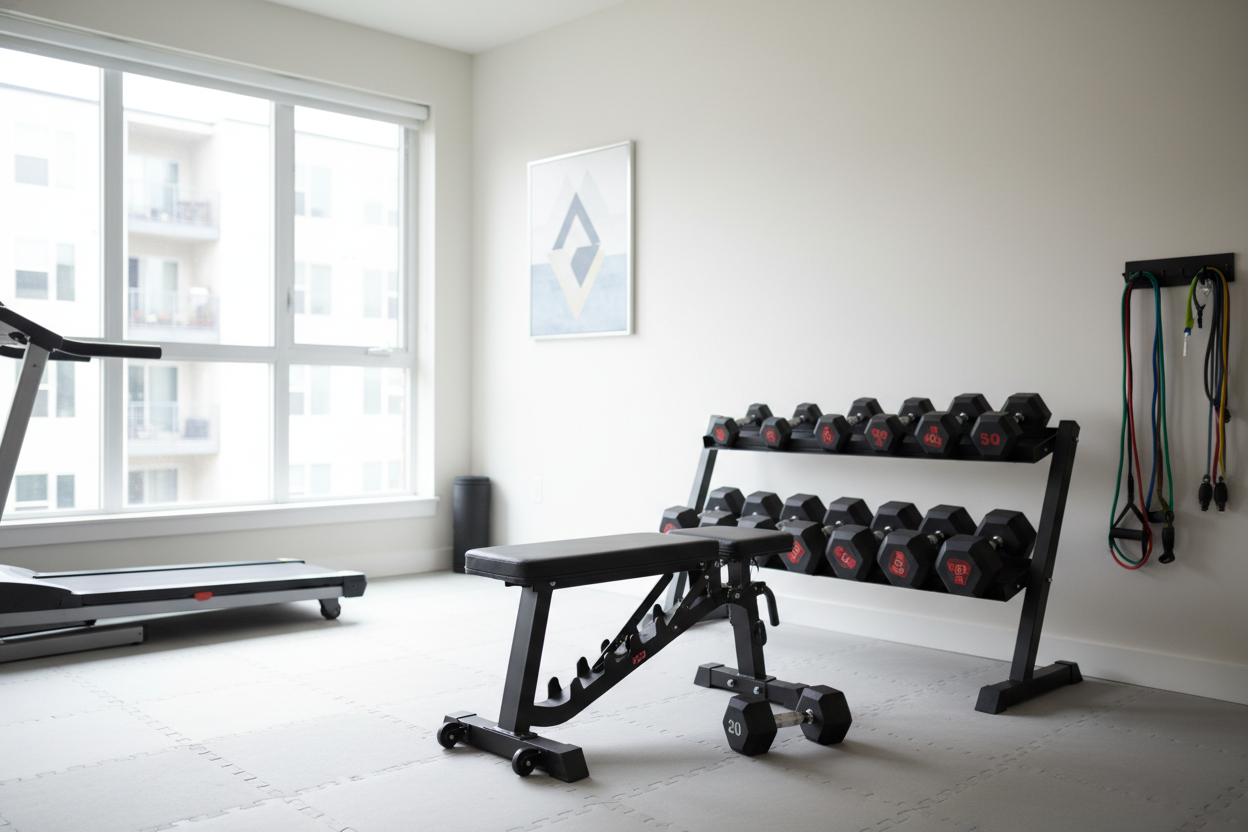
You don't need a massive rig to build an effective small space gym. My standard setup for a client fits perfectly into a 6x6 foot clearing between the sofa and the TV. But the base layer of that space matters immensely.
To execute apartment friendly exercises safely, you need a surface that handles sweat, grips the floor, and acts as a sound baffle. Standard 3mm yoga mats are too thin for this; they roll up and offer zero acoustic dampening. I always have my clients roll out a thick apartment exercise mat. A high-density 7mm or 9mm mat absorbs the structural noise of heavy breathing, kneeling, and dumbbell transitions while protecting your joints during floor work.
Beyond the flooring, your gear selection should prioritize silence. Cast iron plates clank. Hex dumbbells rattle. Instead, look into quiet exercise equipment for apartment living like adjustable urethane-coated dumbbells or heavy resistance bands. Bands are particularly great because they weigh nothing, fit in a drawer, and provide ascending resistance without ever touching the floor.
Apartment Friendly Exercises: The Core Movements
Let's translate this methodology into an actual apartment friendly workout. We are going to take the loudest, most common home gym movements and swap them for stealth alternatives.
Loud: The Jump Squat
Stealth: The 1.5 Rep Goblet Squat. Instead of jumping, hold a single heavy dumbbell at your chest. Lower down over four seconds. Come halfway up, go back down to the bottom, and then stand up fully. That is one rep. Your quads will be on fire by rep eight, and your feet never leave the mat.
Loud: The Burpee
Stealth: The Slider Body Saw to Push-up. Put sliders or towels under your toes. Start in a plank. Push your body backward using your forearms, stretching your core, then pull back to the start. Press up to your hands and execute a slow push-up. It taxes the chest, triceps, and core far more strictly than a sloppy, flopping burpee.
Loud: Jumping Lunges
Stealth: Slider Reverse Lunges. Keep a slider under your right foot. Slide that foot backward into a deep lunge, pulling yourself back up to standing by dragging the foot forward. The constant friction means your lead leg glute and hamstring never get a break.
I personally tested this slider lunge protocol using a set of 5-52.5 lb adjustable dumbbells. Going up to just 30 lbs per hand while dragging my back foot on a towel completely fried my legs in three sets. The one honest downside? If you sweat heavily on a hardwood floor, the towel can suddenly grip and trip up your rhythm, so you have to keep your slide path dry.
Crafting Your Apartment Workout Plan
Throwing random quiet exercises together won't drive progress. To make this work, you need a structured apartment workout plan that sequences movements intelligently. Since we aren't doing traditional cardio like sprints or jump rope, we rely on density to keep the heart rate up.
I prefer antagonist supersets for this. This means pairing opposing muscle groups back-to-back with minimal rest. For example, you do a slow, friction-based push-up variation, then immediately transition into a banded bent-over row. While your chest rests, your back works. This keeps your cardiovascular system engaged the entire time.
When building your perfect routine, aim for 45 to 60 seconds of continuous work per set, followed by 30 seconds of rest. If you keep this pace up for 30 minutes, I guarantee you will be sweating just as hard as you would on a treadmill. Density is the hidden engine of the small space gym.
A Sample Apartment Workout Routine
Here is a 3-day full-body apartment workout routine you can start this week. Perform this circuit on Monday, Wednesday, and Friday. Rest 45 seconds between supersets.
-
Superset 1:
- A1: 1.5 Rep Goblet Squats – 3 sets of 10-12 reps.
- A2: Slider Body Saw – 3 sets of 12-15 reps.
-
Superset 2:
- B1: Slider Reverse Lunges – 3 sets of 10 reps per leg.
- B2: Banded Overhead Press (seated on the floor to save vertical space) – 3 sets of 12 reps.
-
Superset 3:
- C1: Paused Push-ups (3-second hold at the bottom) – 3 sets to failure.
- C2: Banded Pull-aparts – 3 sets of 20 reps.
This apartment exercise routine hits every major movement pattern, requires almost zero space, and generates zero impact noise.
Long-Term Progression in Small Spaces
The biggest challenge with any exercise for apartment dwellers is progression. When you max out your adjustable dumbbells, you can't exactly drop a barbell and 400 pounds of plates into your living room.
Instead, progress through mechanical disadvantage. Elevate your back foot on the sofa for Bulgarian split squats. Add a resistance band across your back during push-ups. Increase the pause at the bottom of your squat from three seconds to five seconds. You can always make a light weight feel heavy by manipulating leverage and time. If you need more ideas on how to scale these movements, explore our workout hub for advanced variations.
Frequently Asked Questions
Can you build muscle with just apartment workouts?
Yes. Muscle growth requires mechanical tension and progressive overload, neither of which require jumping or dropping weights. By using slow eccentrics and deep pauses, you can fully fatigue the muscle in a small space.
What is the best cardio for an apartment?
Slider mountain climbers, kettlebell swings (with proper form to avoid floor strikes), and high-density antagonist supersets. These elevate your heart rate dramatically without your feet ever leaving the floor.
How do I protect my apartment floors from weights?
Always use a high-density, large-format exercise mat. It prevents sweat damage to hardwood, stops dumbbells from denting the floor, and dampens the acoustic vibrations that bother downstairs neighbors.