Arm Exercise Machine Names: The Complete Gym Equipment Guide
Walking into a commercial gym for the first time often feels like stepping into the cockpit of an alien spaceship. You see levers, pulleys, and stacks of weights, but you have no idea what they actually do. You know you want to build bigger biceps and triceps, yet the vocabulary is missing. Knowing the correct arm exercise machine names isn't just about sounding smart; it is about efficiency and safety.
If you don't know what a machine is called, you can't look up proper form, and you certainly can't track your progress effectively. This guide cuts through the confusion. We are going to identify the specific equipment used to target the upper arms, explaining exactly what to look for on the gym floor.
Quick Summary: Common Arm Machines
If you are looking for a quick reference list of arm gym machine names to spot in your facility, here are the essentials:
- Cable Crossover Machine: The versatile dual-pulley tower used for curls and pushdowns.
- Preacher Curl Machine: Features an angled pad to isolate the biceps and prevent cheating.
- Assisted Dip Machine: Uses a counterweight to help you perform tricep dips.
- Seated Tricep Press Machine: A lever-based machine that mimics the dipping motion.
- Bicep Curl Machine: A fixed-path machine (often selectorized) for seated curls.
- Smith Machine: A barbell fixed on rails, often used for close-grip bench presses.
The Bicep Builders: Identifying Pulling Machines
When looking for arm workout machines names specifically for the front of the arm, you are looking for equipment that facilitates elbow flexion (bending the arm). These machines lock you into position to isolate the muscle belly.
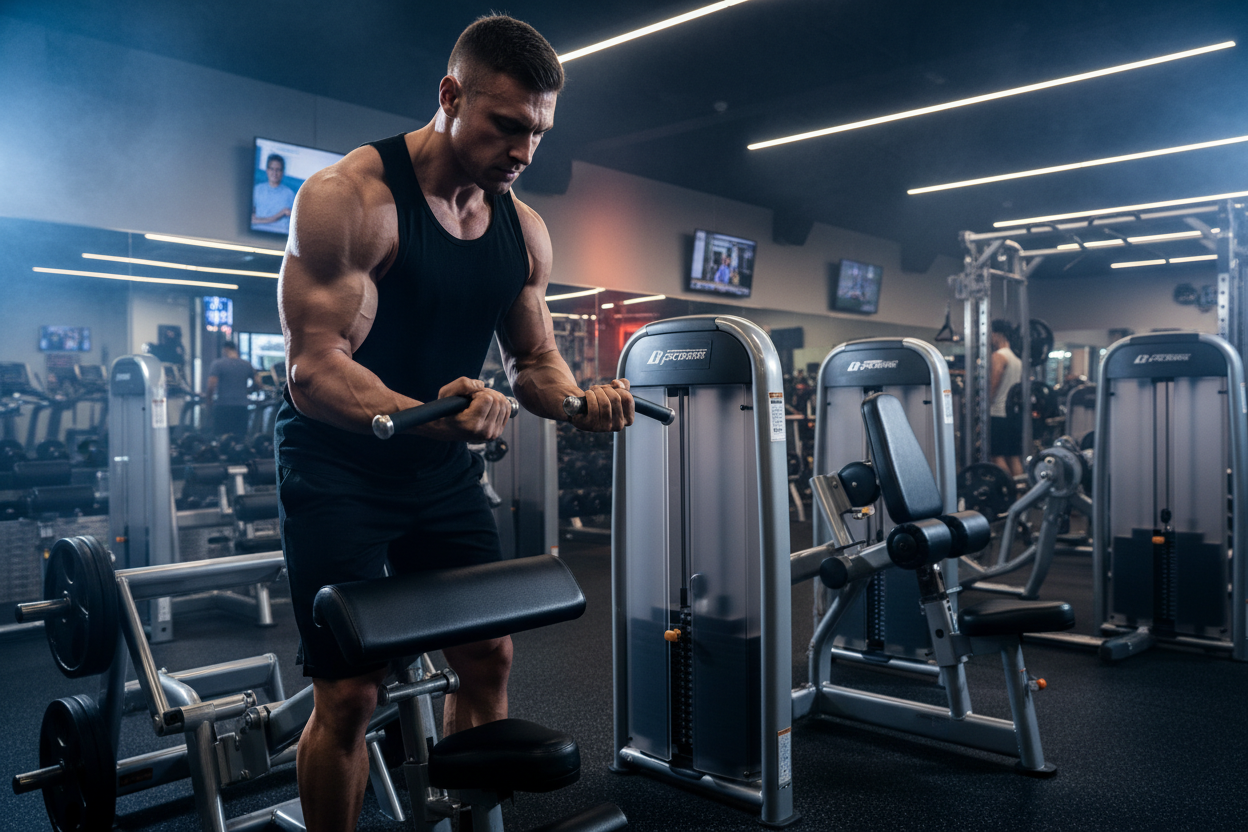
The Preacher Curl Machine
This is perhaps the most recognizable piece of gym equipment names for arms. You will identify it by the slanted pad (usually angled at 45 degrees). You sit down, drape your arms over the pad, and grab the handles.
The Science: The pad forces your elbows to stay in front of your torso. This creates "active insufficiency" at the shoulder, which essentially makes the long head of the bicep work harder while preventing you from swinging your body to generate momentum. It is strictly for isolation.
The Cable Tower (Cable Crossover)
While technically a multi-purpose unit, this is the king of arm gym equipment names. It consists of a weight stack connected to a cable and pulley system. For arms, you will usually attach a straight bar or a rope.
Why it works: Unlike dumbbells, where tension drops off at the top of the movement (due to gravity), cables provide constant tension throughout the entire range of motion. This mechanical tension is a primary driver for hypertrophy (muscle growth).
The Tricep Torchers: Identifying Pushing Machines
The triceps make up about two-thirds of your upper arm mass. To find these arm machines at the gym names, look for equipment that involves extending the elbow against resistance.
The Cable Station (Rope Pushdowns)
You will use the same Cable Tower mentioned above, but the setup changes. By attaching a rope or V-bar to the high pulley, this becomes the premier station for tricep pushdowns.
The Nuance: Using a rope attachment allows you to pull your hands apart at the bottom of the movement. This slight rotation and extension allow for a deeper contraction in the lateral head of the tricep compared to a fixed bar.
The Assisted Dip Machine
This is one of the most misunderstood gym machine names for arms. It looks like a standard dip station but features a padded platform that moves up and down. You kneel on this platform.
How it works: It uses a counterweight system. If you weigh 200lbs and select 100lbs on the stack, you are only lifting 100lbs of your body weight. This allows you to train the mechanical failure safely without risking shoulder injury from fatigue-induced form breakdown.
Identifying Fixed-Path Machines
When discussing arm workout equipment names, we cannot ignore selectorized machines. These have a weight stack and a pin. They move in a fixed path.
Seated Bicep Curl Machine
This machine removes the need for stabilization entirely. You sit, grab the handles, and curl. Because the path is rigid, you can focus entirely on the squeeze without worrying about balancing the weight. It is excellent for drop sets or burnout sets at the end of a workout.
Seated Tricep Press
This mimics the dip motion but you are seated with handles at your sides. You push down to lift the weight stack. This is often safer for the shoulder joint than standard bench dips because your torso remains upright and supported.
My Personal Experience with arm exercise machine names
I have spent over 15 years in weight rooms, from gritty garage gyms to high-end health clubs, and I have developed a love-hate relationship with specific machines. There is a very specific sensory detail that generic guides miss: the "friction" of a poorly maintained cable machine.
I remember training at a budget commercial gym where the cable crossover hadn't been oiled in years. When doing tricep pushdowns, the weight didn't move smoothly; it stuttered. That gritty, jerking vibration traveling up the wire and into my hands completely ruined the mind-muscle connection. I learned then that knowing the machine name isn't enough—you have to check the maintenance.
Another specific detail is the smell of the vinyl on an old Preacher Curl bench. If you are really grinding out that last rep, your face is inches from that pad. If the gym doesn't wipe it down, you are inhaling years of dried sweat. It taught me to always bring a towel, not just for hygiene, but so I could focus on the rep rather than the smell of the equipment. These machines are tools, but the user experience varies wildly depending on the facility.
Conclusion
Learning the proper arm exercise machine names is the first step toward gym confidence. Once you can distinguish between a Preacher Curl station and a Seated Dip machine, you can structure your workouts with intent rather than guessing. Don't be afraid to ask staff or use the diagrams usually printed on the machines themselves. The equipment is there to help you; knowing what to call it is the key to mastering it.
Frequently Asked Questions
What is the best machine for big arms?
While "best" is subjective, the Cable Crossover station is widely considered superior for both biceps and triceps. The constant tension provided by the cables stimulates muscle growth more effectively than machines that lose tension at the top or bottom of the movement.
What is the arm machine with the ropes called?
That is the Cable Machine or Cable Crossover. The "ropes" are actually an attachment (a tricep rope) clipped onto the pulley system. It is primarily used for tricep pushdowns and hammer curls.
Are arm machines better than free weights?
Not necessarily better, but different. Free weights require more stabilization and engage more secondary muscles. Machines isolate the target muscle and are generally safer for beginners or for training to absolute failure without a spotter.