Angled Smith Machine Bench Press: Stop Facing the Wrong Way
You walk up to the machine, slide the bench in, and then pause. The guide rails aren't vertical; they lean. Suddenly, a simple chest workout becomes a geometry problem. Do you face the slope, or turn your back to it?
This is the single most common issue lifters face with the angled smith machine bench press. Get the orientation wrong, and you aren't just missing out on chest activation—you are actively grinding your rotator cuffs against a fixed, unnatural path.
The angled design isn't a flaw; it's a feature meant to mimic the natural arc of a free-weight press. But it only works if you set up correctly. Let's fix your form.
Quick Summary: The Golden Rule
If you are in a rush to hit your set, here is the immediate answer to the most common question: Which way do I face?
- The Bar Path Rule: As you press the weight UP, the bar should travel BACK toward your face/eyes.
- The Feet Rule: If the bar travels toward your feet/stomach as you press up, you are facing the wrong way.
- The "J" Curve: The angled path is designed to replicate the natural "J" curve of a barbell bench press (starting at the sternum, ending over the shoulders).
- Bench Placement: Position the bench so the bar touches your lower chest at the bottom of the rep.
Why the Smith Machine is Slanted
Most commercial gym Smith machines (like those from Hammer Strength or Cybex) feature a 7-degree slant. This isn't aesthetic. It is biomechanical.
When you bench press with a free barbell, you don't push in a straight vertical line. You push up and slightly back. You lower the bar to your sternum (nipple line) and press it up until it is stacked over your shoulder joints.
A slanted smith machine bench press forces this path. However, because the machine is fixed, it cannot adjust to you. You must adjust to it. If you face the wrong direction, you force your shoulders to press the weight away from your center of gravity, placing immense shear force on the front delts.
Which Way to Face on Smith Machine Bench Press
This is where 90% of gym-goers get confused about the smith machine bench press direction. Visualizing the rails can be tricky, so focus on the movement of the bar relative to your head.
The Correct Orientation
Sit on the bench. Look at the guide rails. They should lean toward your head at the top. When you unrack the bar and press, the bar should move horizontally closer to your eyes as it rises.
This allows you to press from the lower chest (power position) to the upper chest/shoulder area (lockout position).
The Incorrect Orientation
If you set up so the rails lean away from your head, you are pressing toward your hips. This is sometimes used for a niche tricep-dominant press or a "Guillotine" style neck press, but for a standard chest builder, it is dangerous. It removes the mechanical advantage of your pecs and puts your shoulders in a compromised, internally rotated position.
How to Bench on Angled Smith Machine: Step-by-Step
Once you have determined which way to bench on angled smith machine, the setup requires precision. Since the bar doesn't move horizontally, you have to place your body in the exact spot where the bar would be.
1. Align the Bench
Pull the bench under the bar. Lie down and do a dry run with an empty bar. Lower the bar all the way down. It should land exactly on your lower chest or sternum. If it lands on your neck, slide the bench down. If it lands on your stomach, slide the bench up.
2. The Grip and Unrack
Grip width should be slightly outside shoulder width. Because you don't need to stabilize the weight, you can experiment with a slightly wider grip to bias the chest. Rotate your wrists back to unhook the safeties.
3. The Descent
Control is everything here. Lower the bar slowly. Because of the fixed path, you can't "tuck" your elbows as naturally as with free weights. Keep your elbows flared slightly (about 45 degrees) to match the machine's plane of motion.
My Training Log: Real Talk
I’ve spent years training in commercial gyms where the only option was a beat-up, angled smith machine. Let me tell you something the textbooks don't mention: the "wrist fight."
On a specific leg day (I was using the Smith for close-grip bench as an accessory), I realized that the knurling on these machines is often terrible because it's designed for general use, not powerlifting. The bar is also usually thicker than a standard Olympic barbell.
I found that because the bar rotates to unrack, my wrists would sometimes roll back during the heavy portion of the press, causing the hooks to graze the safety slots. That clack-clack-clack sound kills your momentum.
My fix? I started using a "thumbless" or suicide grip on the Smith machine (and only on the Smith machine). Because the bar is captured on rails, it can't fall on my throat. This allowed me to keep my wrists neutral and prevented that accidental re-racking mid-rep. It also took the forearms out of the equation and I felt a much deeper stretch in the pecs. If you try this, just make sure the safety stops are set correctly—don't rely on your grip to save you.
Conclusion
The angled smith machine bench press gets a bad reputation from purists, but usually, that’s because they are using it backward. It is a potent tool for hypertrophy because it removes the stability requirement, letting you take your pecs to absolute failure safely.
Just remember the golden rule: The bar goes back toward your eyes. If it goes toward your feet, flip the bench around.
Frequently Asked Questions
Does the angled Smith machine count as a flat bench?
Yes, it targets the same muscles (pectoralis major, triceps, anterior delts). However, the activation is slightly different due to the lack of stabilizers. Most lifters can lift more weight on a Smith machine, so don't equate your Smith max directly to your free weight max.
Is the bar weight different on a Smith machine?
Yes. A standard Olympic bar is 45 lbs (20kg). Smith machine bars are often counterbalanced. Some weigh as little as 15 lbs, while others (usually older models) can weigh up to 50 lbs depending on the drag and pulley system. Assume the bar is 20 lbs unless labeled otherwise.
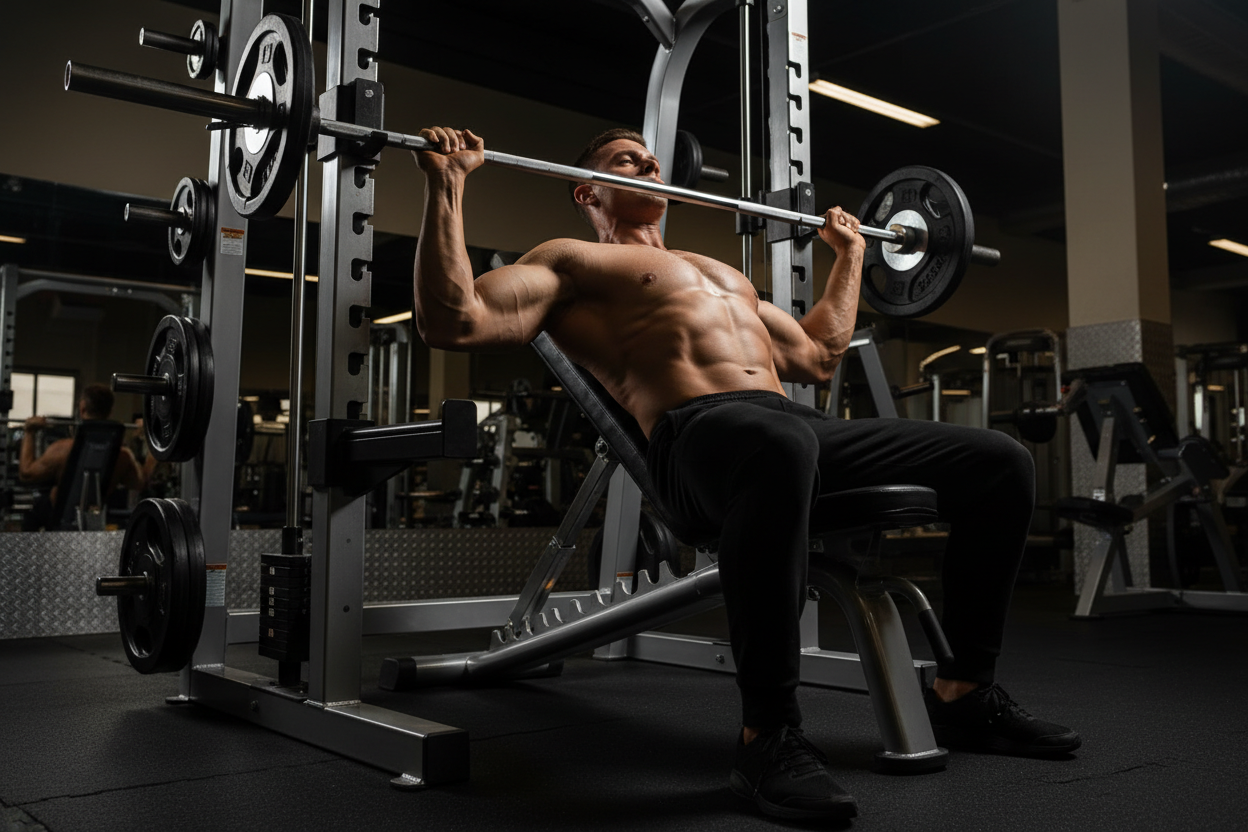
Can I do incline press on an angled Smith machine?
Absolutely. The rules remain the same regarding direction. Ensure the bar travels back toward your face as you press up. In fact, the angled path often feels smoother for incline pressing than flat pressing because it aligns perfectly with the upper chest fibers.