Aerobics Beginners Exercises: The Single Mat Method
I remember walking into a client's 400-square-foot apartment a few years ago. She had shoved her sofa against the wall, stacked her coffee table on her dining chairs, and was still terrified of kicking her television during her workout. That spatial anxiety is the number one reason people quit doing cardio at home. You simply do not need a massive dance studio to get your heart rate up and build endurance. Mastering aerobics beginners exercises is entirely possible within the exact footprint of a single piece of padded flooring.
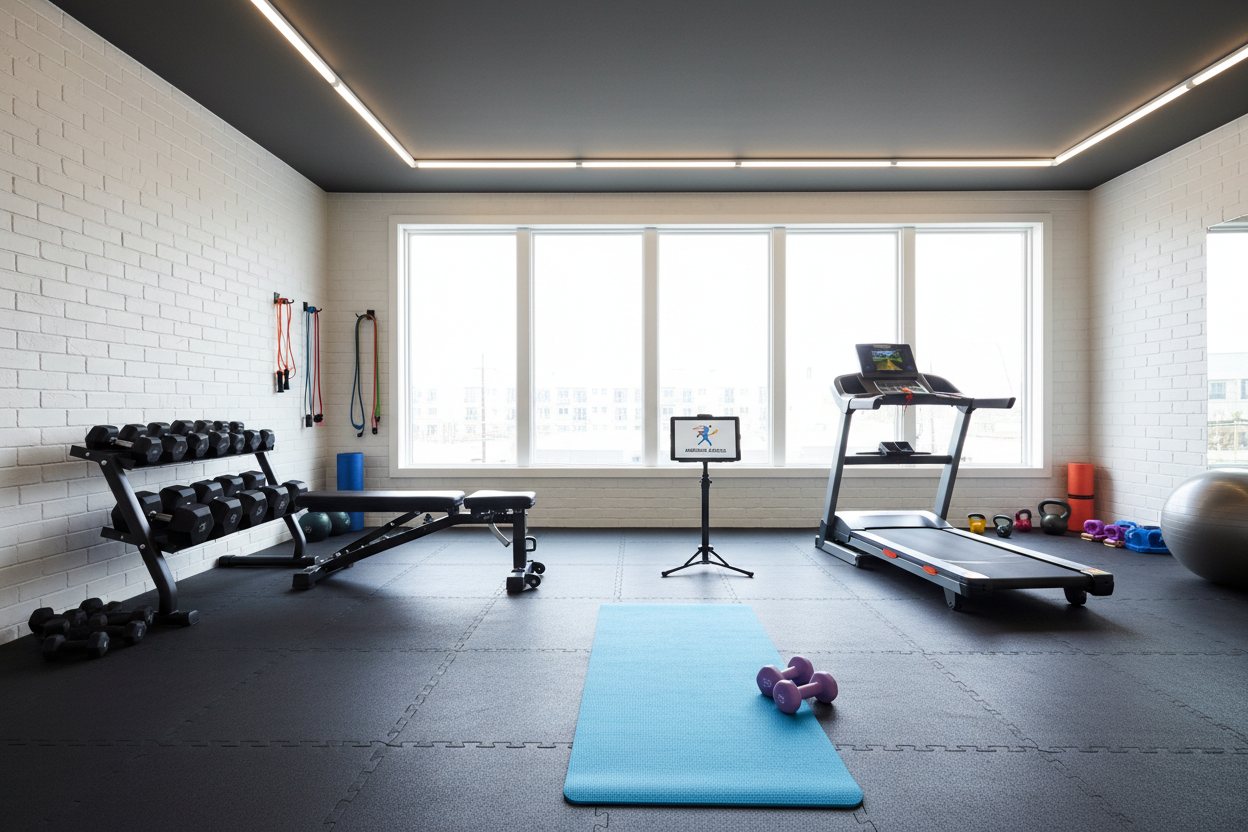
I teach my clients the 'Mat-Bound' method. This approach locks your entire cardiovascular routine into a defined, safe zone. It eliminates the fear of tripping over furniture, protects your joints from hard subfloors, and allows you to focus entirely on your movement instead of your surroundings.
Quick Takeaways
- Your entire cardiovascular routine can fit safely inside a standard 24-square-foot area.
- You can easily modify wide, sweeping video movements into compact, lateral steps.
- A dedicated, thick surface prevents slips on hardwood and protects your knees.
- Tactile feedback from the edges of your flooring keeps you centered while watching a screen.
Why Your Living Room Size Doesn't Matter
When you start working out at home, it is easy to look at sprawling online fitness studios and feel inadequate. The 'Mat-Bound' philosophy proves that cardiovascular health is about movement intensity, not square footage. You do not need to rearrange your entire house to get an effective workout. By confining your movements to a specific area, usually around 6 feet by 4 feet, you create a psychological boundary that actually frees you to move more intensely.
Spatial anxiety causes hesitation. If you are worried about your heel clipping a bookshelf, you will subconsciously shorten your stride and reduce your effort. When you establish a defined physical boundary on the floor, your brain maps that safe zone. You know exactly where you can step, hop, and reach without consequence. This mental shift is critical for beginners. It transforms a cramped living room into a highly functional micro-gym.
Furthermore, staying in one spot forces you to focus on form. Instead of relying on forward momentum to carry you across a room, you have to actively engage your core and leg muscles to change direction quickly within a tight space. This builds better stability and balance right from day one.
Adapting Aerobics Exercise Videos for Beginners to Your Space
One of the biggest hurdles my clients face is trying to replicate exactly what they see on their screens. Instructors in popular aerobics exercise videos for beginners often film in massive, empty studios. They might take three giant grapevine steps to the left, which in a normal living room would put you straight through a wall. Visual scaling is the skill you need to develop to make these routines work for you.
When an instructor takes a wide, sweeping movement, you simply cut the distance in half while doubling the tempo, or swap the movement entirely for a stationary equivalent. If the video calls for a traveling grapevine across the floor, you execute two quick, compact step-touches side-to-side instead. You are still working the same lateral leg muscles, specifically the gluteus medius, and keeping your heart rate elevated, but you remain safely within your 6x4 footprint.
Arm movements also need spatial awareness. If you have low ceilings or tight side clearances, modify wide arm circles into bent-arm raises or overhead presses. Keep your elbows tucked closer to your ribcage during punches or reaches. The goal of following aerobics exercise videos for beginners is to mimic the cardiovascular demand, not the exact physical displacement. As long as your arms and legs are moving continuously and you are breathing heavier, the exact choreography is secondary to the physiological benefit.
The Core Aerobics Beginners Exercises (Mat-Bound)
Building a routine requires mastering a few foundational movements that keep you anchored safely within your defined workout area. These four low-impact exercises are staples in my programming because they deliver high cardiovascular returns without requiring you to move more than two feet in any direction.
First, the March in Place. This sounds overly simple, but it is highly effective when done correctly. Do not just lightly lift your feet. Drive your knees up to hip height, land softly on the balls of your feet, and actively pump your arms forward and back. A rigorous three-minute march will significantly elevate your heart rate and prepare your joints for more lateral work.
Second, the Step-Touch. This is the bread and butter of side-to-side aerobic movement. Step your right foot out to the side, then bring your left foot to meet it, tapping the floor lightly. Repeat to the left. This is where your flooring dimensions matter immensely. A standard 24-inch wide yoga mat is far too narrow for this. You really need a 6x4ft exercise mat for home workouts to safely perform lateral aerobics movements without stepping off the cushioned surface and jarring your ankles.
Third, the Half-Jack. Traditional jumping jacks require explosive vertical impact and wide landings. The half-jack is a low-impact alternative. Keep your left foot planted, step your right foot out to the side, and sweep your right arm overhead. Return to the center and switch sides. You get the same shoulder mobility and lateral leg work without the harsh landing forces.
Finally, Skater Taps. Start with your feet together. Step your right foot wide to the right, and sweep your left leg behind you, tapping your left toe to the floor. Swing your arms naturally like a speed skater. This movement builds incredible lateral stability and targets the glutes, all while keeping you firmly centered in your designated workout zone.
How to Follow Aerobic Videos for Beginners Without Tripping
When you are learning new choreography, your eyes are naturally glued to the television or tablet screen. This visual fixation means you lose the ability to look down and track your foot placement. In a home environment, this is a recipe for tripping over the edge of a rug or slipping on a hardwood floor.
Proper foot traction is non-negotiable. If you try to do these routines wearing just socks on a hard floor, you will eventually slide out of control. Even barefoot, sweat can quickly turn a wood or tile floor into an ice rink. Having a large exercise mat for home gym acts as a crucial safety barrier between slippery socks or sweaty feet and dangerous hard flooring during video follow-alongs.
Beyond traction, a dedicated surface provides essential tactile feedback. When you are watching aerobic videos for beginners, you cannot see your feet, but you can feel them. The slight drop-off at the edge of a 7mm thick mat acts as a physical boundary line. If your toe brushes the edge, your brain instantly registers that you are drifting off-center, allowing you to correct your position without ever having to take your eyes off the instructor. This physical anchoring reduces anxiety and lets you push your pace with confidence.
Expanding Your Setup When You Are Ready
After three to four weeks of consistent, mat-bound workouts, your endurance will improve, and the basic movements might start to feel a bit too easy. You do not need to abandon your compact space to increase the intensity. Instead, you can introduce light resistance or elevation to your existing routine.
Adding a pair of 2-pound or 3-pound dumbbells to your step-touches and marches drastically increases the calorie burn by forcing your upper body to work harder. Alternatively, sliding a 4-inch or 6-inch aerobic stepping platform into the center of your space allows you to add vertical challenges to your routine without expanding your horizontal footprint.
As you progress, you might want to explore the best home exercise equipment for beginners to add light dumbbells or resistance bands. A simple set of loop bands placed around your thighs during half-jacks will turn a basic cardio move into a serious lower-body burn, all while keeping you safely anchored in your original spot.
Trainer's Notes: My Experience with the Mat-Bound Method
I have tested this exact setup with over 40 virtual clients over the last three years. I personally use a 7mm thick, high-density 6x4 mat in my own office for quick 15-minute conditioning sessions between client calls. The tactile feedback is real; I never look down at my feet anymore. The one honest downside? If your flooring is too thin (under 5mm), high-impact moves like traditional jumping jacks will still send shockwaves straight into your shins. Stick to the low-impact modifications I listed above until you have a surface thick enough to absorb the force.
Conclusion: Consistency Over Square Footage
Waiting until you have a massive, perfectly equipped home gym is the easiest way to guarantee you never start working out. Your cardiovascular health does not care about the size of your living room. By adopting the mat-bound method, you eliminate the excuses of tight spaces, hard floors, and spatial anxiety. Focus on building a daily movement habit within your defined 24 square feet, and you will see results long before you ever need to upgrade your space.
Frequently Asked Questions
Can I do beginner aerobics every day?
Yes, low-impact aerobics can be done daily. Because movements like marching and step-touches do not place heavy stress on your joints, a 20 to 30-minute session is safe for daily cardiovascular conditioning. Just listen to your body and take a rest day if your calves or arches feel overly fatigued.
Do I need to wear shoes on an exercise mat?
It depends on the mat's density and your foot strength. High-density mats are designed to withstand the tread of athletic shoes, which provide necessary arch support for beginners. If you choose to go barefoot, start with shorter 10-minute sessions to build up the small muscles in your feet and ankles.
How long should a beginner aerobics workout last?
Aim for 15 to 20 minutes of continuous movement when you first start. This is enough time to elevate your heart rate, break a light sweat, and practice the choreography without causing severe muscle soreness the next day. You can gradually increase the duration by 5 minutes each week.