A 90 Day Workout Plan to Build Muscle When Your Dumbbells Are Too Light
I remember the exact moment I outgrew my home gym. I was staring at my pair of 50-lb hex dumbbells, realizing that my chest press had become a high-rep cardio session. I didn't have another $400 for a heavier set, and my rack was already maxed out with plates. It’s a frustrating wall to hit, but it’s also where the real training begins.
You don't need a 100-lb dumbbell to get a 100-lb stimulus. This is designed for the garage trainee who is long on grit but short on heavy iron. We’re going to stop chasing plate math and start chasing mechanical tension by manipulating how we move the weight we already own.
Quick Takeaways
- Tempo is your new best friend; slow eccentrics make light weights feel heavy.
- Isometric pauses at the bottom of a lift eliminate momentum and force more fiber recruitment.
- Mechanical drop sets allow you to train past failure without switching weights.
- High-density flooring is non-negotiable for floor-based 'dead-stop' movements.
The Garage Gym Dilemma: When You Run Out of Heavy Iron
Most people think progressive overload is a linear line of adding five pounds to the bar every week. That works until you run out of bar space or your budget dries up. If you're stuck with a modest set of adjustables or a few pairs of fixed dumbbells, you have to get creative with 'Fixed-Weight Overload.'
Instead of increasing the external load, we increase the internal demand. We're talking about making a 30-lb dumbbell feel like a 60-lb anvil by removing every possible advantage your body tries to take. No bouncing, no swinging, and definitely no ego lifting. This is how you stay on a without turning your garage into a commercial warehouse.
Phase 1 (Days 1-30): The Tempo Trap
For the first month, we are going to wage war on the eccentric phase. Most people let gravity do half the work. Not you. For every single rep of every single set, you are going to maintain a strict 4-second negative. If you're doing a goblet squat, you count 'one-one-thousand' all the way down until your hamstrings hit your calves.
This creates massive amounts of micro-trauma in the muscle fibers. You'll find that your usual 12-rep set becomes a struggle at rep six. I recommend tracking these tempo shifts religiously. You can find templates for this over at our Workout Hub to ensure you aren't cheating the clock as the sets get harder.
By the end of week four, your mind-muscle connection will be dialed in. You’ll stop 'throwing' weights and start 'placing' them. It’s humbling, but it’s the foundation of this entire protocol.
Phase 2 (Days 31-60): The Dead-Stop and Squeeze
In the second month, we’re killing the stretch reflex. You know that little 'bounce' you get at the bottom of a bench press or a squat? That’s stored elastic energy, and it’s making the lift easier. We don't want easy. We want growth.
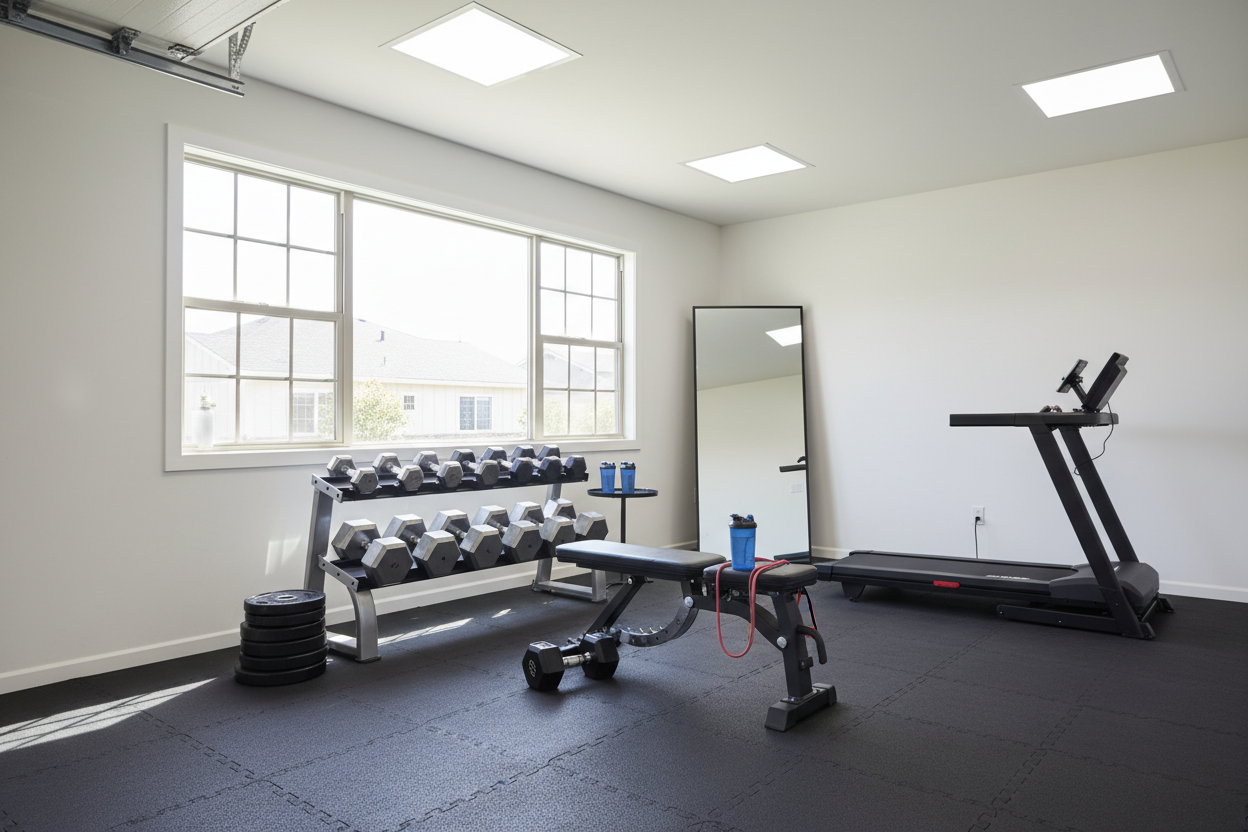
We’re moving to dead-stop variations. This means floor presses instead of bench presses, and deep split squats where your back knee actually settles on the ground for a full two-second pause. To do this safely, you need a surface that won't destroy your joints. I use a 6X8Ft Exercise Mat Yoga Mat Gym Flooring For Home Workout because it’s dense enough to support a heavy floor press but has enough give to protect your knees during those paused lunges.
The goal here is to start every rep from a position of zero momentum. It forces your nervous system to recruit more motor units just to get the weight moving. Expect your 'max' reps to drop, but your muscle density to increase significantly.
Phase 3 (Days 61-90): Mechanical Drop Sets
The final month is about total exhaustion. Since we can't 'drop' the weight to a lighter pair of dumbbells, we change the leverage of the exercise to make it easier as we fatigue. This is a mechanical drop set.
For example, you’ll perform dumbbell flys until you can’t do another clean rep. Then, without putting the weights down, you immediately tuck your elbows and start performing neutral-grip chest presses. You're using the same weight, but moving from a weak mechanical position (fly) to a strong one (press). This allows you to push the muscle far beyond its normal failure point.
These sets are brutal on the central nervous system. If you find your performance tanking mid-week, I Micro-Dosed My 7 Day Workout Plan to Build Muscle by splitting these high-intensity blocks into shorter, more frequent sessions. It keeps the quality high without the burnout.
How to Schedule Your Rest When Every Set is Brutal
When you manipulate tension like this, your recovery needs skyrocket. You aren't just taxing your muscles; you're taxing your tendons and your brain. If you try to train six days a week with 4-second negatives and mechanical drop sets, you'll hit a wall by day 45.
I suggest a 2-on, 1-off cadence. On those off days, don't just sit on the couch. Some people think Rest Days Kill Momentum: A 7 Day Muscle Building Workout Plan, but the trick is active recovery. Go for a walk, do some light mobility work, or just move enough to get the blood flowing. The goal is to show up to your next heavy session feeling snappy, not sluggish.
Personal Experience: The 'Light Weight' Mistake
I once tried to do a similar 90-day block using only a pair of 25-lb dumbbells because I was traveling. I thought I was a hero and tried to do 8-second negatives on every rep. By day three, my elbows were so inflamed I couldn't even grip a coffee mug. My mistake was jumping into extreme tempos too fast. Start with a 3 or 4-second count. If you go straight to 'super slow-mo' without acclimating, your connective tissue will pay the price before your muscles even get a chance to grow.
FAQ
Do I really not need heavier weights?
Eventually, you will. But most people haven't even come close to exhausting the potential of a 50-lb dumbbell. If you can't do 15 reps with a 5-second negative and a 2-second pause, you haven't 'outgrown' that weight yet.
Can I do this with just one dumbbell?
Absolutely. Unilateral (one-sided) training is actually better for home gym owners because it forces your core to stabilize the load, making the exercise even more demanding.
What if I don't have a bench?
The floor is your best friend. Floor presses and floor flys are actually safer for your shoulders and force that 'dead-stop' mechanic we want in Phase 2. Just make sure you have decent flooring so you aren't grinding your bones into the concrete.