6 Month Muscle Gain Program: Periodization Phases, Split Evolution, and Home Gym Floor Staging
Architecting a 6-Month Hypertrophy Roadmap: The Three-Phase Periodization Model
Building significant lean mass requires deliberate long-term structure rather than random day-to-day session choices. Committing to a comprehensive 6 month muscle gain program provides the multi-month runway necessary to stimulate progressive overload, refine movement mechanics, and manage systemic fatigue across sequential training blocks. A half-year timeframe allows lifters to systematically shift focus between foundational movement mastery, high-tension mechanical loading, and targeted volume accumulation.
When designing what many consider the best 6 month workout plan, dividing the twenty-four weeks into three distinct two-month blocks prevents adaptation plateaus. Rather than repeating the exact same set and rep ranges endlessly, periodizing the stimulus ensures your muscular and nervous systems continuously receive novel demands while allowing connective tissues adequate time to adapt to escalating workloads.
- Phase 1 (Months 1–2): Structural adaptation, movement patterning, baseline volume balance, and tendon preparation.
- Phase 2 (Months 3–4): Mechanical tension emphasis, heavy multi-joint compound progression, and increased working intensity.
- Phase 3 (Months 5–6): High-density volume accumulation, targeted hypertrophy specialization, and strategic fatigue management.
Phase 1 (Months 1–2): Movement Mastery and Structural Foundation
The initial eight weeks establish technical proficiency across fundamental movement patterns: the squat, hinge, horizontal press, vertical press, row, and vertical pull. Rushing directly into maximal loads without consistent execution can limit long-term gains. For lifters establishing their base or returning after an extended break, reviewing an introductory plan build muscle guide helps reinforce the value of patient habit formation and standard movement tempos.
During this opening phase of your 6 month workout plan to build muscle, a three-day full-body or four-day upper-lower split works exceptionally well. Focus on controlled eccentric phases (lowering the weight steadily), crisp concentric drives, and leaving one to three repetitions in reserve on working sets. This controlled approach stimulates hypertrophy while allowing connective tissues to adapt comfortably to progressive resistance.
Keep tracking straightforward: record your exercises, completed repetitions, and working weights in a training log. Aim to add small increments of resistance or an additional repetition each week while holding technique strictly constant.
Phase 2 (Months 3–4): Intensified Mechanical Tension and Load Progression
Once fundamental movement patterns are firmly grooved, the mid-stage of the program shifts toward progressive mechanical tension. As a structured 6 month workout plan male lifters and dedicated trainees use to drive hypertrophy, this block emphasizes primary multi-joint lifts performed with higher relative loads and slightly longer rest intervals between sets.
Training splits typically evolve into a four-day upper/lower or five-day push-pull-legs arrangement during months three and four. This split evolution distributes weekly volume across distinct muscle groupings, allowing lifters to train with higher output per session while providing ample recovery windows for each target area.
- Primary Compound Focus: Barbell or heavy dumbbell presses, Romanian deadlifts, barbell rows, and squat variations lead each session.
- Rest Intervals: Extend rest periods on key compound movements to maintain high force output across consecutive sets.
- Proximity to Failure: Working sets can be taken closer to muscular failure while maintaining strict form and stable joint alignment.
Phase 3 (Months 5–6): High-Density Volume Accumulation and Muscle Specialization
The final block of the half-year program maximizes localized metabolic stress and volume accumulation. With a robust strength foundation established in earlier phases, the body can tolerate increased accessory volume, higher repetition ranges, and focused isolation work.
In this final stretch of your 6 month workout plan to build muscle, incorporate varied rep spectrums, targeted supersets, and controlled rest-pause sets on isolation exercises for muscle groups like the deltoids, biceps, triceps, and calves. Balancing this increased localized volume with scheduled deload weeks ensures systemic fatigue remains manageable and performance stays high throughout the final training weeks.
Adapting the 6-Month Plan for Home Training Environments
Executing a dedicated program at home requires thoughtful exercise substitutions and equipment organization. A successful 6 month home workout plan relies on adaptable tools such as adjustable dumbbells, resistance bands, a sturdy bench, and a versatile barbell setup. Lifters transitioning between commercial facilities and garage setups can benefit from reading a foundational build muscle workout guide to understand how machine movements translate into free-weight or bodyweight equivalents.
When training at home, progressive overload can be applied by adjusting tempo, increasing set volume, shortening rest periods, or utilizing unilateral variations like Bulgarian split squats and single-arm rows when absolute dumbbell weight is finite.
Home Gym Floor Mat Staging for Heavy Lifting and Subfloor Protection
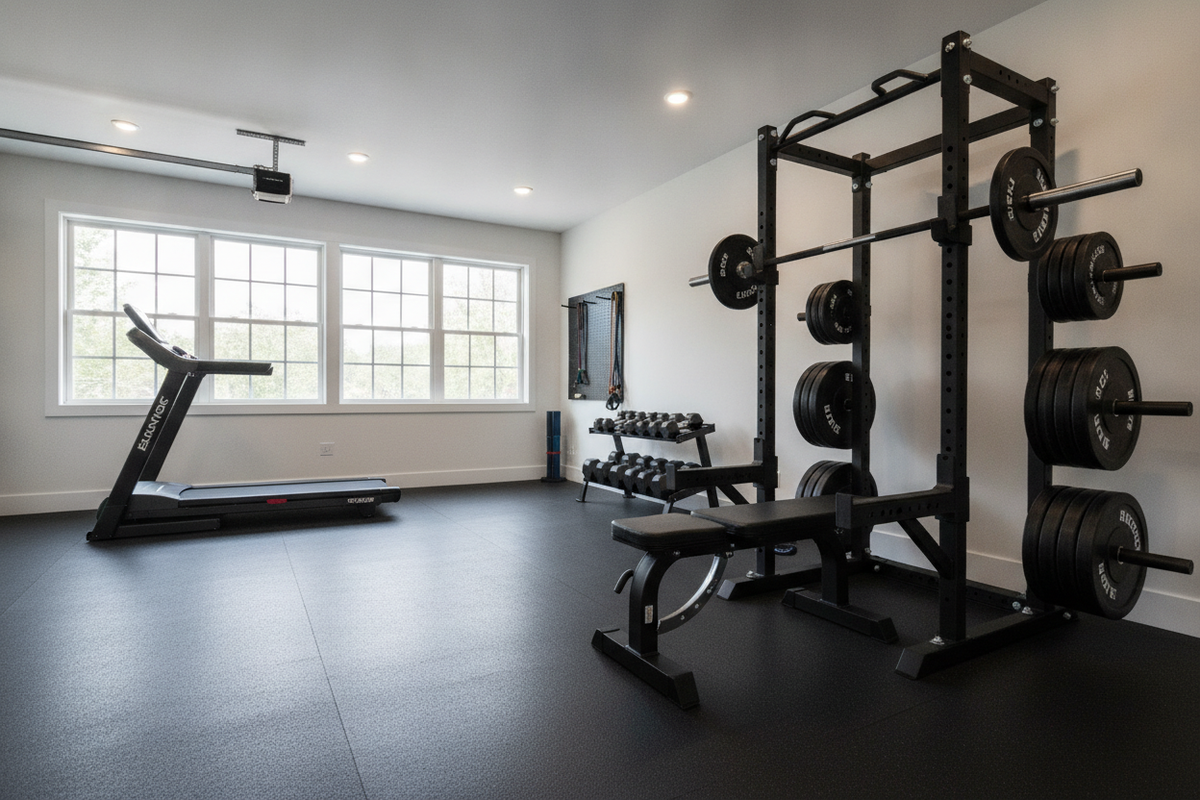
A frequently overlooked component of long-term home hypertrophy training is the flooring underfoot. Sustained heavy lifting over a six-month timeline places cumulative stress on residential subfloors, concrete slabs, and lifters' joints. Setting up a dedicated workout product area using a dense, large-format mat creates a stable foundation for compound lifts.
High-density gym mats provide firm traction during heavy presses, deadlifts, and squats, preventing footing slippage under load. Additionally, broad mat coverage dampens equipment contact noise, cushions joint impact during loaded movements, and shields underlying hardwood, tile, or concrete from dropped dumbbells and plate contact throughout months of rigorous training.