30 Minute Gym Workout: Station Consolidation Architecture, Timed Density Frameworks, and Floor Staging
Introduction
Executing an effective training block within a compressed timeframe requires deliberate planning and spatial control. When time is constrained, traditional lifting protocols that involve extensive rest intervals and frequent transitions across different areas of a facility often lead to lost training volume. A structured 30 minute gym workout relies on eliminating idle transit time, consolidating equipment into a dedicated boundary, and sequencing movement patterns that allow continuous work without excessive localized fatigue.
By treating the physical workout area as an integrated training cell, lifters can shift the focus from logistical management to high-density execution. Whether training in a commercial space or a home gym, establishing a fixed perimeter supported by appropriate flooring and staged resistance tools ensures that every minute delivers training value.
Core Mechanics of an Efficient 30-Minute Gym Routine
Maximizing density across a condensed timeframe requires a systematic approach to exercise selection. Rather than working muscles in isolation, high-efficiency programming prioritizes compound multi-joint movements paired to minimize downtime while maintaining movement quality.
Antagonistic and Non-Competing Movement Pairings
The foundation of a compressed 30-minute gym routine rests on pairing movements that recruit opposing muscle groups or non-overlapping kinetic chains. Combining an upper-body pressing movement with a lower-body hinge, or pairing an upper-body pull with a quad-dominant squat pattern, allows one primary mover to recover while the alternating muscle group performs mechanical work.
This structure prevents premature central nervous system and localized muscle burnout. lifters who consult a detailed gym workout guide often observe that pairing exercises such as dumbbell floor presses with Romanian deadlifts or goblet squats with chest-supported rows maintains steady cardiac output and mechanical tension without requiring extended seated rest.
Station Consolidation and Reducing Transit Latency
In a standard gym setting, walking between distinct equipment stations—such as moving from a cable machine on one side of the room to a dumbbell rack on the other—consumes significant time. In a short session, transit latency directly reduces total set volume.
Station consolidation involves selecting a single 6-by-8 foot or 6-by-10 foot perimeter and bringing all required resistance elements into that footprint before starting the timer. Staging two to three pairs of dumbbells, a set of resistance bands, and a dedicated floor surface eliminates the need to negotiate shared equipment or wait for open stations.
Session Frameworks for a 30 Minute Session
Structuring a successful 30 minute session depends on applying timed interval frameworks or density ladders rather than open-ended set-and-rep counts. Standard frameworks help standardize work-to-rest intervals and maintain steady pacing throughout the training window.
The Compact Dumbbell and Bodyweight Circuit
A compact circuit framework organizes four distinct movement categories within a unified space: lower-body push, upper-body pull, lower-body pull/hinge, and upper-body push. Moving through these stations in continuous cycles keeps the training rhythm steady.
- Station A: Goblet Squats or Front-Rack Split Squats
- Station B: Dumbbell Bent-Over Rows or Neutral-Grip Pulls
- Station C: Romanian Deadlifts or Kettlebell Swings
- Station D: Push-Ups, Dumbbell Floor Presses, or Overhead Presses
For individuals looking for tailored loading variables, reviewing a specialized gym workout routine guide can offer additional insight into balancing volume, rep ranges, and movement tempos across multi-joint circuits.
Unilateral Strength and Core Stability Ladders
Unilateral exercises, such as single-leg lunges, single-arm presses, and offset carries, challenge core stability while developing balanced muscular strength. Because unilateral movements often require moderate absolute loads compared to bilateral barbell lifts, setup and breakdown time is significantly reduced.
Structuring these movements into density blocks—such as completing an escalating ladder of reps across eight-minute clusters—allows lifters to self-regulate pacing while accumulating substantial functional volume within a small physical zone.
Equipment Placement, Floor Protection, and Environmental Setup
High-density routines require quick transitions between standing lifts, floor-based pressing, and ground-level core work. The physical surface underfoot plays a direct role in maintaining traction, stabilizing joint mechanics, and safeguarding the surrounding environment.
Subfloor Absorption and High-Tempo Weight Drops
During timed density workouts, weights are frequently set down rapidly between supersets. Dropping cast iron or urethane dumbbells directly onto unprotected hardwood, tile, or thin residential flooring risks surface cracking and transmits vibration through the building structure.
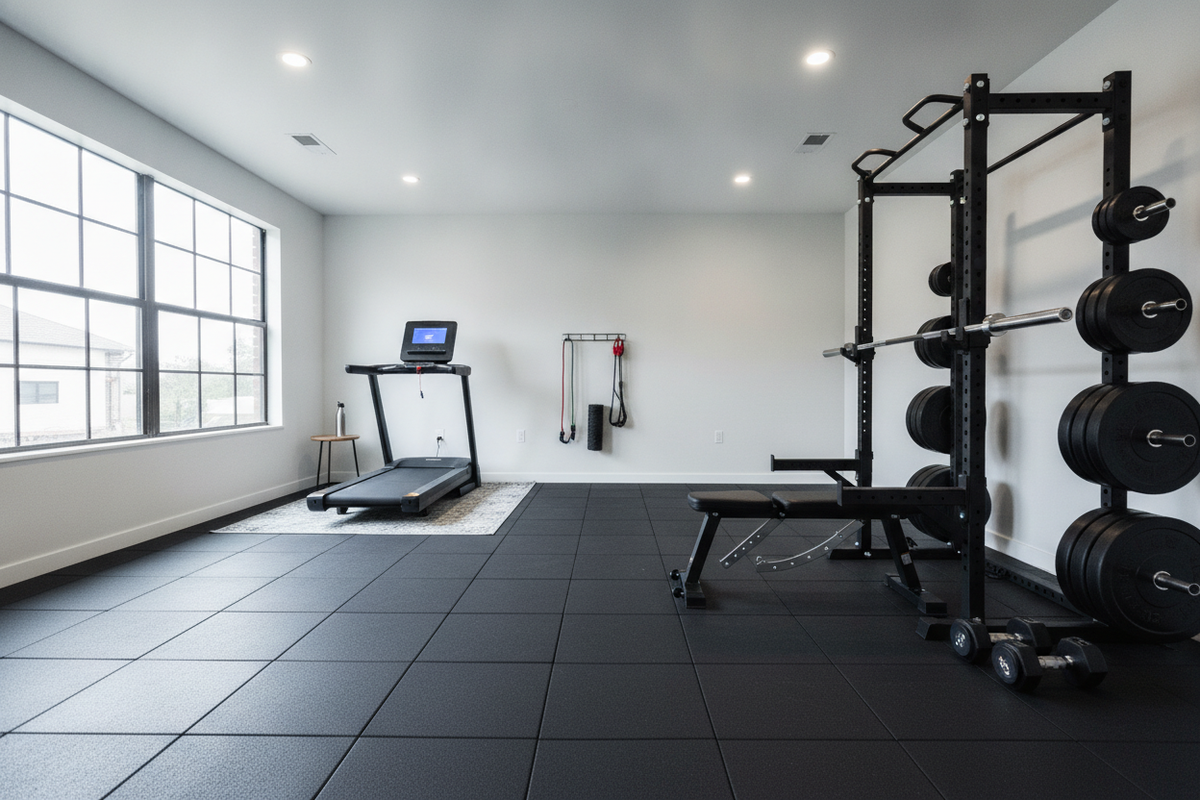
Utilizing high-density, shock-absorbing flooring provides a necessary buffer for both the subfloor and the equipment. A dedicated large-format gym workout product creates a stable, non-slip foundation that absorbs minor impacts, dampens noise, and supports rapid transitions from standing compound movements to floor-based exercises.
Ergonomic Layout and Staging Within Mat Boundaries
To prevent tripping hazards and maintain smooth movement flow, equipment within the training cell should follow a zoned layout:
- Active Exercise Zone: The central area of the mat, kept clear of stray weights, used exclusively for dynamic lifting, lunging, and floor work.
- Equipment Staging Boundary: The top or lateral edge of the mat, where secondary dumbbell pairs, resistance bands, and hydration tools remain parallel to the boundary line.
- Transition Corridor: A designated side for dropping into prone or supine positions without risk of making contact with resting weights.
Optimizing Pacing, Transition Protocols, and Mat Maintenance
Managing execution details ensures consistent performance across consecutive training days while preserving gym equipment and flooring integrity.
Managing Rest Intervals and Focus Under Time Constraints
Strict pacing does not mean moving at maximum velocity until form degrades. Rather, pacing should emphasize steady, controlled breathing between sets. Monitoring recovery through nasal inhalation and controlled exhalation allows lifters to gauge readiness for the next movement block without checking external clocks constantly.
Structuring the workout into three 8-minute working blocks separated by 90 seconds of active recovery creates a reliable framework that accommodates warm-up sets and cool-down transitions within the 30-minute allotment.
Post-Workout Floor Care and Equipment Storage
High-intensity workouts inevitably result in sweat accumulation on exercise surfaces. Preserving mat traction and hygiene requires prompt wiping with a mild, non-abrasive cleanser after each session. Storing dumbbells on dedicated racks or perimeter corner blocks keeps the central floor surface free from indentations and ready for the next scheduled routine.
For additional layout blueprints and training templates tailored to compact fitness spaces, exploring an integrated workout resource provides complementary systems for organizing home and commercial training environments.
Conclusion
A compressed training window is no barrier to achieving balanced physical development. By combining non-competing movement pairings, eliminating spatial transit, and establishing a secure, shock-absorbing floor perimeter, the 30 minute gym workout becomes a dependable, high-density training model. Proper equipment staging and deliberate pacing ensure that every minute on the mat is organized, productive, and sustainable over the long term.