100 Workouts Blueprint: Bodyweight Movement Taxonomy, Routine Sequencing, and Floor Staging
Deconstructing the 100 Workouts Architecture: Modular Bodyweight Training
Large-format bodyweight libraries, frequently compiled into comprehensive collections of 100 workouts without equipment, offer athletes and home fitness practitioners a practical framework for functional conditioning. The appeal of a massive workout catalog lies in its visual modularity and minimal gear dependency: rather than relying on specialized machinery or heavy load stations, each session systematically reorganizes fundamental human kinetic patterns into distinct metabolic, balance, and strength challenges.
A well-curated catalog of 100 no-equipment workouts eliminates logistical barriers to consistency while preserving the core tenets of progressive overload. When external resistance is unavailable, progressive stimulus is achieved through mechanical leverage manipulation, tempo modulation, eccentric control, expanded ranges of motion, and interval density. Approached with a systematic mindset, bodyweight libraries serve as versatile training blueprints capable of developing full-body work capacity, muscular endurance, and movement literacy across multiple planes of motion.
Taxonomy of 100 Exercises Without Equipment: Core Movement Archetypes
To navigate an extensive movement catalog without feeling overwhelmed, categorizing individual exercises into distinct biomechanical archetypes provides immediate structural clarity. Broad collections of 100 exercises without equipment generally distribute variations across five primary functional movement vectors:
- Upper-Body Horizontal and Vertical Pushing: Push-up variations (standard, wide-grip, close-grip diamond, decline, archer, and pike positions) along with bench or chair dip progressions condition the pectorals, anterior deltoids, and triceps. For a detailed breakdown of targeted bodyweight pressing angles, explore effective chest exercises you can do at home without equipment.
- Knee-Dominant Lower Body: Bodyweight air squats, tempo squats, split squats, reverse lunges, forward lunges, lateral side lunges, and single-leg squat progressions target the quadriceps, adductors, and gluteal complex across multi-directional foot positions.
- Hip-Dominant and Posterior Chain: Single-leg and double-leg glute bridges, good morning hinges, and hip thrust variations recruit the hamstrings, gluteus maximus, and spinal erectors to counterbalance sitting posture.
- Dynamic and Anti-Extension Core: Forearm planks, side planks, hollow-body holds, bird-dogs, dead bugs, and mountain climbers build midsection isometric tension, anti-rotational stability, and pelvic control.
- Plyometric and Metabolic Transits: Burpees, jumping jacks, tuck jumps, squat jumps, and skater hops elevate heart rate while conditioning rapid force absorption and multi-directional agility.
Structuring a 100 No Equipment Workout Routine: Circuit Design and Progression
Executing a productive 100 no equipment workout requires organized programming rather than arbitrary exercise selection. When training without external weights, the sequencing of movements dictates the physical stimulus and fatigue accumulation. Structured bodyweight sessions typically adopt one of several core programming templates:
- Density Circuits: Selecting four to six non-competing exercises (such as a push, squat, core hold, and hinge) and performing continuous rotations for a preset time window, focusing on steady pacing and movement quality.
- Interval and Tabata Protocols: Alternating fixed periods of active work with controlled rest periods (such as forty seconds of work followed by twenty seconds of rest) to elevate metabolic output while preserving clean form during high-cadence reps.
- Movement Pyramids and Ladders: Ascending or descending repetition schemes across complementary movement pairs, managing muscular fatigue during complex bodyweight levers.
- Positional Holds and Tempo Clusters: Incorporating isometric pauses at the bottom of squats or push-ups to increase time under tension without adding external mass.
For individuals seeking practical examples of how targeted muscle group training fits within balanced bodyweight sequencing, reviewing effective chest workouts you can do at home without equipment offers valuable insight into organizing no-gear upper-body sessions.
Workflow Optimization: Managing Visual Charts and 100 No Equipment Workouts PDF Guides
Many home fitness enthusiasts rely on visual workout cards, poster grids, or a downloaded 100 no equipment workouts PDF to direct their daily training. To translate these large collections into a sustainable habit, establishing an efficient organizational workflow inside your training environment is essential:
- Categorization by Training Objective: Segment workout sheets into distinct tracks based on your focus for the day, such as high-output conditioning, strength and leverage practice, mobility and active recovery, or core stabilization.
- Sequential Card Rotation: Rather than repeating familiar routines, follow a rotating schedule across different cards to ensure balanced physical demands and avoid overworking specific movement patterns.
- Accessible Visual Staging: Position printed workout sheets on a wall clipboard or mount your tablet on a stable stand near your training perimeter. Keeping instructions clearly visible prevents disruptive pauses during timed intervals and flow circuits.
- Progress Tracking: Keep a simple notebook nearby to record completed rounds, rest times, and form notes, ensuring you maintain a continuous record of your conditioning progression.
Biomechanical Floor Staging: Impact Attenuation for High-Volume Groundwork
High-volume bodyweight training involves continuous, repetitive physical contact with the floor. Dynamic routines that combine sprawling burpees, explosive jump squats, mountain climbers, and sustained forearm planks direct significant mechanical stress onto the wrists, elbows, knees, ankles, and spine. Performing these movements directly on hard domestic flooring such as unyielding tile, bare concrete, or rigid hardwood can lead to acute discomfort and joint strain over time.
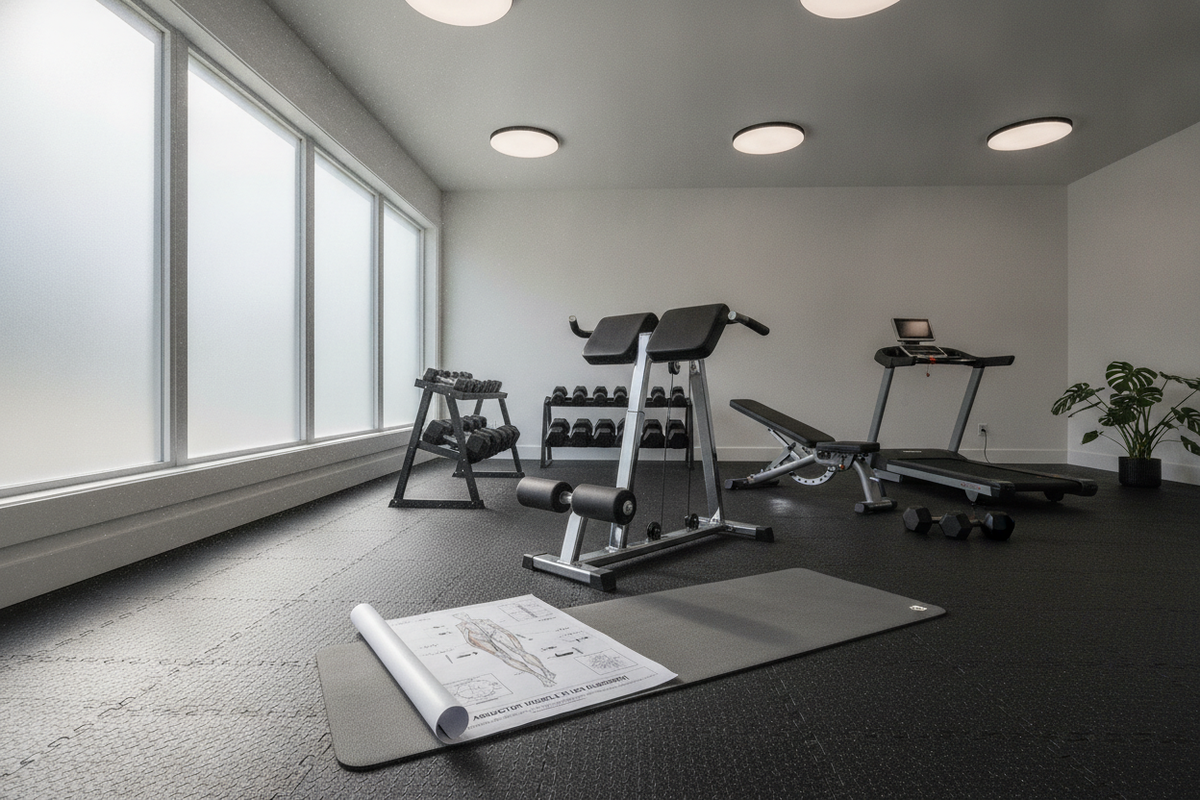
Establishing a supportive workout surface is critical for maintaining consistency during no-equipment training cycles. Setting down a durable large-format exercise mat gym flooring creates a dedicated training boundary that provides essential impact absorption, dependable multi-directional grip for sweaty hands and feet, and effective protection for your underlying home floors against repetitive scuffs and friction.
Hybrid Progression: Integrating Strength Equipment into Bodyweight Foundations
While an extensive library of bodyweight routines provides an exceptional baseline for conditioning and functional movement, many athletes eventually choose to expand their training into a hybrid model. As your relative strength develops, adding focused external resistance through dedicated strength equipment—such as adjustable dumbbells, kettlebells, pull-up bars, or resistance bands—complements calisthenic patterns by introducing heavy vertical pulling and progressive posterior loading.
By combining a shock-absorbing floor foundation with a structured taxonomy of bodyweight archetypes and complementary strength gear, you build a versatile, resilient home gym setup capable of supporting both minimalist calisthenics routines and advanced progressive overload.