
last updated 24.11.25
X6 POWER RACK BUYING GUIDE
X6 Power Rack is one of GXMMAT’s new Home Gym Select Series launched in 2025, providing an all-in-one strength training solution for home gym use.
What's a Power Rack?
Before you dive in, there’s one thing you really need to know—what exactly is a power rack? There are tons of different strength-training rack setups on the market, so are you sure you actually understand the differences and that a power rack is the one that truly fits your needs?
Multi-column
Functional Trainer
Pair text with an image to focus on your chosen product, collection, or blog post. Add details on availability, style, or even provide a review.
Power Rack / Power Cage
Pair text with an image to focus on your chosen product, collection, or blog post. Add details on availability, style, or even provide a review.
Smith Machine
Pair text with an image to focus on your chosen product, collection, or blog post. Add details on availability, style, or even provide a review.
Squat Rack / Half Rack
Pair text with an image to focus on your chosen product, collection, or blog post. Add details on availability, style, or even provide a review.
Power racks and squat stands are both important tools for strength training commonly found in most gyms. Before setting up your home gym, it’s useful to know how squat stands differ from power racks, since they serve similar but not identical functions.
A power rack typically features four to six vertical posts, forming an open cage-like frame. The uprights of the power rack are equipped with supports for standard and specialty barbells at different heights. These supports include J-hooks and safety bars. You can secure the barbell at your desired height for easy lifting, and during heavy lifting, the safety bars can effectively catch the barbell if it happens to drop. The squat rack has a simpler structure, consisting of just two metal uprights, and is therefore also called a half rack.
Squat stands are primarily used for fundamental lifts like squats and bench presses. Power racks, on the other hand, offer greater versatility, allowing for exercises such as pull-ups, chin-ups, deadlifts, and rows in addition to the basics to effectively strengthen more muscle. Most power racks include safety bars that can be adjusted horizontally to enhance safety during heavy lifts. They can generally support heavier loads than squat stands, reducing the risk when training with large bumper plates.
Power Racks are equipment that have no fixed tracks or guided systems. Users can control the movement path and maintain balance by themselves, which makes them well-suited for heavy compound lifts such as squats, bench presses, and deadlifts.
While Smith Machine belongs to guided frames which also uses barbell as the resistance source but fixes it within steel rails, which limits its movement path during strength training exercises. This keeps balance, enhances safety and makes it the equipment more suitable for beginners, solo workouts, and fixed-path exercises.
X6 SERIES

FAQS
PRODUCTS
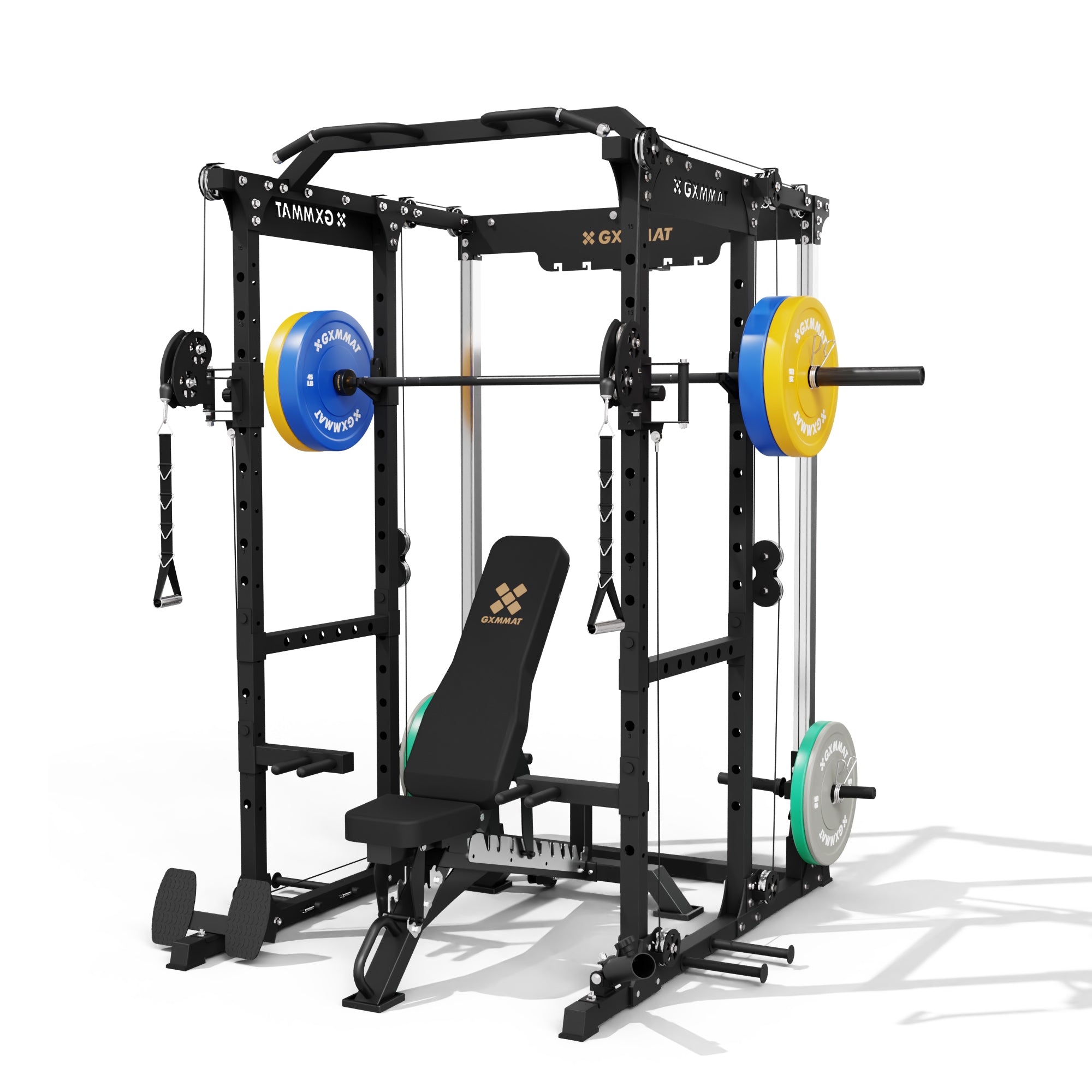
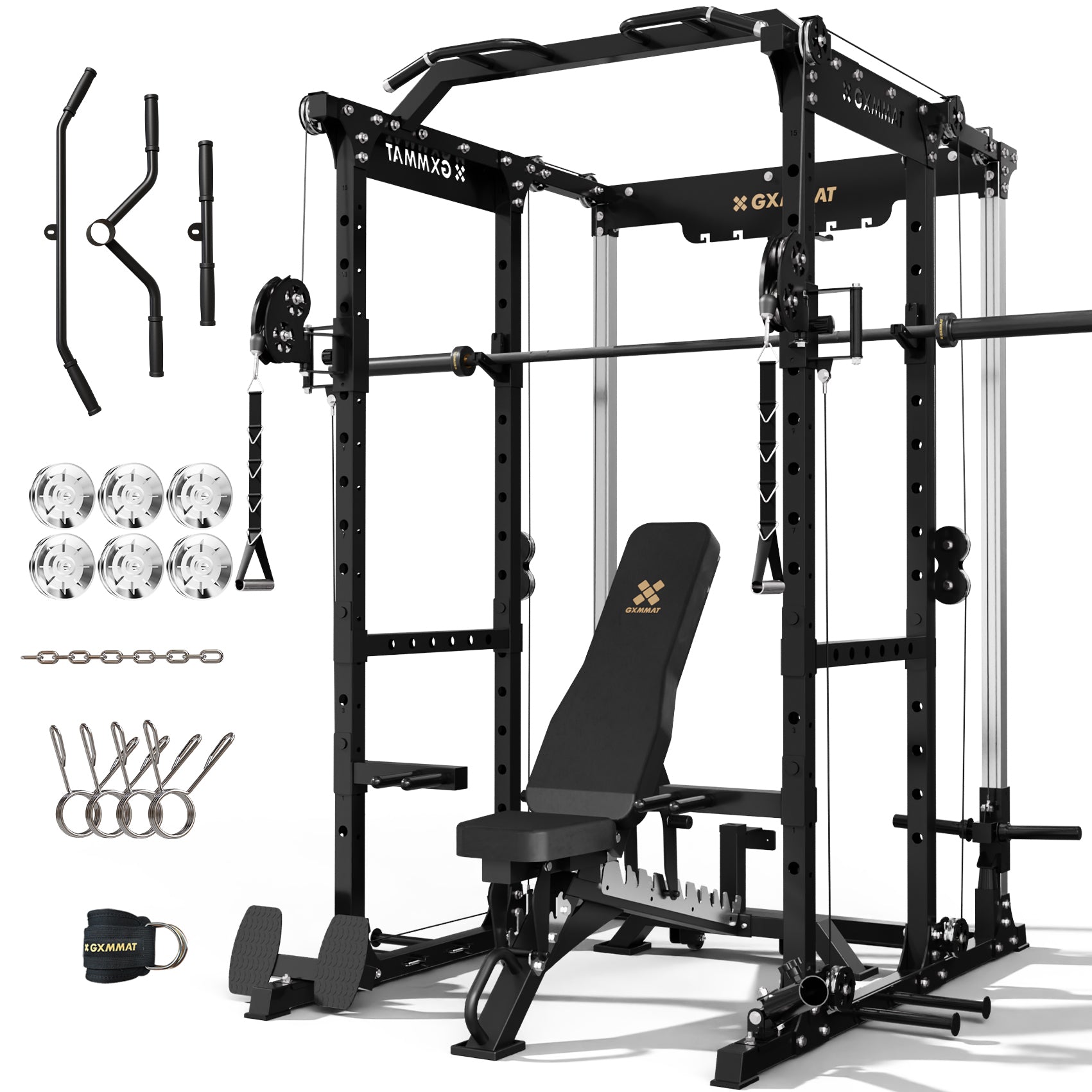
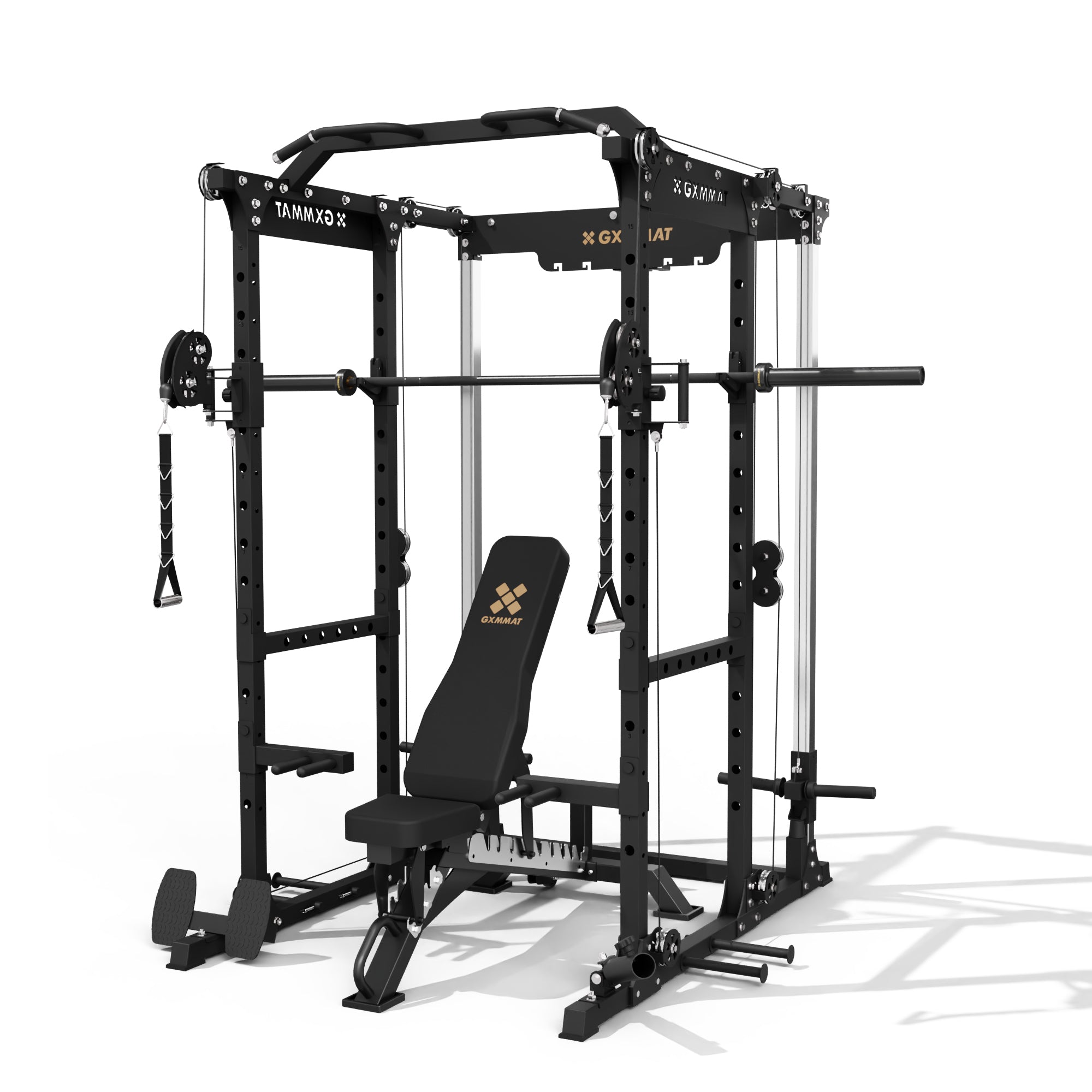
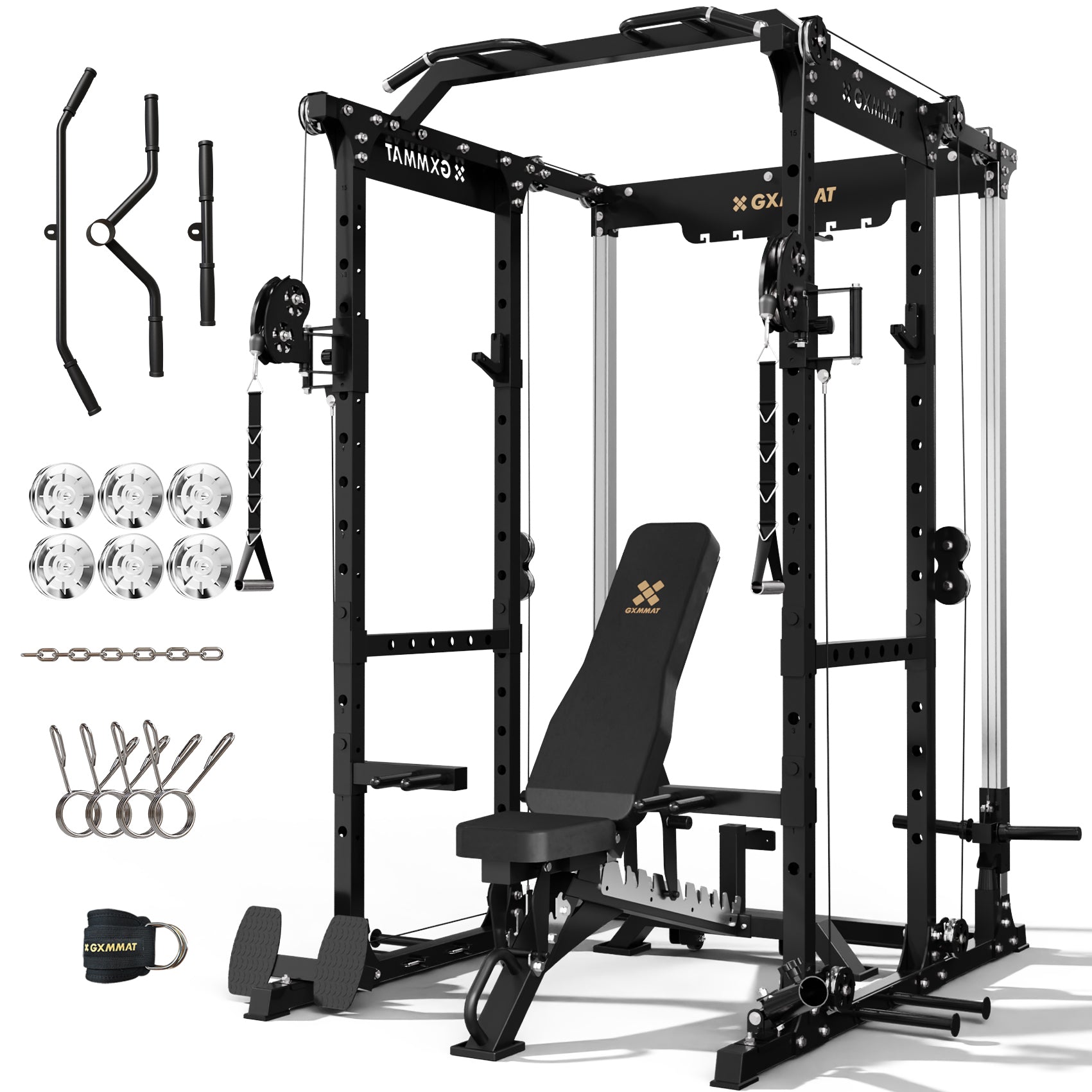
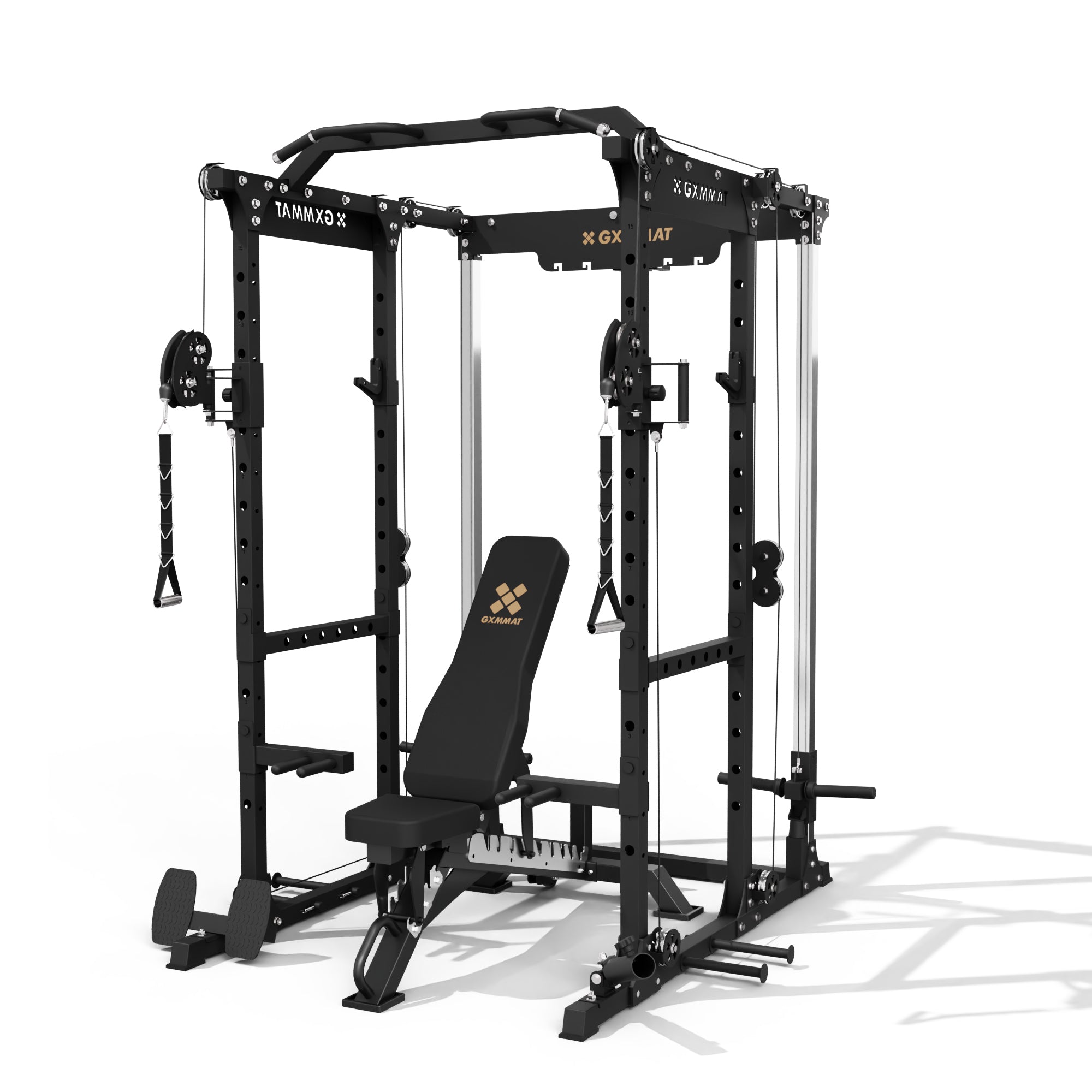
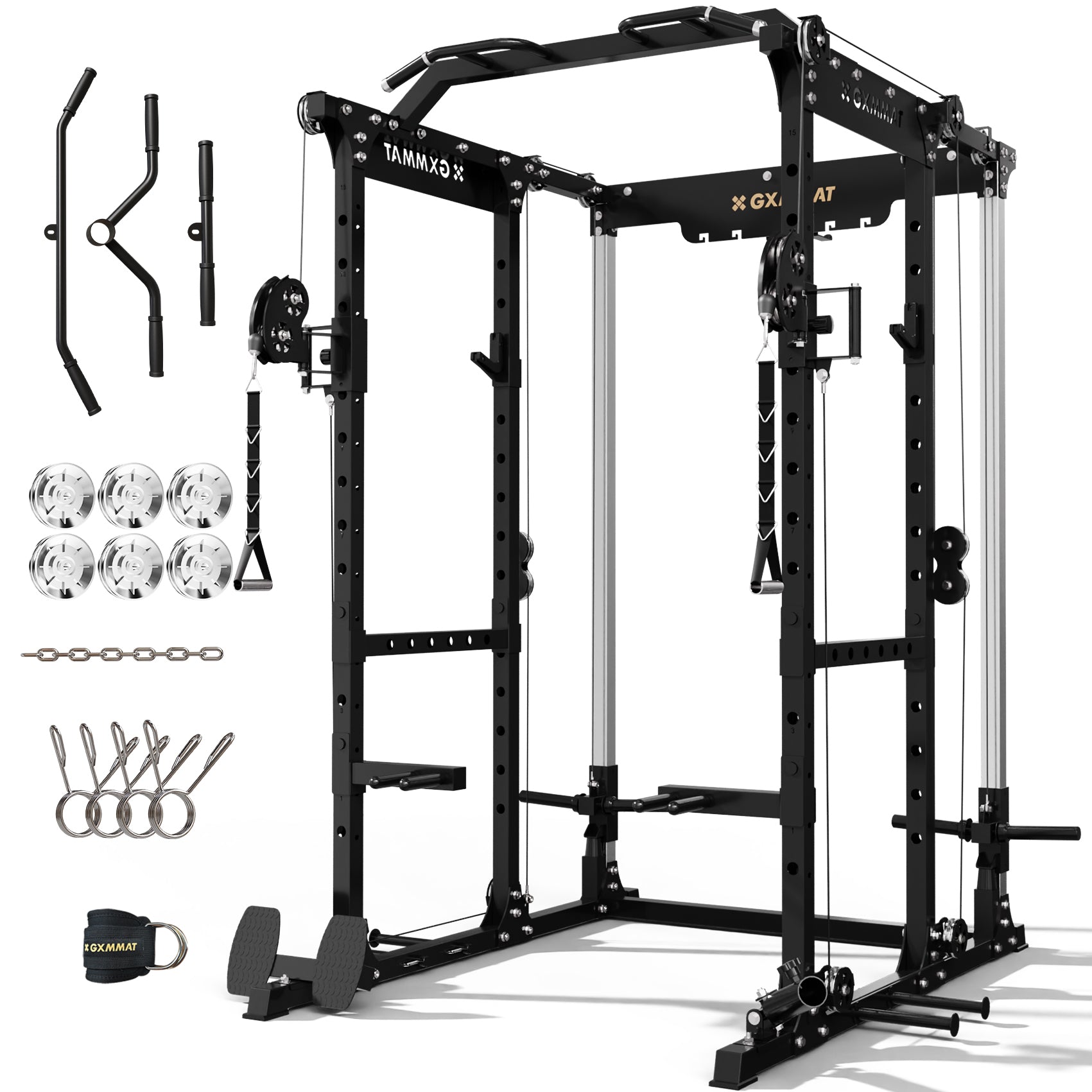
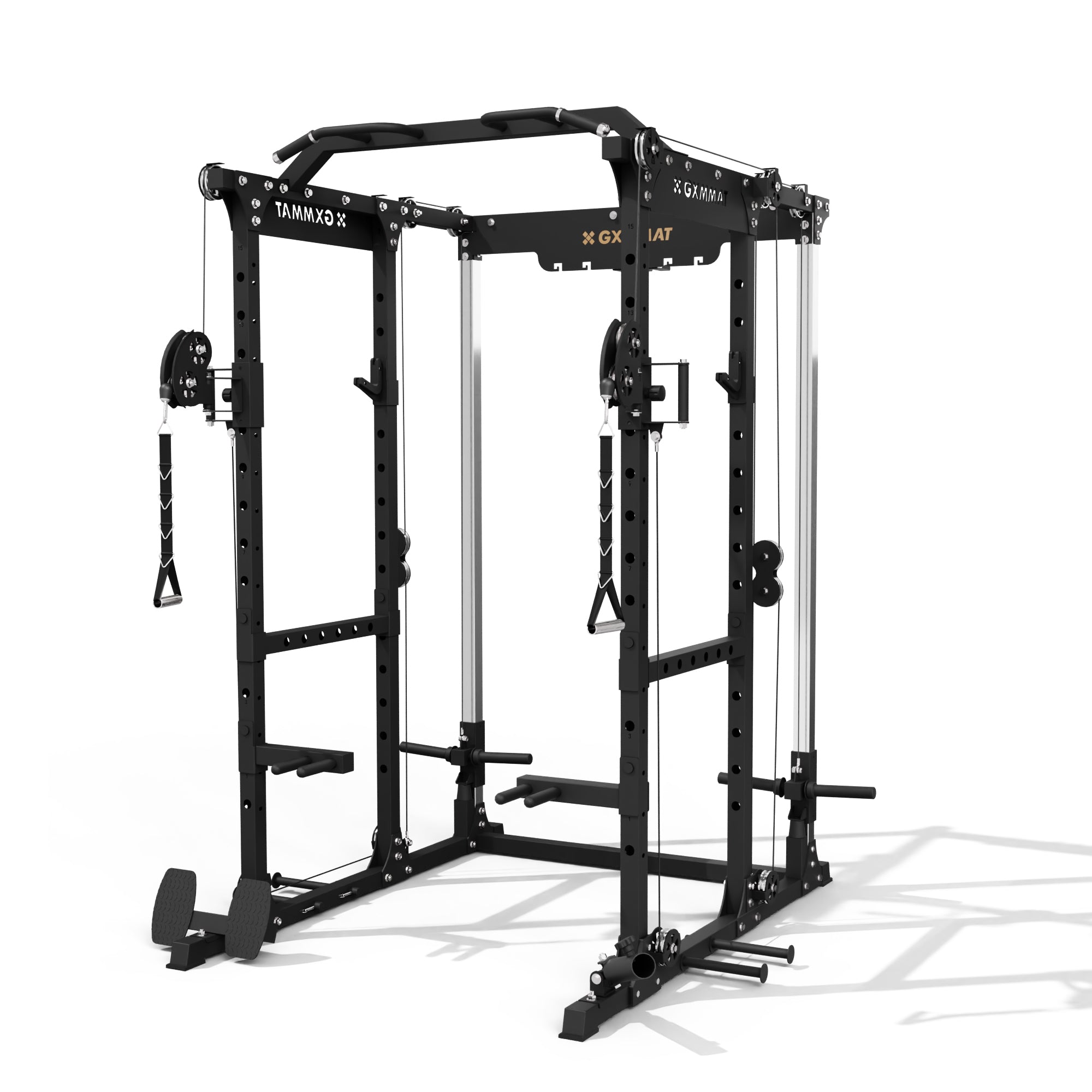
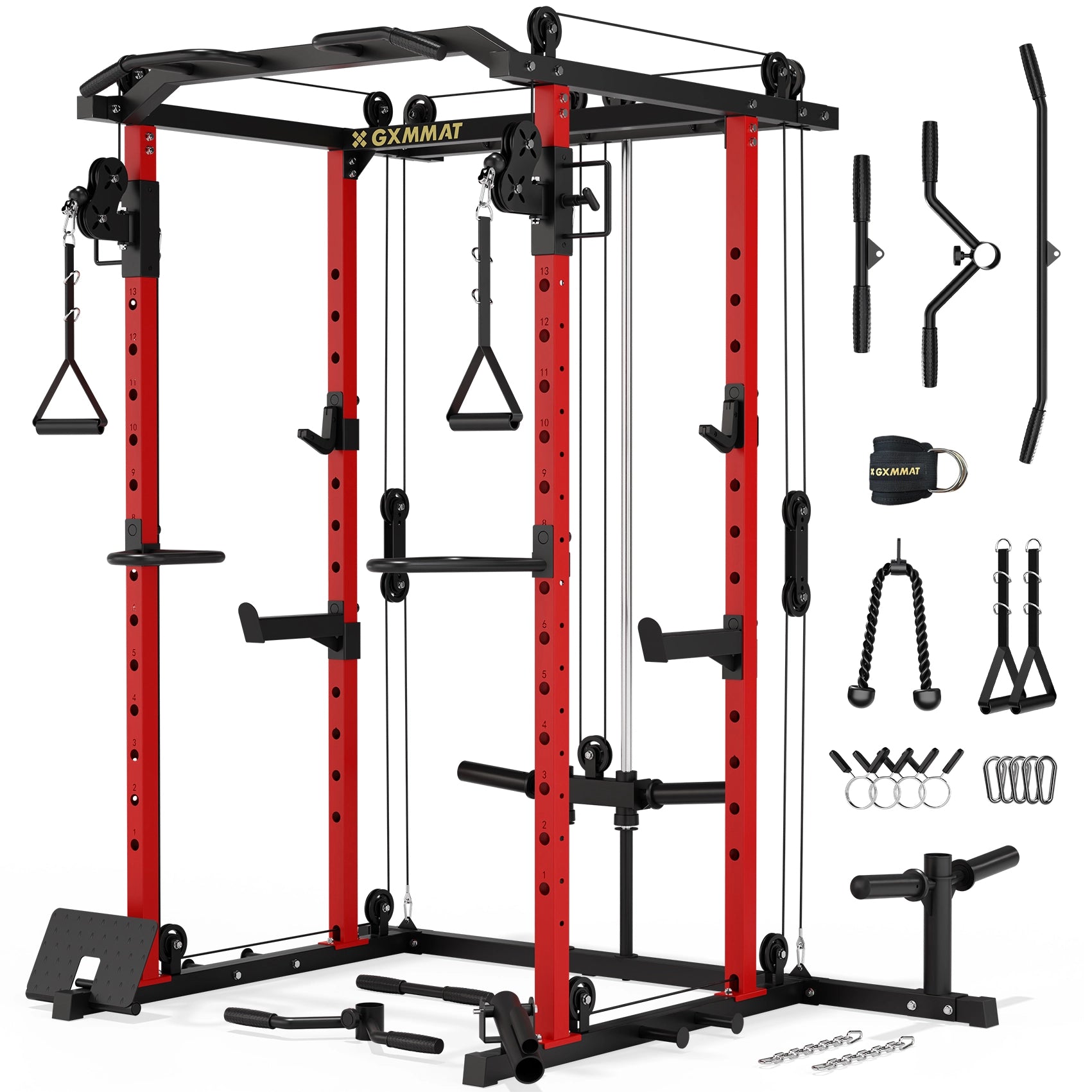
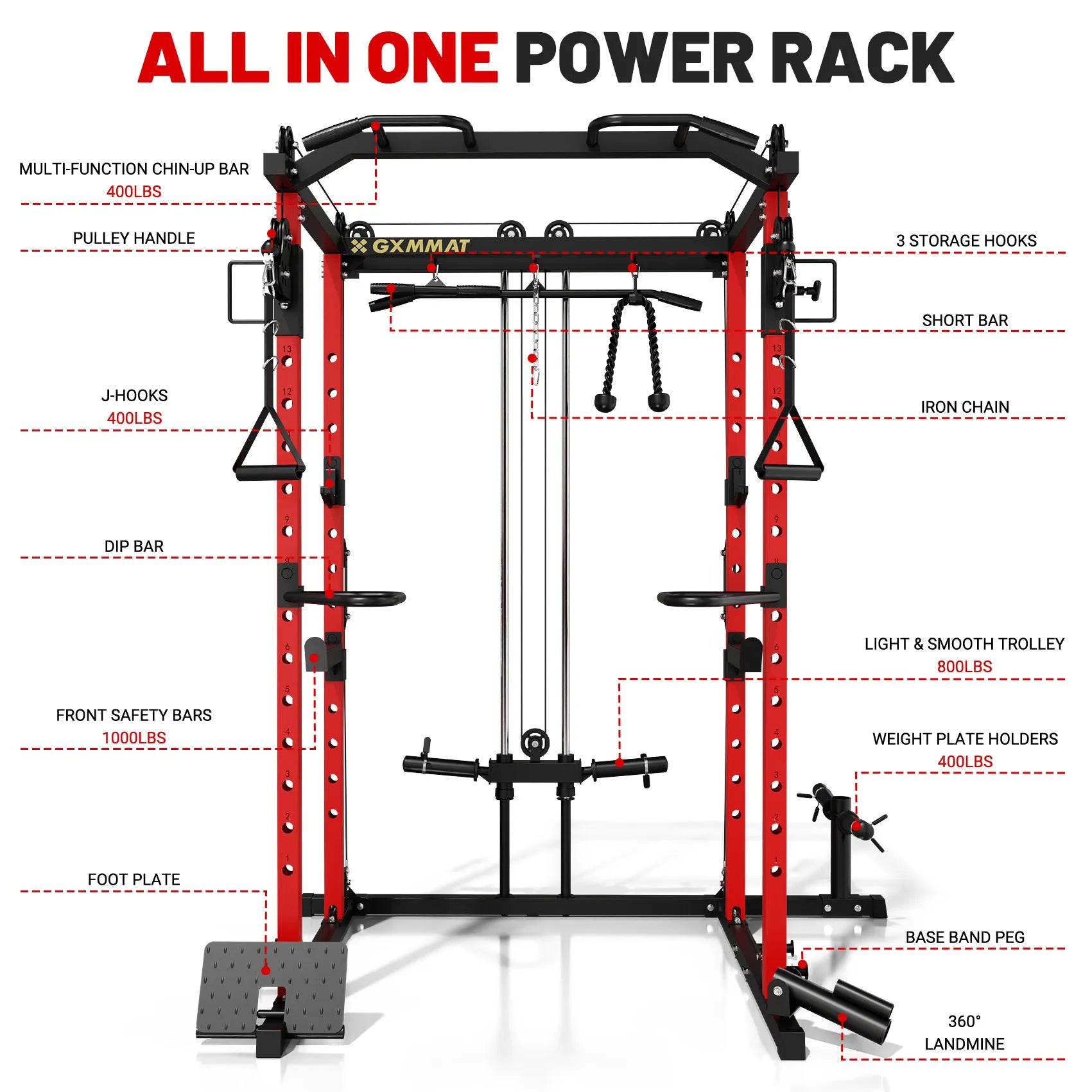
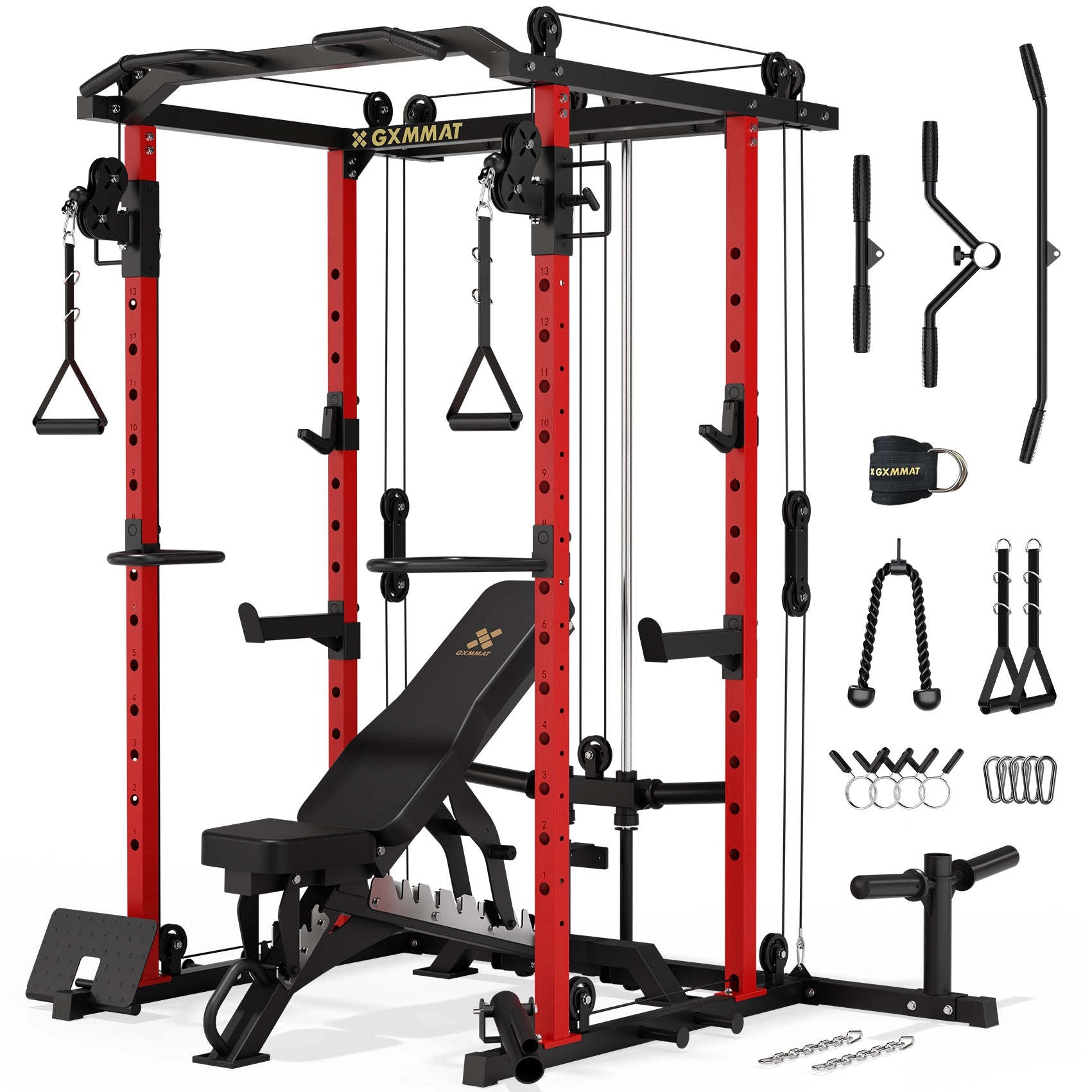
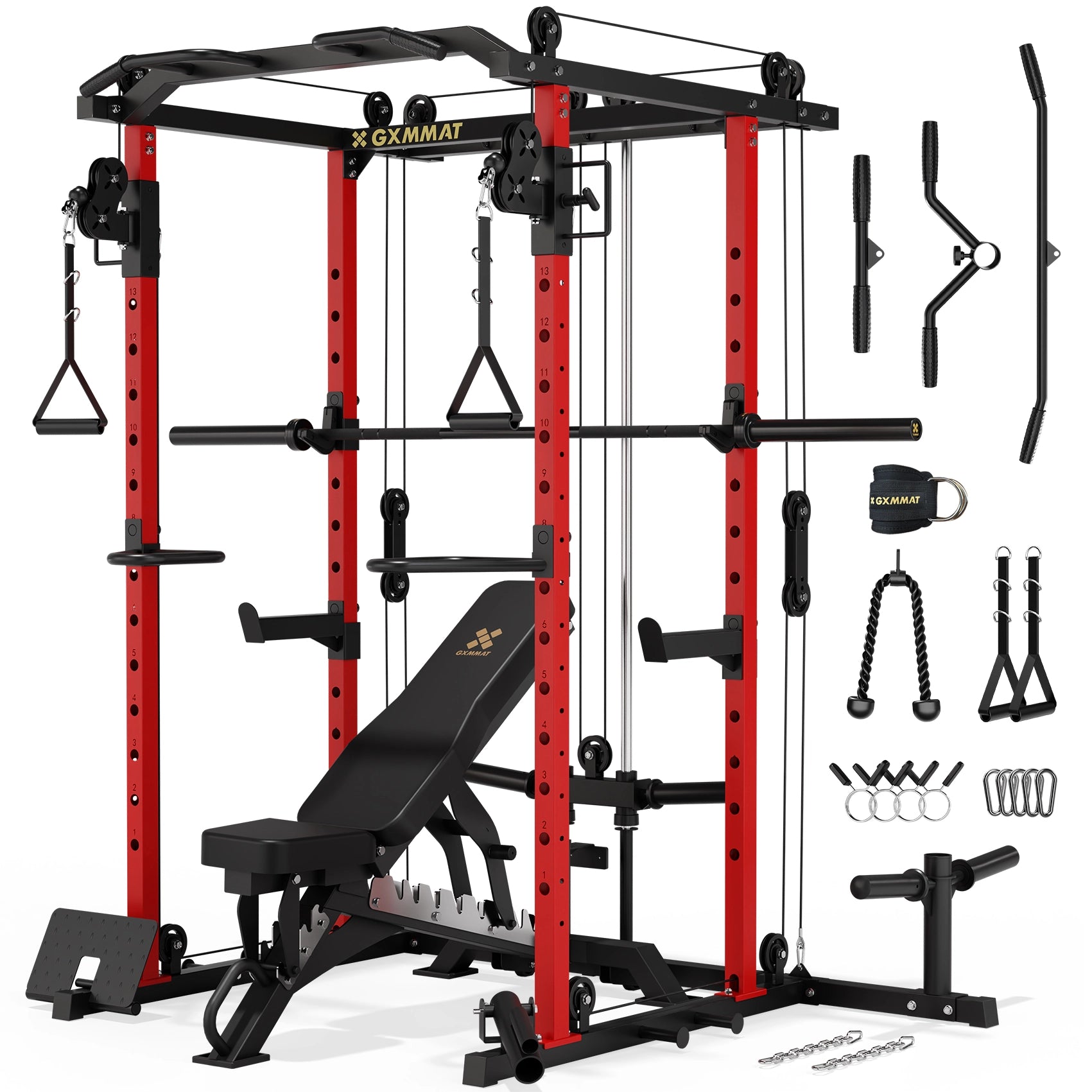
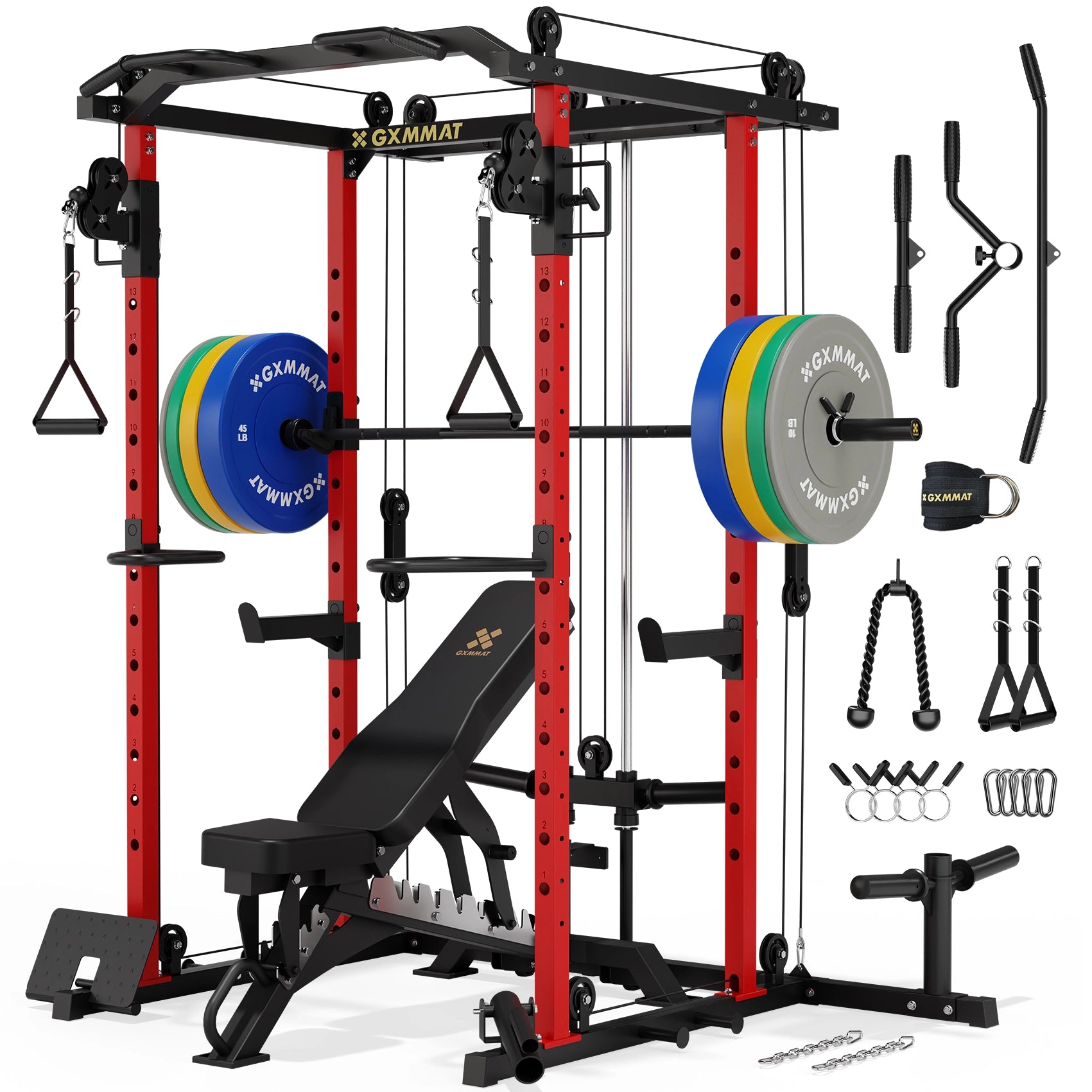
GXMMAT X6 Power Rack with pulley system features a sturdy 6-post design combined with a smooth dual cable system, providing a safe and reliable training experience for home fitness enthusiasts while also meeting the high performance demands of professional users. Whether you do basic strength exercises or advanced compound movements, our power racks for home gym will offer stable support and precise resistance control, helping you efficiently train all major muscle groups. With multiple accessories, it supports a variety of exercises such as squats, bench presses, shoulder presses, and cable exercises, making it an all-in-one function trainer. The key design highlights of X6 Power Rack are included below:
- All-aluminum Pulleys: Ensure a smoother and quieter pulling experience.
- Dual Cable System: Power rack with cable system provides more balanced resistance on both sides, allowing for bilateral training or dual-user workouts.
- 1:1 Pulley Ratio: Delivers precise resistance, the weight you load is the weight you get.
- External Cable Routing: Maintains rack expandability & prevents interference between attachments and cables.
- Compact Design: Minimizes footprint for home use.
With these design features, the X6 Power Rack is not only suitable for home use but also meets the needs of professional strength training, making it an ideal choice for both home gyms and professional gyms.
Based on different resistance sources, strength training equipment can be divided into three categories: cable-based machines, free weight frames, and bodyweight equipment. Compared with the other two categories, the advantages of power rack with cables are their ability to provide constant resistance throughout the entire range of motion, support more natural and versatile movement patterns, and allow users to safely train alone with adjustable resistance. They also enable a wide variety of exercises within a compact footprint, making them highly efficient for both home and commercial gyms.
Power racks and squat stands are both important tools for strength training commonly found in most gyms. Before setting up your home gym, it’s useful to know how squat stands differ from power racks, since they serve similar but not identical functions.
A power rack typically features four to six vertical posts, forming an open cage-like frame. The uprights of the power rack are equipped with supports for standard and specialty barbells at different heights. These supports include J-hooks and safety bars. You can secure the barbell at your desired height for easy lifting, and during heavy lifting, the safety bars can effectively catch the barbell if it happens to drop. The squat rack has a simpler structure, consisting of just two metal uprights, and is therefore also called a half rack.
Squat stands are primarily used for fundamental lifts like squats and bench presses. Power racks, on the other hand, offer greater versatility, allowing for exercises such as pull-ups, chin-ups, deadlifts, and rows in addition to the basics to effectively strengthen more muscle. Most power racks include safety bars that can be adjusted horizontally to enhance safety during heavy lifts. They can generally support heavier loads than squat stands, reducing the risk when training with large bumper plates.
Cable ratio refers to the relationship between the weight you load on a cable machine and the actual resistance you feel during the exercise. Common ratios include 1:1 and 2:1. With a 2:1 ratio, the cable moves 2 feet for every 1 foot the weight stack moves, so you will experience only half of the loaded resistance. With a true 1:1 ratio, the cable and the weight stack move the same distance, so you will experience nearly the same resistance as the weight loaded. If you’re strength-oriented, a true 1:1 ratio offers heavier resistance and you don't need to worry about how fast the cable moves. For those who prioritize functional training or rehabilitation training, 2:1 ratio is ideal since it provides smoother movement with lighter resistance. It can also keep the cable moving quickly which is great for stability and agility training.
Power Racks are equipment that have no fixed tracks or guided systems. Users can control the movement path and maintain balance by themselves, which makes them well-suited for heavy compound lifts such as squats, bench presses, and deadlifts.
While Smith Machine belongs to guided frames which also uses barbell as the resistance source but fixes it within steel rails, which limits its movement path during strength training exercises. This keeps balance, enhances safety and makes it the equipment more suitable for beginners, solo workouts, and fixed-path exercises.
During squats, bench presses, or other heavy lifts, the stability of a power rack mainly relies on the following design and structural features:
- Wide and heavy base: Lowers the center of gravity and prevents tipping.
- Thick steel construction: Made of high-strength steel, ensuring it does not bend or wobble under heavy loads.
- Crossbeams and support bars: The vertical posts are connected by horizontal crossbeams, combined with thick gusset plates and back plate, which evenly distributes weight, enhances overall rigidity, and keeps the rack stable during training.
- Firm contact with the floor: Non-slip feet or use floor mats to reduce movement and protect the floor.
- Even barbell weight distribution: During training, the barbell’s weight is evenly supported by the vertical posts, safety supports, and back plate, minimizing lateral sway.
WORKOUTS
A power rack is far more than just a squat stand- it’s a versatile training platform designed to help you build strength, sculpt your physique, and enhance athletic performance. By incorporating multi-angle and multi-plane exercises, you can activate all major muscle groups, break through plateaus, and achieve new levels of progress. You can refer to the following target muscle groups and corresponding exercises for focused training:
- Chest & shoulders: high cable fly, lateral & front raise.
- Back & arm: seated lat pulldown, half-squat row & seated row, biceps curl, face pull & cable high pull.
- Core & full-body: hanging knee raise, flat & seated bench press, rope triceps pushdown.
To maximize benefits and reduce injury risk, stand with your feet shoulder-width apart, hold the handle with one hand, and keep your arm by your side. Use a neutral grip with your palm facing down to maintain stability and control. Keep your shoulders relaxed and avoid shrugging as you lift your arm to shoulder height in a controlled motion, with a slight bend in the elbow. Focus on using your shoulder rather than your arm. Pause briefly when your arm is parallel to the floor to maximize tension, then slowly lower back to the starting position, keeping the muscle engaged. Precision and control ensure the lateral deltoid does the work while minimizing compensation from traps or other muscles.
- Control the Eccentric Phase: Slowing down the lowering portion of curls increases muscle damage and growth.
- Prioritize Full Range of Motion: Avoid partial reps; stretch and contract the biceps fully.
- Vary Your Grips: Switching between underhand, neutral, and wide grips targets different parts of the biceps.
- Avoid Excessive Swinging: Using momentum reduces biceps activation—keep movements strict.
Lat Pushdowns:
- Equipment & Position: Usually performed on a cable machine, standing or slightly leaning forward, pushing a weighted bar or handle from high to low.
- Target Muscles: Primarily targets the lower part of the latissimus dorsi and also engages the triceps as a secondary muscle.
- Training Focus: Ideal for isolating the lower lats and triceps, emphasizing controlled and precise movemen
Lat Pulldowns:
- Equipment & Position: Performed sitting on a lat pulldown machine with legs secured under the pads, pulling a bar or handle from high to chest.
- Target Muscles: Works the entire latissimus dorsi, especially the upper and middle portions, while also engaging the biceps and scapular muscles.
- Training Focus: Great for overall back development, increasing width and thickness, and mimicking pull-up movement.
In general, lat pushdowns are more for isolation and controlled movement, while lat pulldowns involve more overall back engagement and larger range of motion, closer to a pull-up.
Your best frequency depends on your primary goal. Here’s what research suggests:
- Improve Health & Fat Loss: Fat loss depends on energy balance. Spreading 150-300 minutes of weekly activity across multiple sessions is more sustainable and supports steady metabolic improvements. You can try 3-5 times per week.
- Maximize Muscle Growth & Strength: With the protein synthesis window lasting 24-48 hours, each muscle group should ideally be trained again within this time frame. You can try 2-3 times per muscle group per week.
- Improve Cardiovascular Endurance: Adaptations like stronger heart muscle and increased capillary density require consistent stimulus. Elite athletes may need 5-6 sessions weekly to maintain peak condition. You can try 3-6 times per week.
The length of rest periods between sets mainly affects the recovery of phosphocreatine, which typically takes about 2-5 minutes to fully replenish. Too short a rest period can lead to insufficient energy supply for fast-twitch muscle fibers. For compound movements such as squats, bench presses, and rows, it is generally best to rest for 2-3 minutes between sets. When your training intensity exceeds 85% of your 1RM or approaches a near-maximal single lift, rest periods can be extended to 3-5 minutes to allow for full recovery of creatine stores and neural drive. Of course, rest times can be adjusted according to your age, training intensity, and physical condition. In general, prioritize longer rest periods for your heaviest lifts, while smaller muscles worked in isolation exercises recover more quickly, usually requiring only 1-2 minutes of rest.
INSTALLATIONS
BLOGS