Your Single-Leg Barbell Hip Thrust Is a Balancing Nightmare (Fixed)
I remember the first time I tried a single-leg barbell hip thrust in my garage. I had my Ohio Bar loaded up, my bench shoved against the wall, and high hopes for a massive glute pump. Three seconds into the set, the bar tipped like a seesaw, nearly taking out my shins and definitely bruising my ego. It is a frustrating lift if you do not respect the physics involved.
- Bumper plates are mandatory for a consistent starting height.
- Your bench must be anchored or heavy enough not to slide backward.
- Grip the bar wider than you think to create more leverage.
- Center the bar over the working leg, not the middle of your pelvis.
Why a 7-Foot Barbell Hates Being on One Leg
The standard Olympic barbell is 7 feet long. When you do a traditional hip thrust, you have two points of contact—your feet—creating a stable, wide base. The moment you lift one foot, you have introduced a massive amount of lateral torque. The single leg barbell hip thrust essentially turns that 45-pound bar into a lever that desperately wants to rotate around your working hip.
Physics is not on your side here. Because the weight is distributed so far away from your center of gravity, even a tiny shift in your hips causes the bar to tilt. Most people fail this lift not because their glutes are weak, but because their core and stabilizers cannot fight the bar's desire to hit the floor. It is a balancing act that can feel more like a circus trick than a strength exercise if you are not careful with your setup.
How to Actually Stabilize a Single-Leg Hip Thrust With Barbell
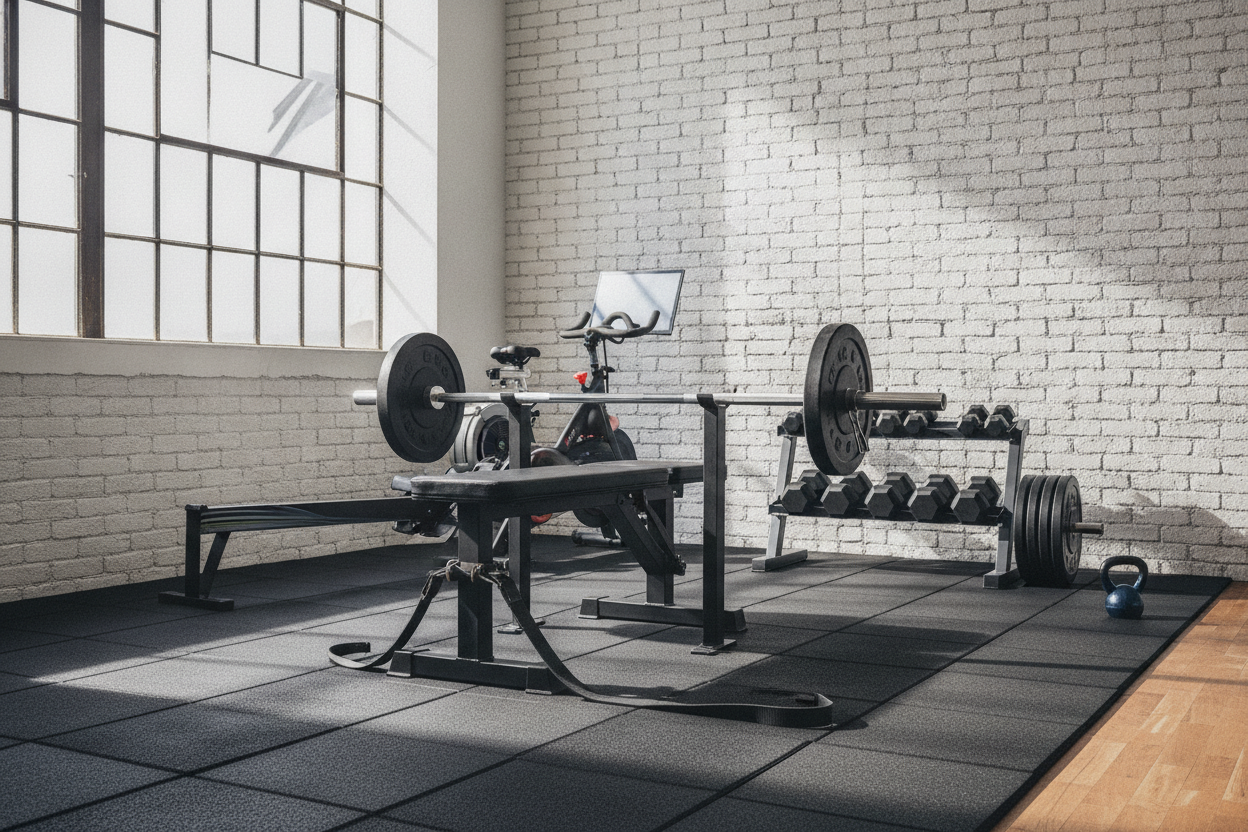
The setup is where most lifters blow it. You cannot just throw a bar on your lap and hope for the best. First, you need the right height. Using a full barbell and bumper plate set is the easiest way to ensure the bar sits high enough off the ground so you can actually get your legs under it without a struggle. Standard 450mm diameter plates are the non-negotiable gold standard here; anything smaller and you are pinned to the floor before you even start.
Once you are under the bar, do not center the barbell on your body. You need to shift the bar slightly toward the side of the working leg. This sounds counterintuitive, but it helps counteract the natural tilt of the bar. Your bench should hit you right at the bottom of the shoulder blades. If the bench is too high, you will never get the proper leverage to lock out the single-leg hip thrust with barbell at the top, and the bar will slide down your thighs.
The 'Death Grip' vs. The 'Guide Grip'
Stop trying to bench press the bar off your hips. I see a lot of people use a 'death grip,' white-knuckling the bar to keep it level. This just fries your forearms and distracts from the actual glute contraction. Instead, use a 'guide grip.' Place your hands wide on the knurling—almost at the collars—and use them to gently steer the bar as you move through the range of motion.
You are not lifting the weight with your hands; you are providing constant feedback to the bar. If you feel one side dipping, a slight pressure from that hand corrects it. Think of your arms as outriggers on a canoe. They are not the motor, but they keep you from flipping over in choppy water. Keep your chin tucked and eyes forward to help maintain this tension throughout the set.
When You Should Give Up on the Bar
I will be honest: some days, the barbell is just a nuisance for unilateral work. If you spend five minutes setting up and another three minutes wobbling through a set of five, you are not getting a good stimulus. If the instability is capping your intensity, it is time to pivot. You might find that you get a much better contraction if you try the 1 leg hip thrust instead using a heavy dumbbell, a kettlebell, or even a sandbag.
The barbell single leg hip thrust is a high-skill movement. If you have a history of lower back tweaks or if you find yourself twisting your spine to keep the bar level, ditch it. There is no trophy for using a barbell for every single exercise in your program. A stable muscle is a muscle that can be pushed to failure. If you are too busy balancing to actually reach failure, you are just doing junk volume.
Programming the Barbell Single Leg Hip Thrust
Treat this as an accessory, not a primary mover. You should not be maxing out on 1-leg thrusts. I like to program these in the 8-12 rep range. It is heavy enough to build strength but light enough that the balance is manageable. If you try to go for a 3-rep max, the barbell single leg hip thrust usually turns into a total mess of form breakdowns and safety hazards.
I usually slot these in after my heavy bilateral work like squats or deadlifts. If you want a brutal finisher, try supersetting these with a hip thrust with band. Use the barbell for the heavy, focused unilateral work to address imbalances, then immediately drop the bar and burn out with high-rep banded bilateral thrusts. Your glutes will be screaming by the end of the second set, and you will have hit both the mechanical tension and metabolic stress markers.
Personal Experience
I used to be a purist who thought dumbbells were for 'toning' and barbells were for 'real' building. Then I tried to load 135 lbs on a single-leg thrust. I spent more time chasing the bar as it rolled toward my toes than I did actually training. I eventually realized that using a smaller, fixed-weight bar or even a specialized hip thrust machine was way more effective for my goals. Don't let your ego dictate your equipment choice; if the 7-foot bar is fighting you, fight back by choosing a better tool.
FAQ
Can I use a pad with this?
Absolutely. In fact, you should. A thick foam pad or a rolled-up yoga mat protects your hip bones. Without it, the concentrated pressure on one side can be agonizing, which leads to you cutting the range of motion short to avoid pain.
Why does my non-working leg cramp?
Usually, it is because you are subconsciously tensing it to help with balance. Try to keep the non-working leg tucked toward your chest or held at a strict 90-degree angle. If it is flailing around in the air, it is going to throw your center of mass off and cause unnecessary tension.
Is the Smith machine better for this?
Unpopular opinion: Yes. For unilateral hip thrusts, the Smith machine removes the balance requirement entirely, allowing you to actually load the glute. If you have access to one, use it for your single-leg work and save the free-weight barbell for your heavy bilateral sets.