Your Gym Home Workout: The Pre-Exhaust Method
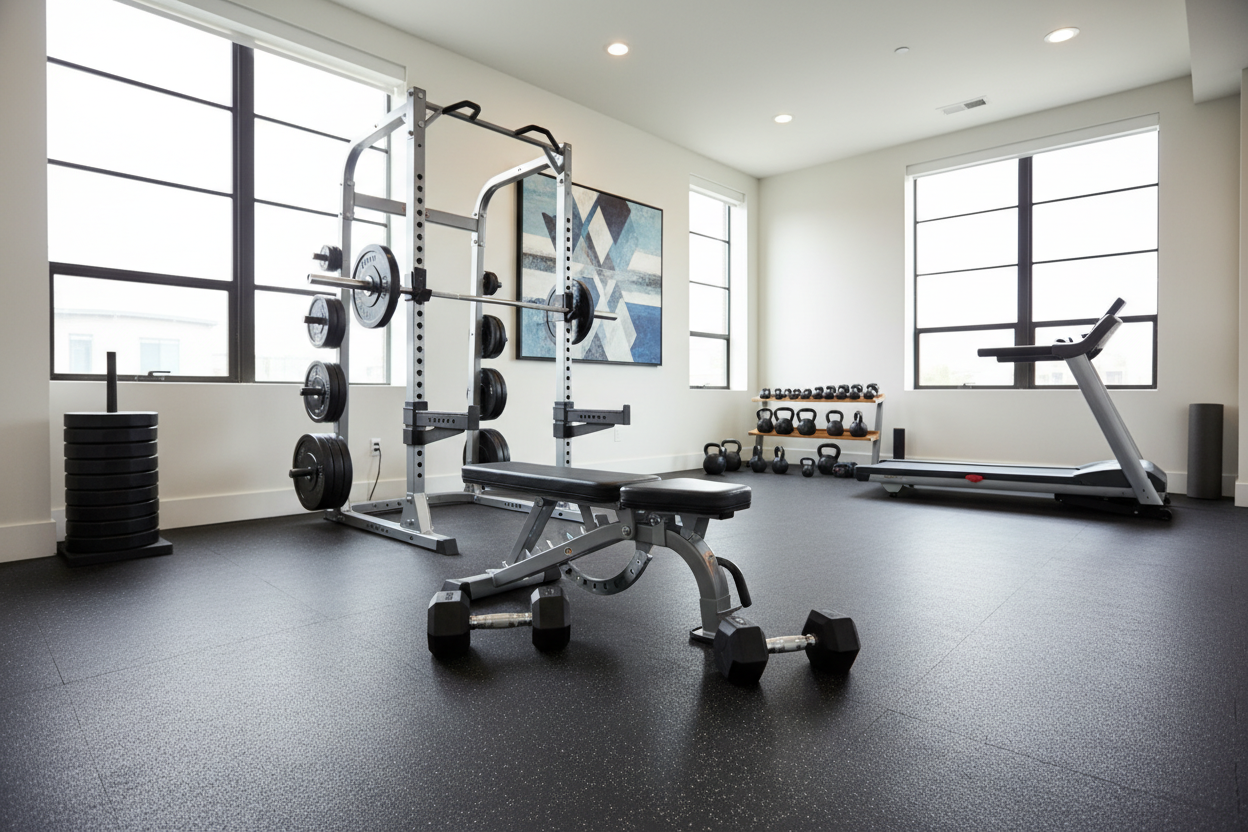
I remember the exact moment my spare bedroom setup stopped working for me. I was pressing my 50-pound adjustable dumbbells, hitting 15 reps, and barely breaking a sweat. Buying heavier plates or a bulky rack wasn't an option in that cramped 10x10 space. If you are stuck in this same frustrating plateau, you need a smarter approach to your gym home workout. You don't necessarily need heavier weights to force muscle growth; you just need to make the weights you already own feel significantly heavier.
This is where the pre-exhaustion method comes in. It is a programming strategy I use with my remote clients to push their muscles to the absolute limit without needing a commercial gym setup. Let's dig into how you can use this technique to break through your current plateau and trigger serious hypertrophy.
Quick Takeaways
- Pre-exhaustion forces your target muscle to fail before your supporting muscles do.
- Pair a single-joint isolation exercise immediately with a multi-joint compound movement.
- You can maximize hypertrophy using lighter dumbbells (up to 50 lbs) or just your body weight.
- Keep transition times between exercises under 10 seconds to maintain metabolic stress.
Why Your Home Setup Feels Too Light
When you first start lifting at home, a pair of 25-pound dumbbells feels like a ton of bricks. But muscles adapt fast. Within a few months, those same weights feel like warm-ups during squats, rows, and presses. The problem isn't that you aren't working hard. The issue is mechanical advantage. During compound movements like a push-up or a goblet squat, your body recruits multiple muscle groups to move the load efficiently.
If you are squatting a 50-pound dumbbell, your powerful glutes and quads are sharing the work. They can handle a lot more than 50 pounds. This is the common plateau where home trainees think they need to drop thousands of dollars on a power rack and Olympic plates.
Instead, I teach my clients the pre-exhaustion method. It is the ultimate workaround for limited equipment. By fatiguing the primary mover first, you artificially lower its strength ceiling. Suddenly, that 50-pound dumbbell feels like 150 pounds. Because you are pushing your muscles to absolute failure, safety becomes a priority. You will be dropping weights and collapsing out of reps. Setting up a solid foundation is non-negotiable, which is why I always have my clients start by laying down a high-quality large exercise mat for home gym use to protect their floors and joints when they hit that point of muscular failure.
The Mechanics of Pre-Exhaustion
Let's break down the science of why this works so well. In a traditional workout, you perform your heavy, multi-joint exercises first when you are fresh. Think barbell bench presses or heavy squats. Your triceps assist your chest during the press, and your lower back assists your legs during the squat.
The flaw in this traditional setup for home lifters is the weak link principle. If your triceps fatigue before your chest, your set ends. Your chest never receives the stimulus it needs to grow because the smaller assisting muscle gave out first. You rack the weight knowing your chest could have done more.
Pre-exhaustion flips this script. You perform a single-joint isolation movement targeting the primary muscle right before the multi-joint compound movement. For example, you do dumbbell flyes to isolate the chest, taking the pecs close to failure without involving the triceps.
Immediately after the flyes, you switch to push-ups. Now, your chest is pre-fatigued, but your triceps are completely fresh. As you perform the push-ups, your fresh triceps can easily push your exhausted chest to absolute muscular failure. The target muscle fails first, exactly as intended.
This creates immense metabolic stress and mechanical tension without requiring massive loads. I have tested this with dozens of clients who were convinced they needed heavy barbells. After one properly executed pre-exhaust superset, their muscles were trembling under loads they used to warm up with.
Structuring Your Routine for Maximum Fatigue
Programming this method requires a bit of strategic thinking. You can't just throw random exercises together and expect results. Effective gym training home routines rely on pairing the exact biomechanical patterns. You want the isolation movement to directly feed into the compound movement with zero redundant overlap. If you pair two compound movements together, you are just doing a cardiovascular circuit, not a targeted pre-exhaust superset.
Upper Body Pairings: Chest and Back
For the chest, the classic pairing is the resistance band fly followed immediately by a push-up or floor press. Grab a light resistance band, anchor it to a sturdy door, and perform 15 to 20 slow, controlled flyes. Squeeze your pecs hard at the peak contraction. The moment you hit failure, drop the band and hit the floor for push-ups. You might normally bang out 30 push-ups, but after the flyes, you will be lucky to hit 8 reps.
For the back, target the lats with a straight-arm pullover. You can do this lying on the floor with a single medium-weight dumbbell. Keep your arms relatively straight and pull the weight from behind your head over your chest. Once your lats are burning, immediately transition into an inverted row using a sturdy table or a suspension trainer hanging from your door. Your biceps, which are completely fresh, will help pull your exhausted lats through the movement, ensuring maximum hypertrophy.
Lower Body Pairings: Legs and Glutes
The lower body is notoriously hard to fatigue without a barbell. Pre-exhaustion is your best friend here. To fry your quads, start with a banded leg extension. Sit on a chair, loop a heavy resistance band around the back legs and your ankles, and extend. Do this until your quads feel like they are on fire, usually around 20 reps.
Immediately stand up and perform Bulgarian split squats or walking lunges holding your heaviest dumbbells. Your quads will be so depleted that the 30 pounds in your hands will feel like a 135-pound barbell.
For the posterior chain, perform unweighted, single-leg glute bridges, pausing for three seconds at the top of each rep. Once your glutes are screaming, transition into dumbbell Romanian deadlifts. Because your legs will literally give out beneath you during these supersets, traction is critical. I've slipped doing heavy lunges on a sweaty hardwood floor, tweaking my knee in the process. Now, I do all my lower body pre-exhaust work on a 6x8ft exercise mat gym flooring to ensure my feet stay planted when my legs start shaking.
Essential Gear for Pre-Exhaust Routines
You don't need a massive budget to make this work, but you do need a few versatile tools. First, a set of adjustable dumbbells is invaluable. Something that goes from 5 to 52.5 pounds is a sweet spot for most home trainees. You need the lighter weights for the isolation movements and the heavier settings for the compound lifts.
Second, invest in a set of loop resistance bands. Bands provide ascending resistance, which is incredible for isolation movements like flyes, lateral raises, and leg extensions. They take up zero space and cost less than a single dumbbell.
Finally, you need a supportive surface. As I mentioned earlier, reaching true muscular failure means you will occasionally drop a weight or collapse out of a push-up. A thick, high-density mat protects your joints and your property. While this minimalist setup is highly effective, some of my clients eventually want to expand their setups. If you have the space and budget to upgrade later, incorporating the best weight training machines can make isolating those specific muscles even easier. But for now, bands and dumbbells will absolutely get the job done.
A Sample Home Gym Strength Workout
Ready to put this into practice? Here is a complete home gym strength workout utilizing the pre-exhaust method. Perform this routine as a full-body session twice a week.
The rule is simple: perform Exercise A (the isolation), then immediately perform Exercise B (the compound). Rest for 90 seconds, then repeat for a total of 3 sets per pairing.
- Superset 1 (Chest): Resistance Band Flyes (15-20 reps) into Push-ups (to failure).
- Superset 2 (Quads): Banded Leg Extensions (15-20 reps) into Dumbbell Goblet Squats (10-12 reps).
- Superset 3 (Back): Dumbbell Pullovers (12-15 reps) into Dumbbell Bent-Over Rows (8-10 reps).
- Superset 4 (Hamstrings/Glutes): Lying Banded Hamstring Curls (15-20 reps) into Dumbbell Romanian Deadlifts (10-12 reps).
- Superset 5 (Shoulders): Dumbbell Lateral Raises (15-20 reps) into Dumbbell Overhead Press (8-10 reps).
Keep the transition time between Exercise A and B under 10 seconds. If you take too long to set up your goblet squat after the leg extensions, your quads will recover, and the pre-exhaust effect is lost. Have your dumbbells loaded and sitting right next to you before you start the isolation set. If you want to dive deeper into programming beyond this specific split, I highly recommend checking out a complete home gym training guide to structure your entire week of training.
Avoiding Common Pre-Exhaust Mistakes
The biggest mistake I see clients make with this method is resting too long between movements. I have watched people finish their dumbbell flyes, take a sip of water, change the song on their phone, and then start their push-ups. By then, the chest has cleared the lactic acid and recovered its ATP stores. The transition must be instantaneous.
Another common error is going too heavy on the isolation exercise. The goal of the first movement isn't to set a personal record; it is to create deep, localized fatigue. If you use too much weight on a dumbbell pullover, your triceps and shoulders will take over, defeating the purpose. Use a light-to-moderate weight and focus on a deep stretch and a hard squeeze.
Lastly, be smart about failure. When you pre-exhaust your legs and go into a heavy lunge, your stabilizing muscles are going to struggle. Keep your core braced, wear flat-soled shoes or lift barefoot on a grippy mat, and never sacrifice your spinal alignment just to squeeze out one more rep.
Is pre-exhaustion better for building muscle or strength?
It is primarily a hypertrophy (muscle building) tool. Because you are artificially fatiguing the muscle, your overall strength output on the compound lift decreases, making it less ideal for raw powerlifting strength but perfect for forcing muscle growth with lighter weights.
How often should I use the pre-exhaust method?
I recommend using it for 4 to 6-week training blocks. It is highly taxing on your central nervous system. After a mesocycle of pre-exhaustion, switch back to standard straight sets to allow your body to recover.
Can I do pre-exhaustion with just bodyweight?
Yes. You can isolate the triceps with bodyweight skull crushers against a wall, then immediately perform close-grip push-ups. Or you can do single-leg glute bridges before transitioning into bodyweight squats.