Your Fitness Gym Workout at Home: The Power of Tempo
I remember staring at a dusty pair of 20-pound dumbbells in my cramped one-bedroom apartment during the 2020 lockdowns. I was used to loading up 315 pounds on a barbell, and I thought those light weights were practically useless for maintaining muscle mass. I was entirely wrong. The secret to replicating a heavy fitness gym workout in your living room isn't buying hundreds of pounds of cast iron plates—it is mastering the clock. Your muscles do not have eyes; they only understand mechanical tension and metabolic stress.
When you learn how to manipulate rep speed, those lightweight dumbbells suddenly feel like massive kettlebells. I have helped dozens of clients build impressive physiques in 10x10 foot spare bedrooms simply by changing how fast they move the weight. It requires discipline, but the results speak for themselves.
Quick Takeaways
- Time-under-tension (TUT) forces light weights to recruit maximum muscle fibers by eliminating momentum.
- A 3-1-3-1 tempo means 3 seconds lowering, a 1-second pause, 3 seconds lifting, and a 1-second squeeze.
- High-traction, dense flooring is mandatory when moving slowly to protect joints and maintain strict stability.
- Hybrid routines let you save heavy barbell lifts for the commercial facility and do high-tension burnout work at home.
- You can apply progressive overload by adding seconds to your reps before you ever need to buy heavier dumbbells.
Why Tempo Beats Tonnage for Home Training
To understand why lifting slowly works, we need to look at the biomechanics of a standard repetition. When you grab a 50-pound dumbbell and heave it up for a bicep curl, momentum is doing a massive percentage of the work. The actual time your muscle fibers are under maximum tension might be less than half a second per rep. If you take a 20-pound dumbbell and force yourself to lower it over four agonizing seconds, your muscle fibers are forced to brake the load continuously.
This continuous braking creates micro-tears and a massive buildup of metabolic stress, which are the primary drivers of muscle hypertrophy. I tested this extensively with a client who only had a 5-52.5 lb adjustable dumbbell set. He was convinced he would lose his chest gains without a heavy bench press. By shifting from standard 1-second reps to 4-second eccentrics (the lowering phase), we triggered the exact same hypertrophy markers as his heavy commercial sessions.
The science of time-under-tension (TUT) shows that a set lasting 40 to 60 seconds is the sweet spot for muscle growth. If you do 10 fast reps, your set is over in 15 seconds. If you do 8 slow, controlled reps, you easily hit that 50-second mark. There is one honest downside I always warn my clients about: tempo training hurts. The lactic acid buildup is mentally grueling. Your brain will scream at you to drop the weight or speed up the rep. It requires a level of mental fortitude that heavy, fast lifting simply does not demand.
Adapting Your Gym Fitness Workout for Slower Tempos
Converting your standard routine into a tempo-based home session requires a bit of mathematical adjustment. You cannot just take your normal gym fitness workout and apply a slow tempo to the same rep scheme, or you will burn out halfway through the first set. If your program calls for 3 sets of 10 barbell rows at 135 pounds, you need to recalibrate for the 30-pound dumbbells you have at home.
Instead of 10 fast reps taking 20 seconds, you will aim for 8 reps at a 4-0-2-0 tempo. This means you pull the weight up in two seconds, do not pause at the top, lower it for four agonizing seconds, and immediately pull it back up from the bottom. This keeps the lat muscles under continuous tension for nearly 50 seconds per set. When I help clients transition their programming, we usually start by taking a basic gym workout plan and simply multiplying the eccentric lowering phase by three.
You keep the exact same exercises—squats, deadlifts, presses, and rows—but the execution speed drops drastically. You will also need to adjust your rest periods. Because tempo training creates so much local metabolic stress and lactic acid, your muscles need slightly longer to flush the waste products. I recommend bumping your rest periods from the standard 60 seconds up to 90 or even 120 seconds between these high-tension sets. This ensures you have the cellular energy required to maintain that strict 4-second lowering phase on your next set without breaking form.
Essential Floor Space for Tempo-Based Routines
When you lift slowly, your base of support becomes hyper-critical. A fast, explosive lunge relies on momentum to bounce out of the bottom position. A slow, 4-second descending lunge requires intense foot traction, ankle mobility, and joint stability. If you attempt these slow movements on a slippery hardwood floor or a cheap, squishy 1/2-inch yoga mat, your ankles will wobble. The moment you lose stability, your central nervous system throttles down muscle recruitment to protect your joints.
You need a dedicated, high-density surface that grips both your shoes and the subfloor. Getting a large exercise mat for home gym use is usually my very first recommendation to clients, even before we discuss buying adjustable weights. I specifically use a 6x8ft exercise mat in my own garage setup because it gives me 48 square feet of grippy, 7mm thick shock absorption.
That specific footprint is vital. It is wide enough for deep lateral lunges, wide-grip push-ups, and sprawling out for tempo planks without my sweat pooling on the living room rug. Furthermore, a dense 7mm mat allows you to train barefoot safely. Barefoot tempo training is incredible for strengthening the intrinsic muscles of the feet and improving your overall balance. When you are taking five seconds to descend into a goblet squat, feeling the floor through your toes provides crucial proprioceptive feedback that soft running shoes completely mask.
Top Fitness Gym Exercises Transformed by Tempo
Let us look at a specific fitness gym exercise: the Bulgarian split squat. Normally, you might hold a 60-pound dumbbell in each hand and crank out 10 reps. At home, grab two 15-pound dumbbells. Apply a strict 3-1-3-1 tempo. Lower your back knee toward the floor for 3 seconds, pause for 1 full second at the absolute bottom stretch, rise smoothly for 3 seconds, and squeeze the quads for 1 second at the top. Suddenly, 30 total pounds feels like 150. Your glutes and quads will be on fire by rep six.
Other fitness gym exercises transform just as effectively. Take the standard push-up. Most people bounce off their chest and lock out their elbows to rest at the top. Instead, take 4 seconds to lower your chest to the floor, pause for 2 seconds hovering just one inch above the mat, and press up in 2 seconds. Stop just short of locking your elbows to keep the tension entirely on the pectorals. A set of 10 tempo push-ups will stimulate more chest growth than 30 sloppy, fast reps.
Dumbbell rows are another perfect candidate. When you use momentum to yank a heavy dumbbell to your hip, your lats miss out on the deep stretch. Use a lighter weight, pull it up in 1 second, hold it against your ribcage for a 2-second isometric squeeze, and lower it over 4 seconds. You will feel your lat fibers tearing in the best way possible. This method forces you to eliminate the bounce at the bottom of every movement, which is exactly where most trainees cheat themselves out of legitimate muscle gains.
Structuring Your Fitness Workout at Gym vs. Home
Many of my most successful clients run a hybrid training schedule. They do not view home workouts as a replacement for the commercial facility; they view them as a different tool altogether. They might do their heavy, central nervous system-taxing lifts during their fitness workout at gym facilities on Monday and Wednesday. Think heavy barbell deadlifts, heavy bench presses, and hack squats where absolute load and moving heavy iron matters.
Then, on Tuesday and Thursday, they stay home for tempo-based hypertrophy work. This saves commute time, allows them to train early in the morning or late at night, and spares their joints from constant heavy loading. Heavy lifting beats up the connective tissues; tempo lifting with light weights flushes those tissues with blood and nutrients, aiding recovery while still building muscle.
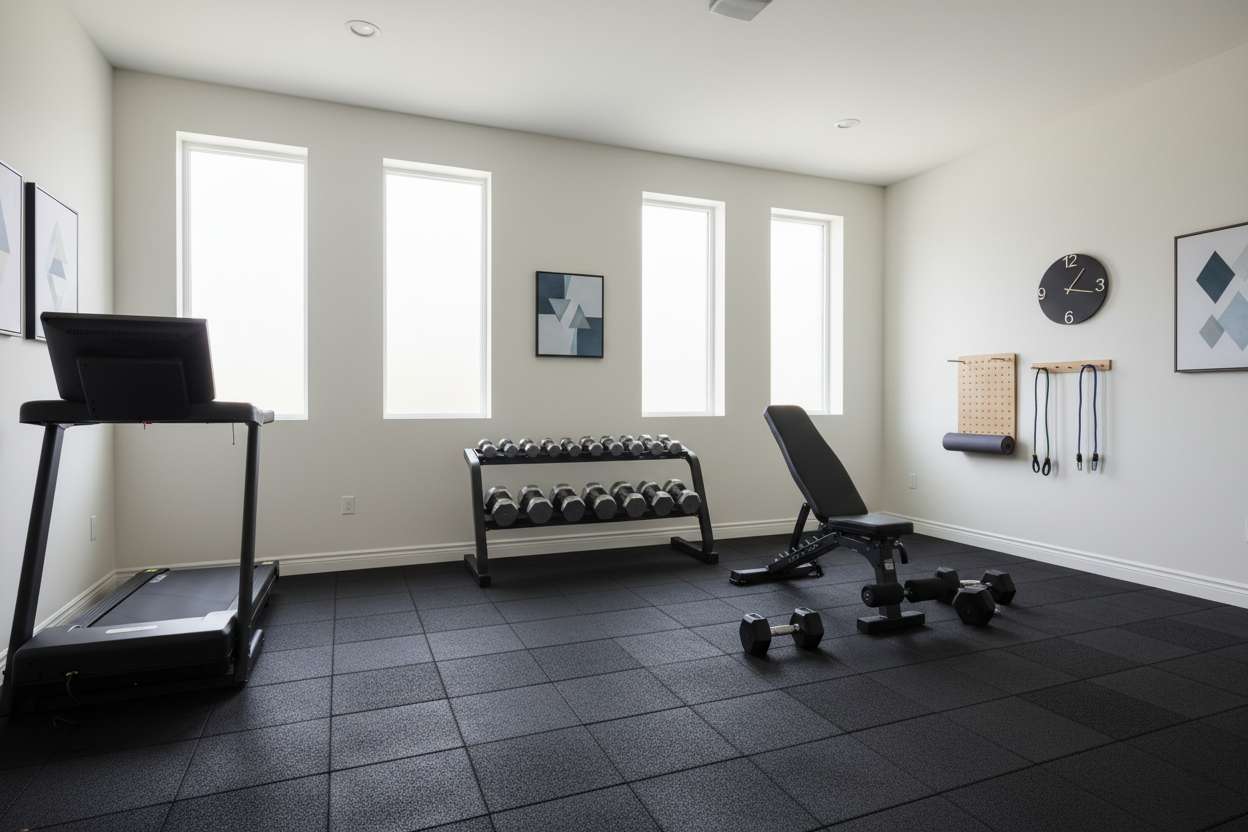
If you want to elevate your home gym setup, build it to complement your commercial membership, not duplicate it. Buy a great set of adjustable dumbbells ranging from 5 to 50 pounds, a set of variable resistance bands, and a massive, dense floor mat. Leave the massive power racks and cable crossovers to the commercial facility. Use your home space specifically for high-tension, strict-form isolation work and slow eccentric training.
Maximizing Results with Minimal Gear
Before you rush out to buy heavier plates because your home workouts are starting to feel too easy, check your stopwatch. Progressive overload does not just mean adding physical weight to the bar. You can add time to the muscle. If a 3-second negative on a dumbbell shoulder press gets easy, push it to 5 seconds.
Add a 3-second pause at the bottom of a goblet squat to completely kill the stretch reflex. Master the tempo, control the tension, and respect the clock. By manipulating time, you will squeeze every ounce of muscle-building potential out of the lightest weights in your living room, proving that technique always triumphs over tonnage.
Does tempo training build as much muscle as heavy lifting?
Yes, provided you take the sets close to muscular failure. Hypertrophy requires mechanical tension and metabolic stress. You can achieve this with heavy weights for short durations, or lighter weights for longer, controlled durations.
How do I read a tempo prescription like 3-1-X-0?
The first number is the eccentric (lowering) phase. The second is the pause at the bottom. The third is the concentric (lifting) phase (X means explosive or as fast as possible). The fourth number is the pause at the top.
Can I do tempo training with just my body weight?
Absolutely. Slowing down bodyweight push-ups, squats, and pull-ups is one of the most effective ways to break through plateaus without needing to buy a weighted vest or specialized equipment.