Workouts for Home: Mapping Exercises to Your Floor Plan
I still remember watching a client try to do lateral bounds in a tiny 10x10 foot apartment. They ended up kicking a coffee table, knocking over a lamp, and twisting an ankle. That was the exact moment I realized that most people fail at workouts for home not because they lack discipline, but because they fight their floor plan. They try to cram sprawling, gym-style routines into spaces that physically cannot handle them.
Instead of buying more folding treadmills or adjustable dumbbells you don't have room for, the secret to sustainable home training is spatial mapping. This means categorizing your movements based on the exact dimensions of the room you're standing in. Once you stop fighting your architecture and start working with it, your training will completely transform.
Quick Takeaways
- Assess your square footage before choosing your exercise selection to prevent injury and property damage.
- Use narrow hallways for linear movements like walking lunges, broad jumps, and bear crawls.
- Reserve your living room for multi-directional agility, lateral bounds, and sprawling circuits.
- Utilize slow-burn isometrics and vertical jumps in confined bedrooms where horizontal space is zero.
- Protect your joints and floors with heavy, properly sized mats designed to match the room's footprint.
Why Your Floor Plan Dictates Your Fitness Routine
When I design a program for a client, the first question I ask isn't about their one-rep max. I ask for the square footage of their workout area. Understanding the physical boundaries of your environment changes everything. If you have a 3-foot clearance between your couch and TV, programming wide-stance sumo squats or lateral kettlebell swings is a recipe for disaster. By analyzing your layout, you can create sustainable exercise at home workouts that actually feel fluid and natural.
Think of your house as a series of specialized training zones. A commercial gym has a turf strip for sled pushes and a squat rack for vertical lifting. Your house has a long hallway and a cramped bedroom. It's the exact same concept, just scaled down. When you stop trying to do everything in one spot, you stop feeling boxed in.
For a broader overview of setting up your space and selecting basic equipment, I always point my clients to a complete home training guide to establish a solid baseline. Once you have that foundation built, spatial mapping becomes your greatest asset. You will start seeing your kitchen island as a sturdy pivot point for mobility work and your narrow corridors as the perfect track for high-rep locomotion drills.
The Hallway Protocol: Mastering Linear Movements
Hallways are the most underutilized fitness zones in modern homes. Most people just walk through them, but from a training perspective, a standard 36-inch wide, 10-foot long corridor is a goldmine for linear fitness at home exercises. Because you lack lateral width, you are forced to focus purely on forward and backward locomotion. This is exactly where you build functional endurance and unilateral leg strength.
I program what I call the Hallway Protocol for clients who need to get their heart rate up without waking up the neighbors. Start with walking lunges. A typical hallway allows for about 4 to 5 deep walking lunges before you have to turn around. Do 10 lengths of that, and your quads will be burning. You can also incorporate broad jumps, requiring you to explode horizontally. Because the walls act as physical barriers, they naturally correct your form. If you jump crooked, you'll brush the drywall, forcing your body to learn straight, efficient power delivery.
Bear crawls are another massive win in this zone. Dropping down into a crawl engages your core, shoulders, and quads simultaneously. I will have clients set a timer for 5 minutes, crawling forward down the hall and reversing backward to the starting point. It requires zero equipment and zero lateral space, yet it yields a massive metabolic response. The key is keeping your hips low and your knees just one inch off the ground. If you want to add load, grab a single 15-pound dumbbell or a heavy textbook and do overhead walking lunges. The narrow space keeps you hyper-focused on your midline stability.
The Living Room Circuit: Multi-Directional Freedom
Your living room is likely the largest open area in your house. Usually, clearing the coffee table gives you roughly a 6x6 to 8x8 foot box of usable space. This is your multi-directional hub. Unlike the hallway, the living room allows for sprawling, lateral movements. This is where you want to program your wide-stance agility drills, lateral bounds, side lunges, and sprawling burpees.
When you have the width to move side-to-side, you can train your frontal plane. Most people completely neglect lateral training, which leads to weak glute medius muscles and nagging knee pain. I love programming 30-second intervals of skater jumps across the living room floor. You get to push off hard, float for a second, and stick the landing. To make this safe and effective, you need proper traction. Sweaty palms or socks on hardwood floors will lead to a slipped disc or a busted chin.
For this specific zone, I always recommend throwing down a 6x8ft exercise mat. It perfectly fills the void left by a moved coffee table and provides enough grip for explosive lateral direction changes. In this space, you can also run high-intensity circuits. Think kettlebell swings, Turkish get-ups, or sprawling push-up variations. Because you aren't boxed in by walls on your immediate left and right, your shoulders and hips have the freedom to move through their full ranges of motion. I often have clients do a Four Corners drill here: placing a marker at each corner of their mat and shuffling diagonally, backward, and laterally to touch each point. It mimics the agility work of a heavy field session right in front of your television.
The Confined Bedroom: Vertical Density Training
Bedrooms are notoriously difficult for training. You usually have a bed, a dresser, and maybe a desk, leaving you with a tiny strip of floor space, often no wider than 3 or 4 feet. When executing a high-intensity fitness workout in home environments with strict spatial limitations, you have to shift your mindset from horizontal distance to vertical density. You can't move out, so you must move up and down.
This is the domain of the squat, the vertical jump, and the strict push-up. Since you don't have the space to do jumping jacks or burpees without hitting the bed frame, we manipulate time under tension instead. Slowing down your movement speed is brutal. If you do a bodyweight squat but take 5 seconds to go down, pause for 3 seconds at the bottom, and take 5 seconds to stand up, 10 reps will leave you shaking. Understanding the power of tempo is crucial when you lack the physical space for explosive agility drills.
I personally tested this vertical density concept during a two-month stint living in a tiny studio apartment. I used a 6x4ft yoga mat wedged right between my bed and the wall. It was exactly enough room to stand and lay flat. My routine consisted of strict handstand push-ups against the wall, pistol squats, and hollow body holds. The one honest downside to this setup is the mental claustrophobia; staring at the side of your mattress while sweating isn't exactly inspiring. But physically, it works. You learn to generate immense internal tension without needing an inch of extra clearance.
Grounding Your Routine: The Safety Infrastructure
No matter how well you map your exercises to your floor plan, the actual surface you are standing on dictates your safety. I have seen too many clients try to do jump squats on slippery tile or heavy 50-pound dumbbell deadlifts on plush carpet. Carpet absorbs impact but destroys your ankle stability. Hardwood looks great but will wreak havoc on your knees and lower back over time.
When you are performing a rigorous fitness exercise workout at home, you need to build a safety infrastructure from the ground up. High-density foam or rubberized flooring provides the necessary shock absorption for your joints while maintaining a firm enough surface for heavy lifting and balance work. If you plan to make this a long-term habit, stop relying on flimsy 3mm yoga mats that bunch up every time you do a mountain climber. You need serious grip and mass to handle 1000+ reps over a training block.
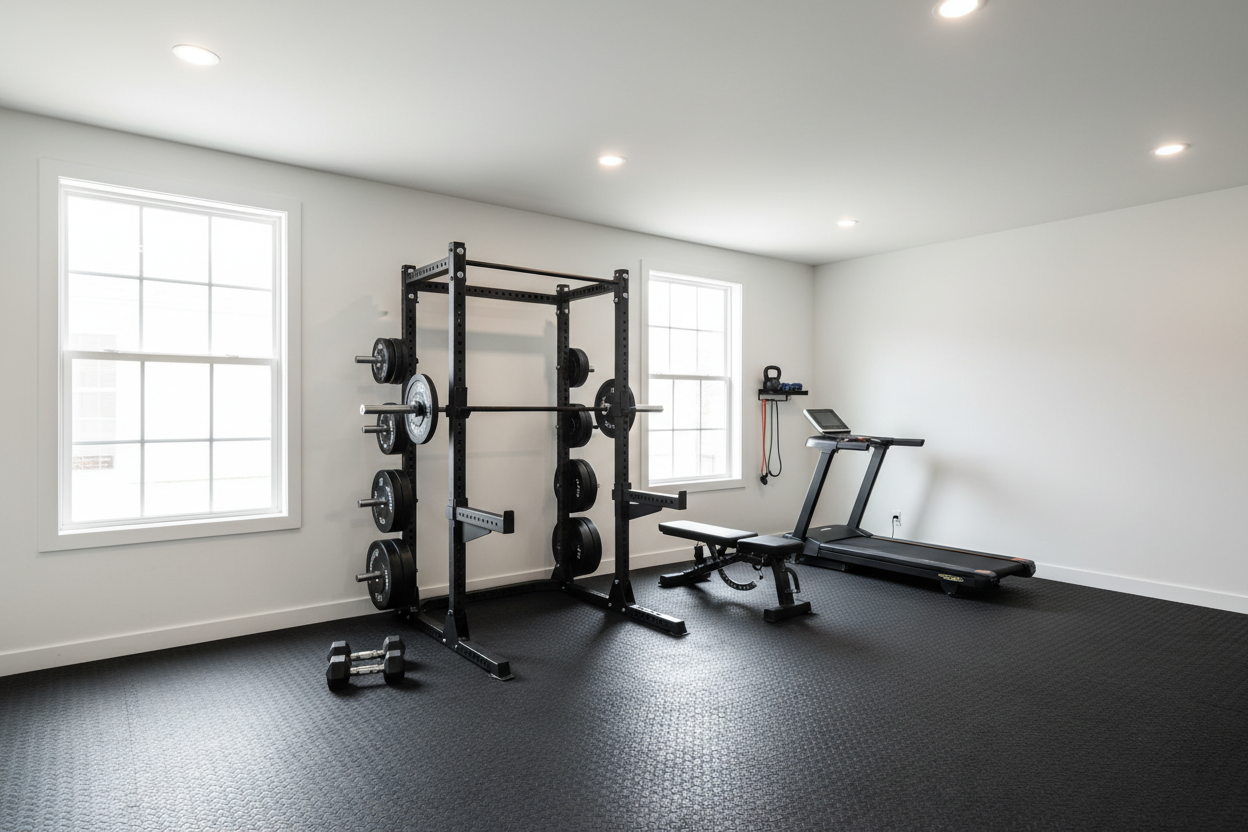
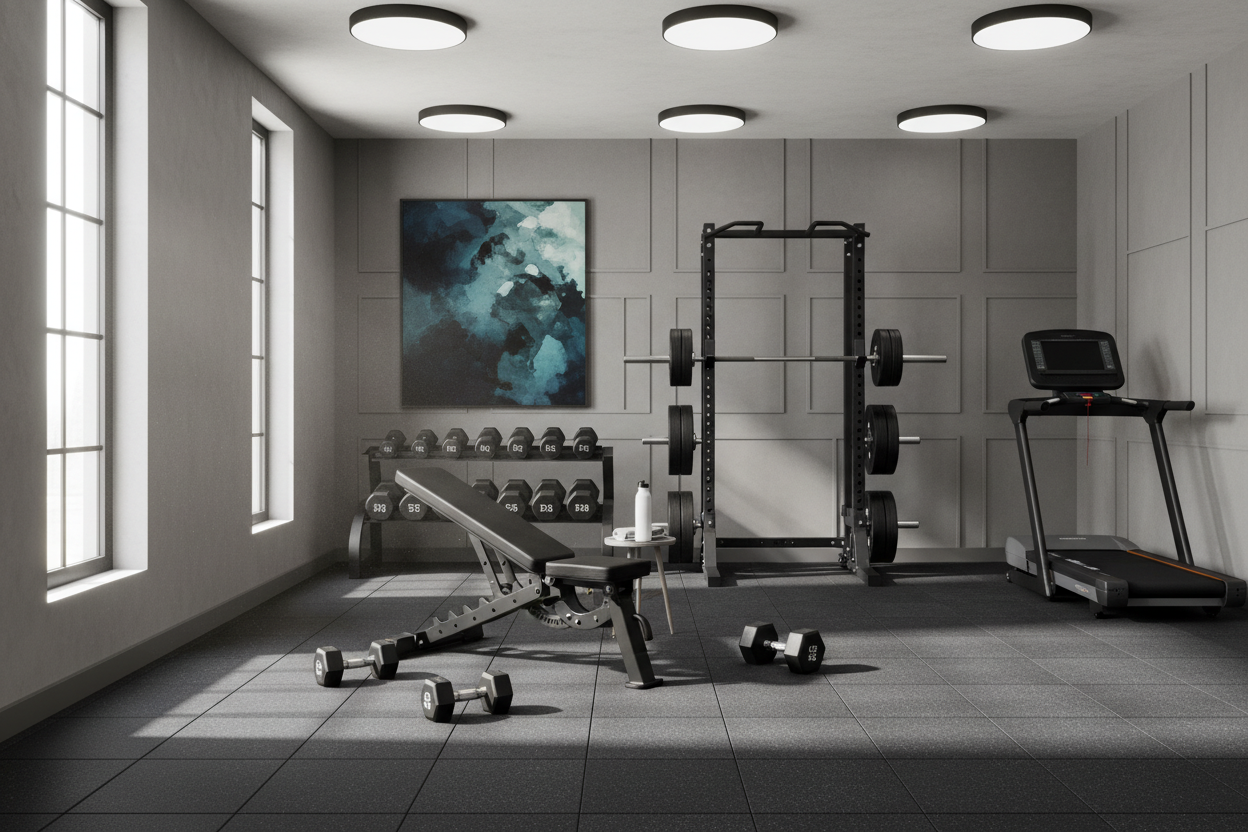
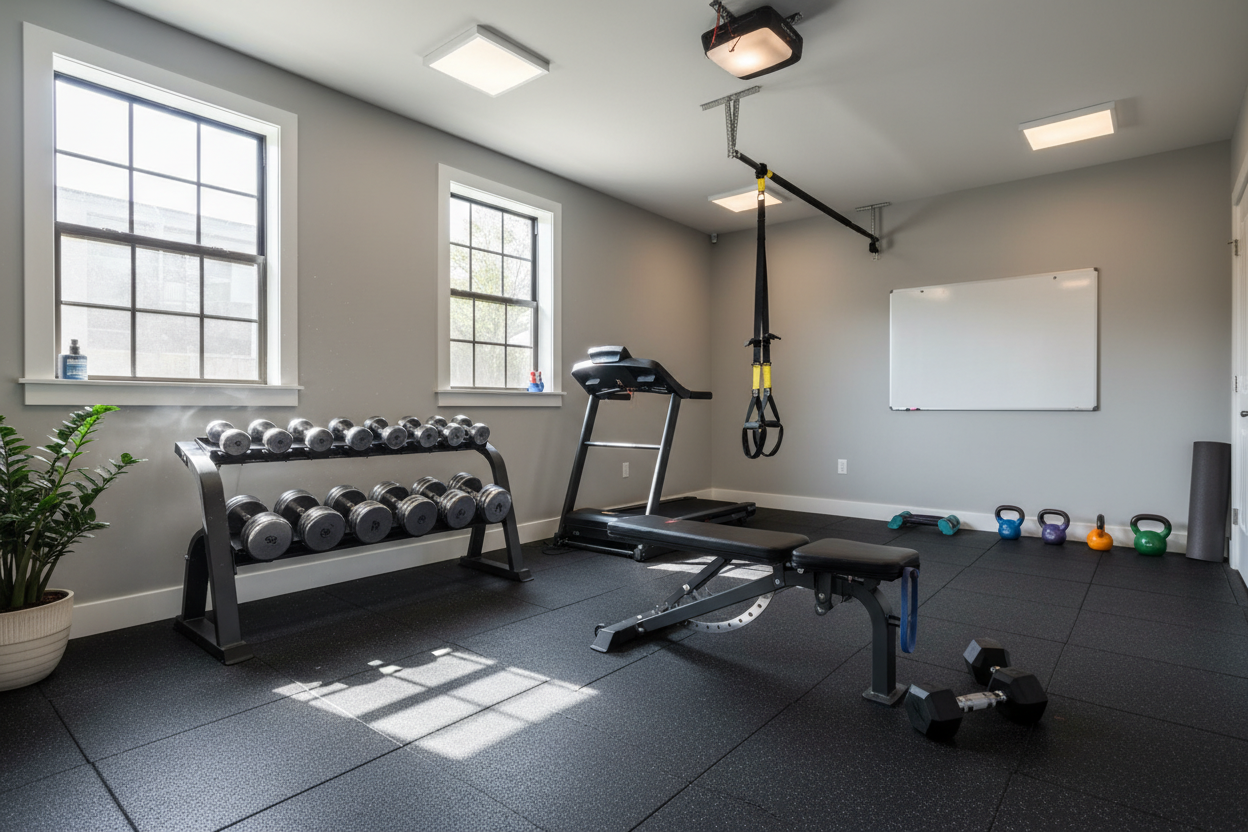
For those who have a dedicated garage space, basement corner, or a spare room they want to permanently convert, investing in proper flooring is non-negotiable. I heavily advise my clients to look into a large exercise mat for home gym setups. A heavy, single-piece mat won't separate like puzzle tiles do when you put lateral force into them. It dampens the sound of dropping weights—keeping your downstairs neighbors happy—and defines a psychological boundary. When you step onto that mat, you are in the gym, even if your couch is three feet away.
Scaling Your Routine as Your Confidence Grows
As you become more comfortable navigating your home's unique layout, your spatial awareness will sharpen. You will stop seeing obstacles and start seeing training tools. That sturdy dining chair becomes a platform for Bulgarian split squats. That heavy oak doorway becomes an anchor point for resistance bands.
Progressive overload still applies to home training. Once you master the hallway bear crawls, add a 20-pound weighted vest. When the tempo squats in your bedroom get too easy, hold a heavy kettlebell. Start blending the zones—do a set of heavy squats in the bedroom, then immediately sprint down the hallway in a superset. Your house is a fully functional training facility if you are willing to look at it through the lens of spatial mapping.
Frequently Asked Questions
How much space do I actually need for a home workout?
You only need a space roughly the size of your body lying flat, which is about 6x4 feet. With this footprint, you can perform vertical density movements like squats, push-ups, and tempo exercises effectively.
Can I build muscle without heavy weights at home?
Absolutely. By manipulating time under tension (tempo) and using unilateral (one-sided) exercises like pistol squats or one-arm push-ups, you can provide enough mechanical tension to stimulate muscle growth without a rack of heavy dumbbells.
How do I stop slipping on hardwood floors during workouts?
Never train in socks on hardwood. Bare feet offer better grip, but the safest and most effective solution is laying down a heavy-duty, high-density exercise mat that won't slide or bunch up during lateral movements.