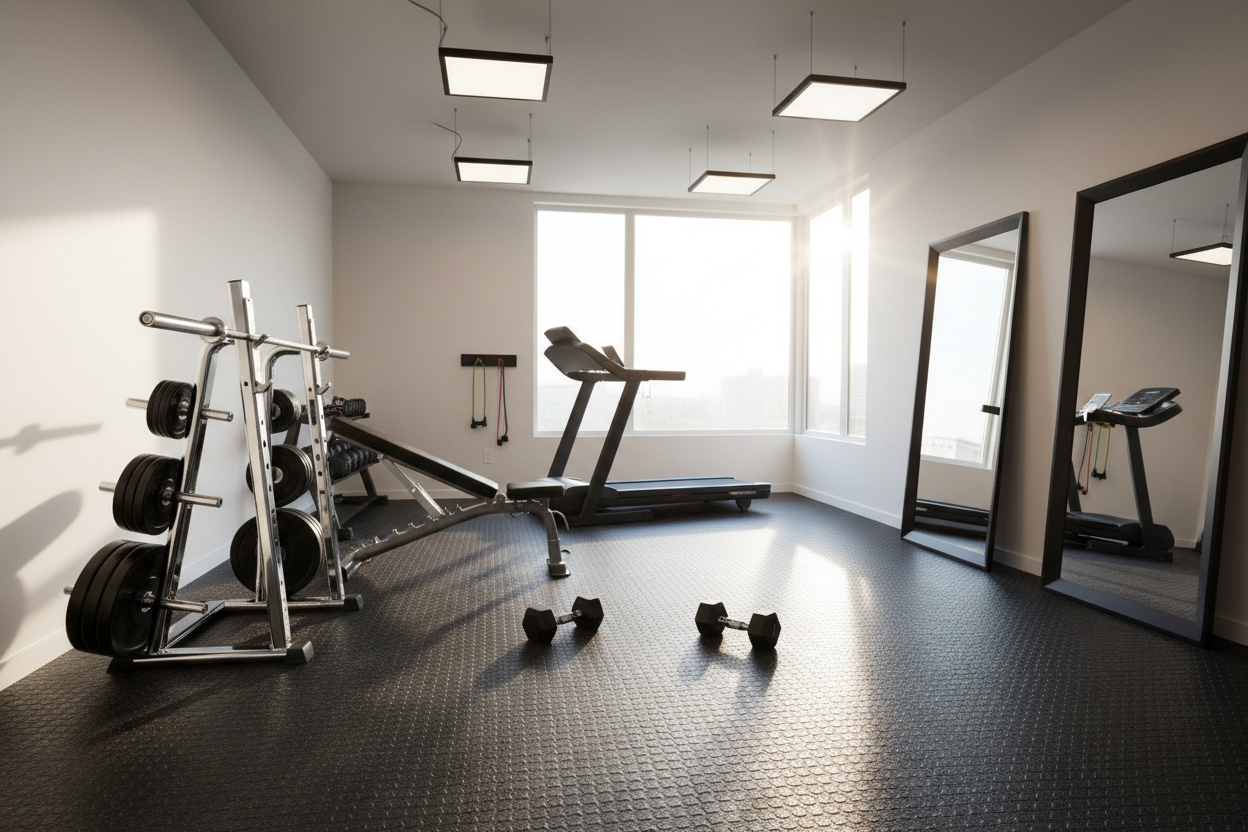
Work Home Exercise Guide: The Active Office Ecosystem
I remember the moment my client Sarah realized her daily commute had shrunk to exactly eleven steps. She went from clocking 8,000 steps a day just navigating her office building to barely breaking 1,500. Her lower back was constantly inflamed, and her hip flexors felt like tightened guitar strings. We needed a system for work home exercise that didn't involve blocking out a separate 60-minute sweat session. We needed an active workstation ecosystem.
Quick Takeaways
- Treat your office as a fluid movement space, not a static desk setup.
- Use audio-only calls for standing glute activation and spinal resets.
- Create a dedicated floor transition zone right beside your chair.
- Replace the afternoon coffee with a 10-minute mid-day energy spike routine.
The Hidden Cost of the Sedentary Home Office
When you work from home, the physical toll sneaks up on you. You sit down at 8:00 AM with a cup of coffee, and suddenly it's 2:00 PM. Your shoulders are creeping up toward your ears, and your glutes have essentially fallen asleep. This prolonged sitting creates a massive mechanical disadvantage for your body. The hip flexors shorten, pulling your pelvis into an anterior tilt, which immediately dumps unnecessary load onto your L4 and L5 vertebrae.
Many of my remote clients initially ask me how to stay fit while working from home, assuming the answer is to buy an expensive smart bike or wake up at 5:00 AM. But when your commute is just a few steps from the bedroom to the spare room, adding a separate, grueling workout to do from home often feels like another chore on the to-do list.
The real challenge isn't finding a killer 45-minute routine. It's figuring out how to stay active while working from home during those eight hours you are actually on the clock. If you are sitting completely still for eight hours, a 45-minute workout in home at 6:00 PM isn't going to undo the stiffness. You need to sprinkle movement throughout the day.
Rethinking WFH Fitness: The Ecosystem Approach
We need to shift your mindset from doing a workout to moving constantly. When I design spaces for clients, I don't just put a desk in one corner and some dumbbells in the garage. I build a work from home exercise plan that turns the office into a fluid movement environment. Your workspace should invite you to change postures every 20 to 30 minutes without breaking your deep focus.
To do this, you have to look at your floor. If your office has cold, hard hardwood or thin, abrasive carpet, you are going to stay glued to your ergonomic chair. Laying down a high-quality foundation changes the psychology of the room. I always have clients install a large exercise mat that covers a significant portion of their usable floor space.
When your floor is comfortable for barefoot movement, spontaneous stretching becomes frictionless. You don't have to go fetch a rolled-up mat from the closet; the environment itself becomes the equipment. This is the core of wfh fitness. You treat the entire room as an active ecosystem where working out while working from home happens organically. You might type a quick email while kneeling, or brainstorm a project while pacing the room.
Designing Your Dynamic Movement Space
Configuring your physical workspace is the first actionable step. You want to eliminate any friction that stops you from moving. If you have to move a heavy chair, step over a pile of cords, or change your clothes to do a quick stretch, you simply won't do it.
Keep your immediate perimeter clear. Route your cables along the underside of your desk. Keep a pair of light resistance bands (I prefer 10-15 lb tension for mobility work) hanging on the back of your door. The goal is to make exercises to do while working from home as accessible as grabbing a pen.
The Desk-to-Floor Transition Zone
The most critical part of your setup is the area immediately behind or beside your office chair. I call this the transition zone. It needs to be a dedicated space where you can drop to the floor for quick working from home exercises without leaving the room or losing sight of your monitor.
For smaller home offices, I usually spec a 6x4ft yoga mat. It is the perfect compact size to slide partially under the desk or sit directly behind your chair. When you push your chair back, you instantly have 24 square feet of padded space to drop into a plank, hit a quick cobra stretch, or do some glute bridges while reading a long document.
The Workflow-Integrated Movement Menu
A successful work from home exercise routine categorizes different types of movement based on your daily work tasks. You can't do jump squats while presenting a quarterly report, but you can certainly do calf raises. Here is how I break down wfh exercise routines to ensure productivity never drops.
Call-Time Posture Resets (Standing)
Audio-only conference calls are your golden ticket for standing work at home exercise. When you don't need to be on camera, stand up. Focus on spinal alignment and glute activation. I have my clients do 20 standing glute kickbacks per leg, holding onto the edge of the desk for balance.
You can also do standing thoracic extensions. Place your hands on your lower back and gently lean backward, opening up the chest that has been hunched over a keyboard. These simple exercises work from home wonders for your posture and can easily be done while actively participating in a call.
Deep-Work Floor Mobility (Sitting/Kneeling)
When you have 30 minutes of deep reading or email triage, get out of the chair. Drop down to your transition zone. You can easily read a screen while in a deep goblet squat hold or a half-kneeling position. Half-kneeling (one knee on the floor, the other foot flat in front of you) is incredible for opening up tight hips.
If you feel your lower back tightening up, take five minutes to run through some dedicated hip mobility exercises. Doing this right on your office floor counteracts the shortened hip flexors caused by your chair, keeping you limber without interrupting your workflow.
The Mid-Day Energy Spike Routine
Right around 1:00 PM or 2:00 PM, the afternoon slump hits. Instead of pouring another cup of coffee, use your lunch hour for a focused work at home workout to elevate your heart rate. It doesn't need to be an hour-long sweat fest.
Keep it to 10 or 15 minutes of high-intensity core and bodyweight work. A quick core routine using a pilates ball or just your body weight engages the central nervous system and wakes you up. I usually program three rounds of 30 seconds of mountain climbers, 30 seconds of plank holds, and 30 seconds of hollow body rocks. You will get back to your desk feeling sharper than you did at 9:00 AM.
How to Stay Active Working From Home Long-Term
Building sustainable habits is the secret to how to stay active working from home. Don't worry about crushing personal bests during your workday. Focus on tracking daily movement volume over intensity. I tell my clients to aim for 20 mini-movement breaks a day. That could be 10 air squats, 5 push-ups, or 60 seconds of stretching.
By the end of the week, those micro-doses of work from home fitness add up to a massive amount of volume. You maintain your mobility, keep your resting metabolic rate elevated, and protect your spine from the chair.
Trainer Experience: What I Learned Building My Own Space
When I transitioned to virtual coaching, I spent 10 hours a day sitting at a desk reviewing client videos. I bought a cheap, thin rug for my office, thinking it would be fine. It wasn't. My knees ached every time I tried to do a kneeling stretch, so I stopped doing them. It wasn't until I upgraded my flooring to a high-density, 7mm thick mat that I actually started using my floor space again. The one downside to thick mats is that heavy rolling chairs can leave temporary indentations, so I recommend keeping the chair slightly off the main stretching area or using a dedicated chair mat over the exercise flooring. But the trade-off for joint comfort is absolutely worth it.
Frequently Asked Questions
- How often should I take a movement break? Aim for 2 to 3 minutes of movement for every 30 to 45 minutes of sitting. Set a silent timer on your phone.
- Can I really get a good workout without sweating? Yes. Mobility work and isometric holds (like planks or wall sits) build tremendous core strength and joint resilience without requiring a shower afterward.
- What is the best exercise to do while working from home? The half-kneeling hip flexor stretch. It directly combats the most damaging physical effect of sitting by opening up the front of your hips.