Why Your Leg Day Needs the Single-Leg Dip (And How to Master It)
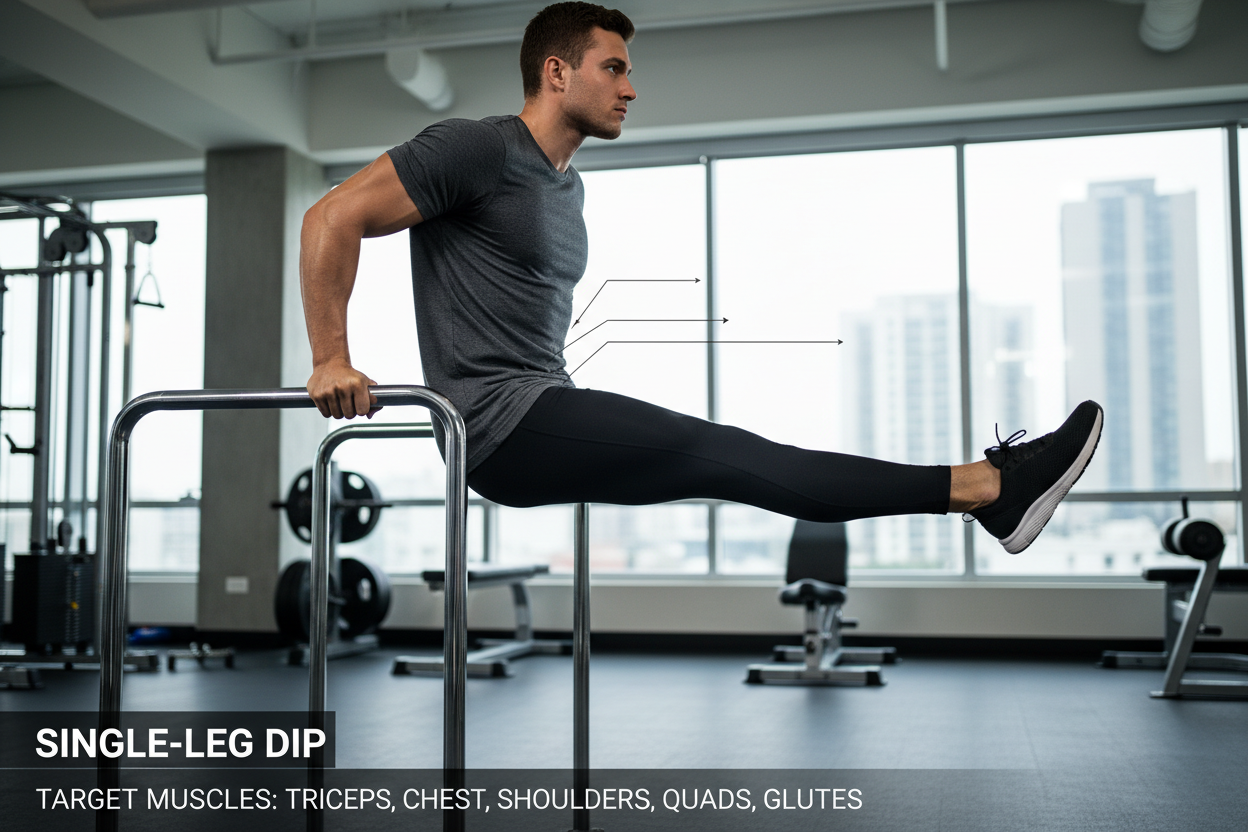
Most people think of leg strength solely in terms of heavy barbell squats or leg presses. While those compound movements are foundational, they often mask imbalances between your left and right sides. This is where the leg dip comes into play. A leg dip is essentially a unilateral (single-leg) squatting movement, often performed on a box or step, where the non-working leg lowers toward the ground. It is a precision tool for building quadriceps strength, enhancing glute stability, and bulletproofing your knees against injury.
Integrating this movement into your routine fixes strength discrepancies that standard squats miss. If you have ever felt one leg shaking while the other remains steady during a heavy lift, you have an imbalance. The leg dip isolates each side, forcing the stabilizer muscles—specifically the gluteus medius and the vastus medialis—to work overtime. This isn't just about aesthetics; it is about functional capacity and keeping your joints healthy for the long haul.
My Wake-Up Call With Unilateral Training
I learned the value of this movement the hard way. A few years ago, I was training for a steep trail run. My general squat numbers were decent, and I felt strong. However, about six miles into a training run, my right knee started tracking inward, leading to sharp pain under the kneecap. A physical therapist watched me do a simple single-leg squat and pointed out immediately that my right hip was dropping. My large muscle groups were strong, but my stabilizers were asleep.
She assigned me the one leg dip exercise—specifically focusing on a slow, controlled descent off a small box. It was humbling. I couldn't do more than five reps without losing my balance. After six weeks of prioritizing these dips, not only did the knee pain vanish, but my main barbell squat improved significantly because my hips were finally firing symmetrically. That experience shifted my entire philosophy on lower body training.
Breaking Down the One Leg Dip Exercise
To perform this movement correctly, you need a stable surface. A plyometric box, a sturdy bench, or even a staircase step works well. The goal is not to drop quickly, but to control the gravity acting on your body.
Start by standing on the edge of the box with one foot. The other foot should hang off the side or front, hovering in the air. Keep your chest up and your core braced. Slowly bend the knee of the standing leg, lowering your hips. The non-working leg should lower straight down or slightly in front of you until the heel gently brushes the floor. Drive through the heel of the standing leg to return to the starting position.
The magic happens during the eccentric phase—the lowering part. This is where you build the braking strength that protects your joints during sports or running. If you cannot reach the floor without your knee collapsing inward, reduce the range of motion. Place a book or a weight plate on the floor to raise the "target" height so you don't have to dip as low.
Common Mistakes That Kill Progress
Even experienced lifters struggle with form here because the leverage is disadvantageous. The most common error is the "hip drop." As you lower yourself, your pelvis should remain relatively level. If the hip of your floating leg drops significantly below the hip of the working leg, you are relying on passive structural tension rather than muscular control. Watch yourself in a mirror; your belt line should stay parallel to the floor.
Another issue is pushing off the bottom. When your floating heel touches the ground, treat it like a button you don't want to press. If you bounce off the floor, you are cheating the movement. The working leg needs to do 100% of the lifting. If you find yourself pushing off, try doing the exercise with the toes of your floating foot pulled up (dorsiflexed), so only the heel taps the ground.
Knee Alignment Matters
Watch your standing knee like a hawk. It should track in line with your second or third toe. If it dives inward toward your big toe (valgus collapse), you are putting immense stress on your ACL and meniscus. If this happens, stop. Reset. Squeeze your glute harder on the standing leg to pull the knee outward into alignment.
Structuring Leg Dips Workouts
You don't need to dedicate an entire hour to this one movement, but it should be a staple in your accessory work. Because this exercise requires high neural drive for balance, it fits best either at the start of a workout as a warm-up (done with bodyweight) or immediately after your heavy compound lifts.
A solid approach for hypertrophy and stability is to perform 3 to 4 sets of 8 to 12 repetitions per leg. Rest periods should be short, around 45 to 60 seconds, since one leg rests while the other works. If you are advanced, hold a dumbbell in the hand opposite to the working leg (contralateral loading). This increases the demand on your core and glutes to prevent rotation.
Here is a sample lower-body session incorporating the move:
- A. Barbell Squats or Deadlifts: 3 sets of 5 reps (Strength focus)
- B. One Leg Dip Exercise (off box): 3 sets of 10 reps each side (Stability/Hypertrophy)
- C. Walking Lunges: 3 sets of 12 steps (Endurance)
- D. Calf Raises: 3 sets of 15 reps
Progression and Variations
Once you master the standard box dip, you can alter the stimulus. The "Pistol Squat" is the ultimate expression of this movement pattern, done on flat ground where the non-working leg is held straight out in front. However, the pistol squat requires immense hamstring flexibility which many people lack. The box dip is generally superior for pure quad hypertrophy because the mechanics are less constrained by mobility issues.
Another variation is the "skater squat," where the non-working leg goes behind you, similar to a reverse lunge but the back foot never touches the ground. This shifts the focus slightly more toward the glutes and hamstrings compared to the quad-dominant box dip.
Why This Should Be a Staple
Ignoring unilateral work is the fastest way to hit a plateau. Leg dips workouts offer a high return on investment. They don't require heavy loads to be effective, which gives your spine a break from heavy axial loading. They teach your body how to absorb force, which is critical for anyone who runs, jumps, or plays recreational sports.
By mastering the control of your own body weight on one leg, you unlock a level of functional strength that makes everything else—from climbing stairs to squatting double your body weight—feel significantly easier. Start with a low box, focus on knee alignment, and build from there.
Frequently Asked Questions
What if I feel pain in my knees while doing leg dips?
Knee pain often indicates that your knee is caving inward or traveling too far forward without heel support. Try reducing the depth of the dip or sitting back slightly more into your hips to engage the glutes, taking pressure off the patella tendon.
Can leg dips replace standard squats?
For general fitness and hypertrophy, they can be a primary leg exercise, especially if you have back issues that prevent heavy spinal loading. However, for maximum raw strength development, bilateral squats allow you to move more total weight, so using both in tandem is usually the best approach.
How high should the box or step be?
Start with a low step, around 4 to 6 inches high. As your strength and control improve, you can increase the height, but never go so high that you lose the ability to keep your hips level or your spine neutral.