Why Your Deadlift Stalled: The Essential Guide to Building Bulletproof Hamstrings
Most lifters treat their hamstrings as an afterthought. You finish your heavy squats, maybe toss in a few half-hearted sets on the leg curl machine while checking your phone, and call it a day. But if you want a physique that looks powerful from every angle and performs as well as it looks, neglecting the posterior chain is a rookie mistake. Building impressive legs requires a dedicated focus on hip extension and knee flexion under load.
To directly answer what works best: the most effective approach combines heavy compound movements that stretch the muscle under load—like Romanian Deadlifts—with isolation movements that focus on peak contraction, such as weighted lying leg curls. You cannot build significant mass in the back of your legs without prioritizing hamstring weight exercises that challenge both functions of the muscle group.
My Struggle with Quad Dominance
I learned the importance of hamstring training the hard way. Early in my lifting journey, I was obsessed with high-bar squats. My quads were growing, but my deadlift numbers wouldn't budge, and I developed a nagging pain in my patellar tendon. A mentor at the gym watched me lift one day and bluntly told me I was "all quads and no brakes." I had zero posterior chain stability. I shifted my focus entirely for six months, prioritizing heavy hinging movements and weight training hamstrings twice a week. Not only did my knee pain vanish, but my squat and deadlift totals shot up by 50 pounds each. That experience taught me that structural balance isn't just about aesthetics; it's the foundation of longevity in lifting.
The Mechanics of Hamstring Growth
Before grabbing a barbell, you need to understand what you are trying to achieve. The hamstrings cross two joints: the hip and the knee. This means they are responsible for extending the hips (thrusting forward) and flexing the knees (bringing your heel to your butt). A complete routine must address both.
Many lifters make the error of only doing one type of movement. If you only deadlift, you are missing out on knee flexion. If you only do machine curls, you miss the massive tension generated by hip extension. The best hamstring lifting exercises integrate both movement patterns to recruit the maximum number of motor units.
King of the Posterior Chain: The Romanian Deadlift (RDL)
If you only have time for one movement, this is it. The Romanian Deadlift is superior to the conventional deadlift for hypertrophy because it maintains constant tension on the muscle belly and removes the help from the quads.
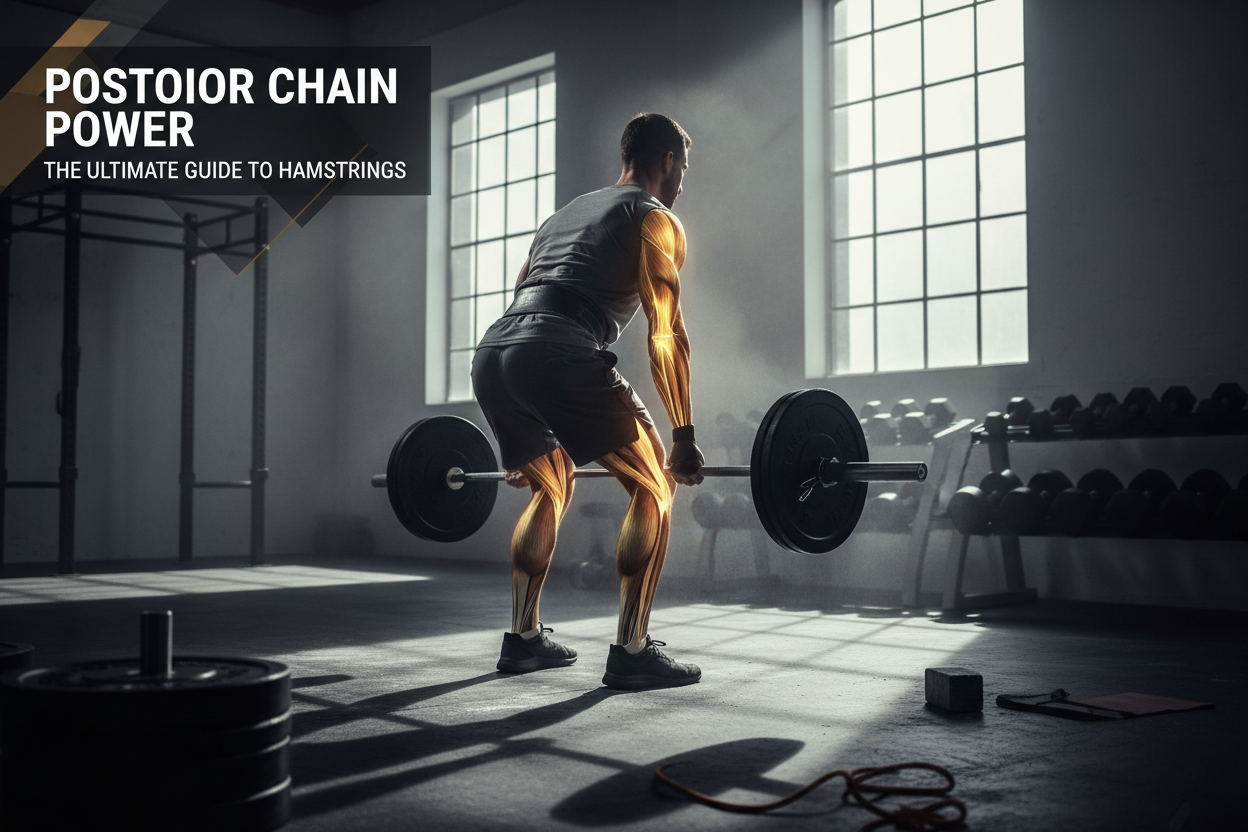
To perform these correctly, unrack the barbell and take a small step back. Keep a slight bend in your knees—this bend should not change throughout the rep. Push your hips backward as if you are trying to close a car door with your glutes. The bar should slide down your thighs. Stop when your hips stop moving back; for most people, this is just below the knee. If you go lower by rounding your back, you lose the tension on the hamstrings and risk injury.
Drive your hips forward to return to the starting position. This is one of the premier hamstring workouts with weights because it allows for heavy loading and progressive overload over time.
Isolation for Mass: Weighted Leg Curls
While compound lifts build the slab of muscle, knee flexion exercises carve out the details and target the short head of the biceps femoris, which RDLs often miss. While machines are great, you can perform weight lifting exercises for hamstrings using free weights if you train in a garage gym.
The Dumbbell Leg Curl is a humble but brutal variation. Lie face down on a flat bench. Have a partner place a dumbbell between your feet (or carefully position it yourself). Grip the bench tight to stabilize your torso and curl the weight up toward your glutes. Control the descent. The eccentric (lowering) phase is where the damage—and growth—happens. Avoid swinging the weight; if you have to use momentum, the dumbbell is too heavy.
The Unsung Hero: Good Mornings
Good Mornings are often feared due to back injury myths, but when performed with strict form, they are exceptional for the posterior chain. Unlike the RDL, where the weight is in your hands, the Good Morning places the load on your back, lengthening the lever arm and increasing the torque on the hamstrings.
Keep the weight lighter than you would for squats. Hinge at the hips, keeping your chest up and back neutral. You should feel a terrifyingly deep stretch in the hamstrings. This movement teaches you to maintain rigid back extension while your hips are in a compromised position, which carries over to almost every other athletic endeavor.
Structuring Your Leg Day
Integrating these moves into your current split requires volume management. Hamstrings have a high proportion of fast-twitch muscle fibers, meaning they respond well to heavy loads and explosive concentric movements, but they also suffer from significant muscle damage.
A solid approach for hamstring weight exercises involves starting your leg day with your heavy compound hip hinge (like the RDL) while you are fresh. Aim for 3 to 4 sets in the 6-10 rep range. Follow this with a knee-dominant squat movement, and finish with higher rep isolation work, such as leg curls for 3 sets of 12-15 reps. If you have a lagging posterior chain, consider adding a second leg day focused purely on the back of the legs.
Advanced Technique: The B-Stance RDL
Bilateral movements are great, but imbalances are common. The B-Stance RDL is a hybrid between a single-leg and two-leg deadlift. Place one foot slightly behind the other, using the back foot only as a kickstand for balance. 80% of the load should be on the front leg. Perform the hinge pattern as usual. This variation torches the hamstrings without the balance constraints of a true single-leg deadlift, allowing you to still move respectable weight.
Recovery and Frequency
Because the hamstrings are often elongated under load during these movements, delayed onset muscle soreness (DOMS) can be intense. Ensure you are eating enough protein to support repair. You might find that training hamstrings twice a week with moderate volume yields better results than obliterating them once a week, as consistent frequency keeps the soreness manageable and reinforces the motor patterns.
Building the back of your legs transforms your physique. It balances the knee joint, improves athletic power, and completes the look of a developed lower body. Treat your RDLs with the same intensity you treat your bench press, and the results will speak for themselves.
Frequently Asked Questions
Why do my hamstrings cramp during leg curls?
Cramping often occurs because the muscle is contracting in a very shortened position, which it isn't used to. Ensure you are hydrated and electrolytes are balanced, but mostly, simply performing the movement more frequently will condition the muscle to handle that shortened state without seizing up.
Can I train hamstrings and quads on the same day?
Yes, and most people do. However, if your hamstrings are a weak point, prioritize them by doing your hamstring lifting exercises at the beginning of the workout when your energy levels are highest, rather than leaving them for the end.
Are stiff-leg deadlifts the same as RDLs?
Not exactly. A stiff-leg deadlift usually starts from the floor with the bar slightly further away from the shins and legs straighter, placing more load on the lower back. The RDL starts from the top down, keeps the bar glued to the legs, and focuses more on the hip hinge mechanics, making it generally safer and better for hamstring hypertrophy.