Why You Should Stop Ignoring the Cables for Leg Day (And How to Do It Right)
Most gym-goers beeline for the squat rack or the leg press machine the moment they walk in for a lower body session. The functional trainer usually sits in the corner, reserved for tricep pushdowns or chest flys. But if you want to carve out definition, improve your stability, and fix muscle imbalances, performing leg exercises on a functional trainer is a strategy you shouldn't overlook. The constant tension provided by the cables creates a unique stimulus that free weights simply cannot mimic, forcing your muscles to work through the entire range of motion without resting at the top or bottom.
Integrating cables into your routine isn't just about variety; it is about changing the force vector. Gravity pulls free weights straight down. A cable machine allows you to load your muscles from the front, side, or back, challenging your stabilizers in ways a barbell never could. Whether you are working around an injury or trying to break through a hypertrophy plateau, the functional trainer offers a versatility that is hard to beat.
My Experience Switching to Cables
A few years ago, I tweaked my lower back trying to push a personal best on the deadlift. The injury wasn't catastrophic, but it was enough to make axial loading—putting a heavy bar on my back or holding heavy dumbbells—uncomfortable and risky. I wasn't ready to stop training legs, so I migrated to the cable machine for six weeks. I assumed I would lose strength or size during this "rehab" phase.
I was wrong. By the time I returned to the barbell, my squat form was deeper, and my glute activation was significantly better. The unilateral nature of the cable work exposed a massive strength deficit in my left leg that the barbell had been masking for years. That experience shifted my philosophy. Now, even when I'm healthy, cable work makes up at least 30% of my lower body volume.
The Mechanics of Cable Leg Training
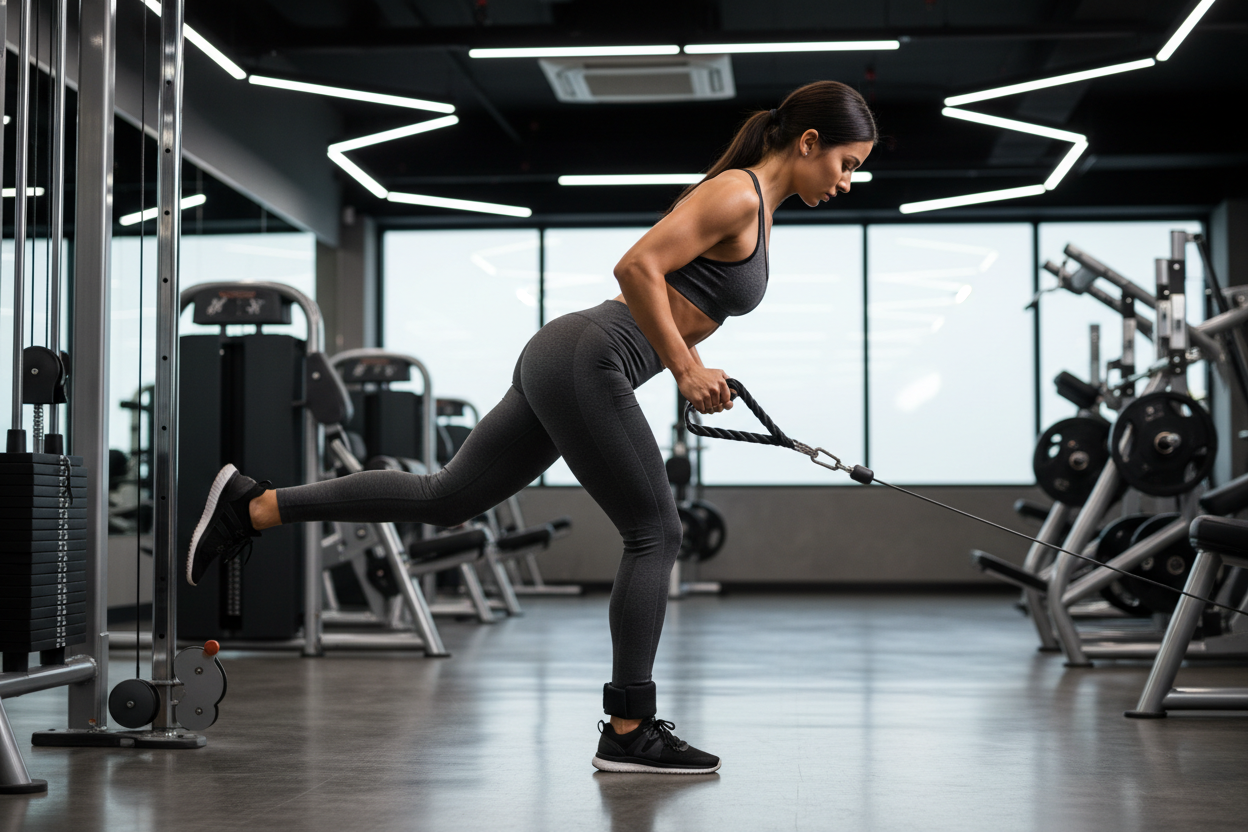
Before diving into specific movements, understand the setup. For most leg movements, you will need the pulley set to the lowest position. While handles work for some exercises, investing in or locating a pair of ankle cuffs at your gym will change the game. Cuffs allow you to drive movement from the leg itself rather than relying on grip strength, which leads to better isolation of the glutes and hamstrings.
The Cable Goblet Squat
This is a phenomenal way to torch your quads while keeping your spine safe. Hook a rope attachment or a straight bar to the low pulley. Stand a few feet back to create tension on the cable. Hold the attachment close to your chest, elbows tucked in.
As you descend into the squat, the cable pulls you slightly forward. To counter this, you must engage your core and keep your torso incredibly upright. This counterbalance allows you to sink much deeper into the squat than you might with a barbell, increasing the stretch on the quadriceps. Drive through your heels to return to the standing position, but don't lock out your knees completely—keep the tension on the muscles.
Cable Pull-Throughs
If you struggle to feel your glutes firing during deadlifts, the pull-through is the antidote. Set the pulley to the lowest setting with a rope attachment. Face away from the machine, reach between your legs to grab the rope, and walk forward until the weight stack lifts.
Stand with a wide stance. The movement is a hinge, not a squat. Push your hips back toward the machine, letting your hands travel through your legs. You should feel a massive stretch in your hamstrings. Snap your hips forward and squeeze your glutes hard at the top. The cable tries to pull you backward, so your glutes have to work overtime to maintain your standing position. This creates horizontal loading on the hips, which is excellent for glute development without compressing the spine.
Unilateral Training for Stability
The functional trainer shines brightest when you train one leg at a time. Unilateral training fixes imbalances and forces your smaller stabilizer muscles to wake up.
Single-Leg Cable Deadlift
Attach a D-handle to the low pulley. Stand on one leg, holding the handle in the opposite hand (contralateral loading). This cross-body tension forces your glute medius to fight against rotation, preventing your knee from collapsing inward.
Hinge at the hips, lowering your torso while extending your non-working leg behind you. Keep a slight bend in the working knee. The cable provides smooth, constant resistance that helps you maintain balance better than a dumbbell, which can swing around. Return to the top and repeat. This move is humbling; you won't need much weight to feel it.
Cable Lunges
You can perform these facing the machine or facing away. Facing the machine hits the quads harder, while facing away mimics a walking lunge pattern. A favorite variation is the reverse lunge holding the cable in the hand same-side as the working leg. As you step back, the cable pulls you forward and down, increasing the eccentric load (the lowering phase). Controlling that pull requires serious quad strength and core stability.
Isolation and Finishing Moves
Once the heavy compound movements are done, use the functional trainer to isolate specific areas. This is where the ankle cuff becomes essential.
Glute Kickbacks
Strap the cuff to your ankle and face the machine. Hinge forward slightly and hold the frame for stability. Drive your leg straight back, focusing entirely on the glute squeeze. Avoid arching your lower back; if your back hurts, you are likely swinging the leg too high or using too much weight. The range of motion is relatively short. The goal is a cramp-like contraction at the top.
Cable Abductions
Stand sideways to the machine with the cuff on the outer leg. Sweep your leg out to the side. This targets the glute medius and minimus—the upper glutes responsible for that "shelf" look and hip stability. Because the cable pulls across your body, you get tension right from the start of the movement, unlike a dumbbell side leg raise where there is zero tension at the bottom.
Structuring Your Session
You don't have to abandon free weights entirely. The best approach is often a hybrid one. Start your workout with your heavy barbell or dumbbell compound lifts (like squats or deadlifts) when you are fresh. Then, move to the functional trainer for your accessory work. This allows you to overload the muscles with heavy weights first, then pump them full of blood and fatigue the fibers thoroughly with the constant tension of the cables.
Alternatively, if you are deloading or traveling and only have access to a hotel gym with a cable stack, you can easily get a full workout. Perform 3-4 sets of 12-15 repetitions for each exercise, keeping rest periods short (45-60 seconds). The continuous tension usually requires slightly higher rep ranges to maximize metabolic stress.
FAQ
Can you build significant leg mass using only cables?
Yes, but it requires strict attention to progressive overload. Since cable stacks have weight limits, you must increase intensity by slowing down your tempo, increasing repetition volume, or reducing rest times to continue stimulating muscle growth (hypertrophy).
Are cable squats safer for bad knees?
Generally, yes. Cable squats allow you to sit back further without falling over, which maintains a vertical shin angle and reduces shear force on the knee joint. However, proper form is still required to ensure pain-free movement.
How do I stop the functional trainer from pulling me off balance?
Engage your core before you start the movement. If the weight is pulling you off balance, you may be standing too close to the stack or the weight might be too heavy for your current stabilizer strength. Widen your stance slightly or lower the weight until you can control the position.