Why You Only Need One Weight Plate to Torch Your Legs
We have all been there. You walk into the gym during peak hours, ready to crush a lower body session, only to find every squat rack occupied and the dumbbell rack picked clean. Instead of waiting twenty minutes for a barbell or skipping leg day entirely, look toward the corner of the room. If you can grab a single 45lb (20kg) bumper or iron disk, you have everything you need for a comprehensive session. A leg workout with plates isn't just a backup plan; it is a legitimate method to build functional strength, improve balance, and correct asymmetries that barbells often hide.
The beauty of using a weight plate lies in its awkwardness. Unlike a dumbbell designed to fit perfectly in your hand or a barbell that rests across your traps, a plate requires active gripping and stabilization. This forces your body to engage more muscle fibers to control the load. You aren't just training your quads and hamstrings; you are torching your core and forearms simultaneously. By manipulating leverage, tempo, and positioning, a simple weight plate leg workout can rival the intensity of heavy machinery.
My Real-World Experience with Plate Training
I stumbled upon the effectiveness of this training style purely by accident. A few years ago, I was traveling for work and staying at a hotel with a "fitness center" that turned out to be a closet containing a broken treadmill and a rack of loose plates—no bars, no dumbbells. I was scheduled for heavy squats that day. Frustrated but determined, I grabbed the heaviest plate available, hugged it to my chest, and started squatting. To make the lighter weight feel heavy, I slowed my descent to a four-second count.
By the fourth set, my legs were shaking more violently than they usually do under a heavy bar. The position forced me to stay upright, torching my core, while the lack of stability fired up my stabilizers. I woke up the next morning with a level of soreness I hadn't felt in months. That session shifted my perspective entirely. I realized that plate exercises for legs offer a unique stimulus that standard equipment often misses, particularly regarding time under tension and postural integrity.
The Mechanics of the Plate Leg Workout
To get the most out of a plate leg workout, you must stop thinking about moving weight from point A to point B. Instead, focus on tension. Since you cannot load a plate as heavily as a barbell, you need to use mechanical disadvantage to your benefit. Holding a plate far away from your body, performing unilateral (single-leg) movements, or pausing at the bottom of a rep changes the physics of the lift.
The Front-Loaded Squat
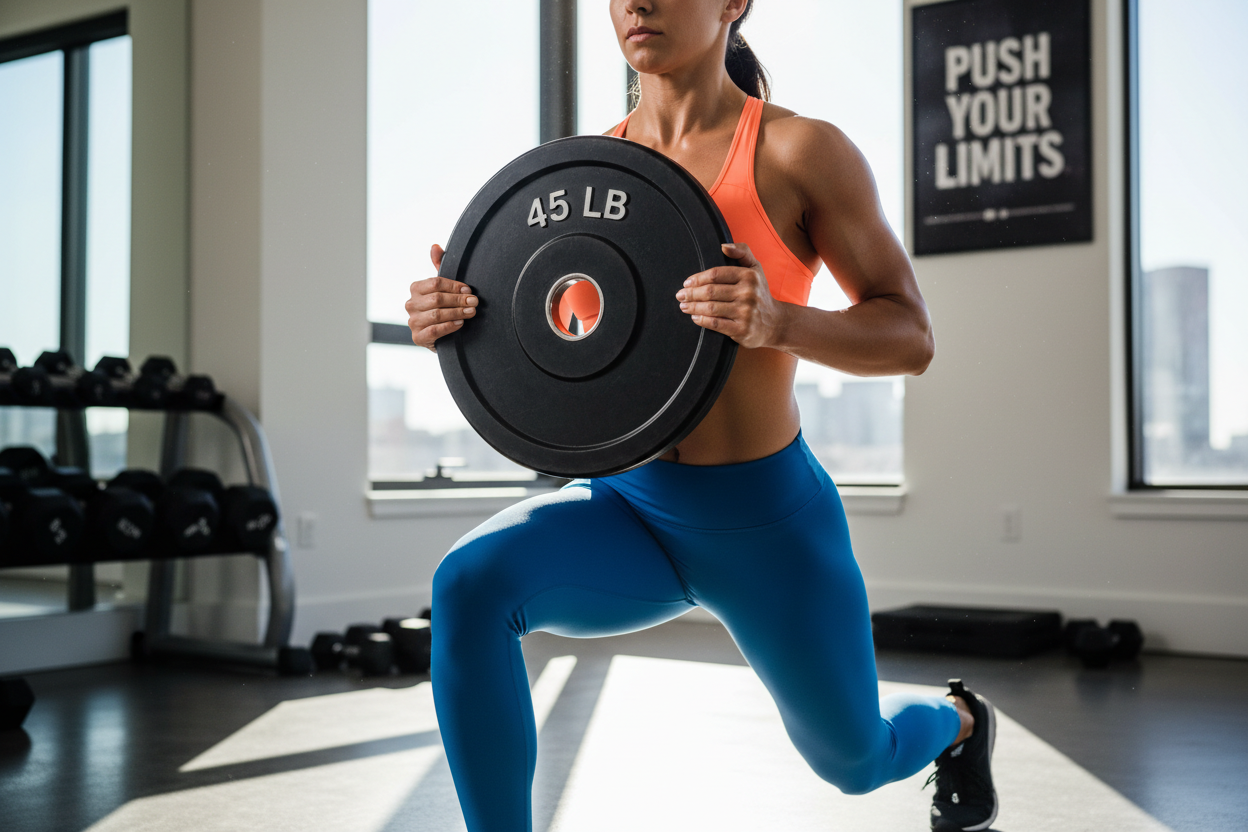
The cornerstone of any leg workout with weight plate focus is the front-loaded squat. You hold the plate tight against your chest, similar to a Goblet Squat. This position acts as a counterbalance. It allows you to sit deeper into the squat than you might be able to with a back squat, increasing the stretch on the quadriceps. Because the weight is anterior (in front of you), your core has to work overtime to prevent you from toppling forward.
For those looking to increase the difficulty, press the plate out in front of you with straight arms as you descend. This shift in the center of gravity turns a standard squat into a brutal core and quad isolator. It effectively lengthens the lever arm, making a 25lb plate feel like 50lbs.
Overhead Walking Lunges
If you want to test your total body stability, overhead lunges are non-negotiable. Lock the plate out overhead with arms fully extended. Step forward into a lunge, tapping your back knee to the ground gently before driving back up. This is one of the most demanding weight plate exercises for legs because any deviation in your torso angle will cause the weight to sway.
This movement exposes weak links in the kinetic chain immediately. If your hips are tight or your core is weak, you will struggle to keep the plate steady. It builds incredible athletic resilience and ensures that your leg strength translates to real-world movement patterns.
Posterior Chain Focus
Many lifters assume you need a heavy deadlift bar to train hamstrings, but weight plate leg workout variations can effectively target the posterior chain. The Plate Romanian Deadlift (RDL) is surprisingly effective. Grip the plate by the rim (or handles if available) and perform a hip hinge, pushing your glutes back while keeping your knees slightly bent. The deficit created by holding the plate allows for a deep stretch in the hamstrings.
Single-leg RDLs are even better here. Holding a plate in the opposite hand of the working leg creates a cross-body stabilization challenge. This targets the glute medius and helps prevent the hip dropping that causes knee pain in runners and lifters.
Structuring Your Session
You don't need a complex spreadsheet to put this together. A circuit style works best for these implements to keep the heart rate up and maximize metabolic stress. Here is a sample routine designed to maximize hypertrophy and endurance:
- Plate Goblet Squats: 4 sets of 15 reps (2 seconds down, 1 second pause at bottom).
- Overhead Walking Lunges: 3 sets of 12 steps per leg.
- Single-Leg Plate RDL: 3 sets of 10 reps per leg.
- Plate Calf Raises: 3 sets of 20 reps (holding the plate at your side or chest).
Keep rest periods short—around 60 seconds. Since the absolute load is lower than a barbell session, volume and density are your drivers for progress. You want to chase the "burn" and muscle fatigue rather than low-rep strength.
Safety and Grip Considerations
While generally safer than heavy spinal loading, weight plate exercises for legs do come with risks. The primary failure point is often grip, not leg strength. If your hands give out before your quads, your workout suffers. Using chalk can help, but you might also view this as a dual-purpose workout that builds a crushing grip alongside big legs.
Be mindful of the plate type. Bumper plates (rubber) are thicker and harder to hold for long periods compared to iron plates with a lip. However, iron plates can be slippery when you start sweating. If you are doing overhead work, ensure your hands are dry to prevent the plate from slipping down onto your head or shoulders.
Utilizing a plate for your lower body training is a masterclass in minimalism. It teaches you to control your body in space, improves your grip, and provides a break from the spinal compression of heavy barbell squats. Next time the gym is packed, grab a plate and find some empty floor space. You might find it's a harder workout than the one you planned.
Frequently Asked Questions
Can I actually build muscle mass using only a weight plate?
Yes, you can build muscle as long as you apply progressive overload. Since you cannot add weight indefinitely, you must increase reps, reduce rest times, or slow down the tempo to increase time under tension, which stimulates hypertrophy.
Is a 45lb plate enough for a strong person?
For standard squats, it might feel light, but once you switch to unilateral movements like pistol squats, single-leg RDLs, or overhead lunges, 45lbs provides significant resistance. The instability of holding the plate also increases the perceived exertion.
How do I hold the plate comfortably for squats?
The best method is usually hugging it against your chest with your arms crossed over it, or holding it by the sides (at 3 and 9 o'clock) with your elbows tucked in. Keep the weight close to your center of mass to protect your lower back.