Why You Don't Need a Squat Rack: The Ultimate Guide to Park Leg Training
You absolutely can build strength, size, and explosive power without stepping foot inside a commercial gym. While heavy barbells are great for maximum force production, an effective leg session outside relies on different mechanisms: high volume, unilateral training, and explosive plyometrics. By manipulating time under tension and leverage, you force your muscles to adapt just as hard as they would under a loaded bar. The key isn't just doing air squats until you get bored; it's about applying intensity to specific movement patterns that challenge your stability and endurance.
Most people underestimate the severity of a proper bodyweight session until they are halfway through it. When you remove the stability of a machine, your stabilizer muscles—particularly in the glutes and ankles—have to work overtime. This functional stress creates a different kind of soreness and growth stimulus. If you have access to a park bench, a hill, or just a patch of grass, you have everything required for a lower-body thrasher.
My Realization on the Road
I learned the hard way that weights aren't the only path to growth. A few years ago, I was traveling through a remote part of the coast with absolutely no gym access for three weeks. I was terrified of losing my squat strength. I decided to head to a local park and commit to a regimen of hill sprints and high-repetition lunges. I figured it would just be a maintenance phase. I was wrong.
After the first session, which involved nothing more than gravity and a steep incline, I woke up with DOMS (Delayed Onset Muscle Soreness) worse than any heavy lifting session I’d had in months. The uneven terrain forced my legs to stabilize in ways the flat gym floor never did, and the explosive nature of the sprints roasted my hamstrings. I returned to the gym weeks later and found my conditioning had improved, and my squat numbers hadn't budged an inch in the wrong direction. That experience cemented my belief that a leg workout outside is a legitimate tool for serious athletes.
The Mechanics of Outdoor Training
To make bodyweight training effective, you have to change the physics. Since you cannot add external load easily, you must decrease your mechanical advantage. This usually means moving from two legs to one. Unilateral exercises place the entire load of your body on a single limb, instantly doubling the relative intensity.
Plyometrics are the second lever you can pull. By adding a jump to a movement, you require your muscles to absorb force (eccentric loading) and release it rapidly (concentric power). This recruits fast-twitch muscle fibers, which are the ones with the most potential for growth.
Top Outdoor Leg Exercises
Not all movements are created equal when you don't have iron plates. You want exercises that offer the most "bang for your buck" regarding range of motion and difficulty. Here are the staples that should form the core of your routine.
The Bulgarian Split Squat: This is the king of outdoor leg exercises. Find a park bench or a low wall. Place one foot behind you on the elevated surface and step the other foot out. Lower your hips until your back knee almost touches the grass. This movement isolates the quad and glute of the front leg while stretching the hip flexor of the rear leg. It requires no equipment but is humbling even for advanced lifters.
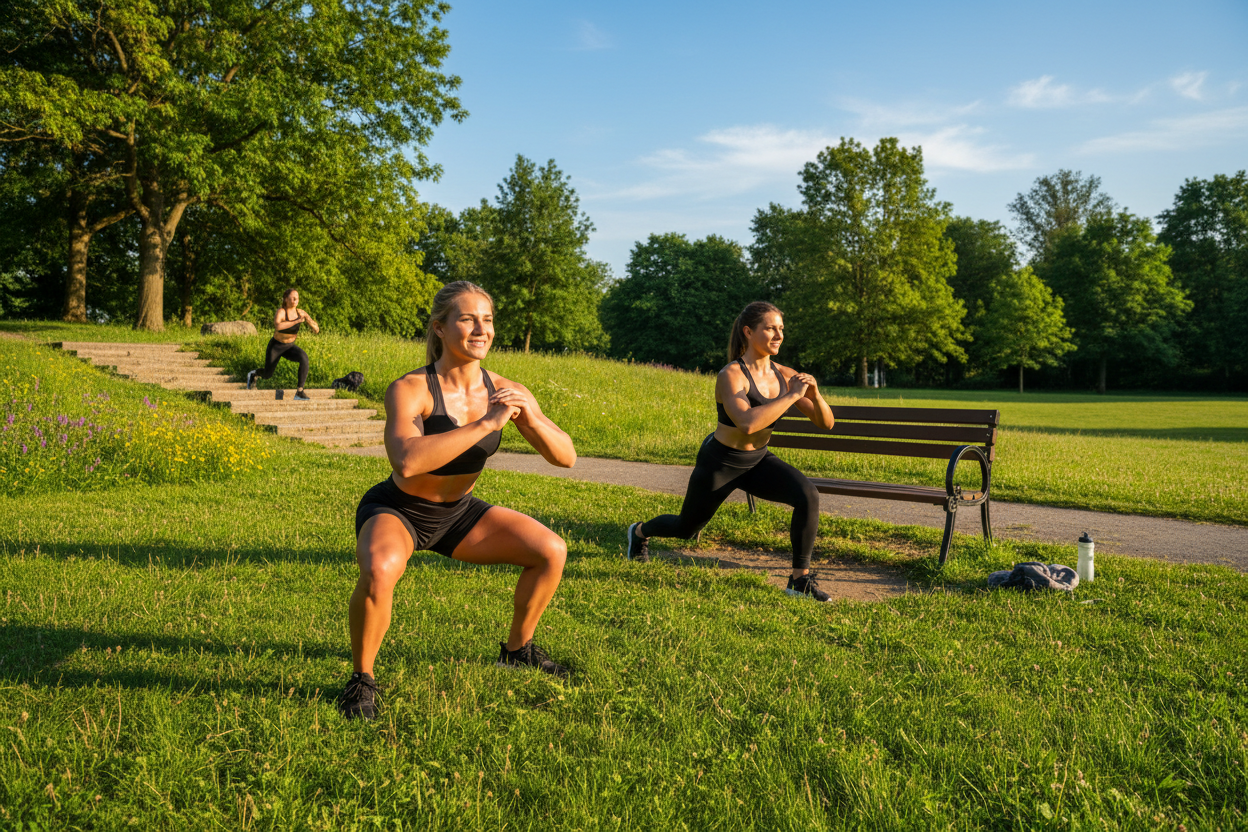
Walking Lunges: The benefit of being outdoors is space. In a gym, you run out of room after five steps. In a park, you can lunge for 50 yards straight. Long-distance walking lunges build incredible muscular endurance and mental toughness. Keep your torso upright and ensure your front heel stays planted to protect the knee.
Step-Ups with a Knee Drive: Using that same park bench, place one foot firmly on the surface. Drive through the heel to lift your body up, bringing the opposite knee high into the air. This mimics the mechanics of sprinting and targets the glutes heavily. Control the descent; don't just flop back down to the ground. The lowering phase is where the muscle tearing occurs.
The Hill Sprint Factor
If you have access to an incline, you have a natural leg press. Hill sprints are arguably the most functional lower-body exercise in existence. Running uphill prevents you from over-striding, which actually makes it safer for your hamstrings than sprinting on flat ground. The incline forces you to drive your knees high and push hard into the ground, creating massive neural drive to the posterior chain.
Treat these like heavy sets. Do not jog them. Sprint at 90% to 100% effort for 10 to 15 seconds, then walk back down slowly to recover. Five to eight rounds of this will leave your legs shaking.
Structuring Your Outdoor Leg Workout
Random effort leads to random results. You need a plan. Here is a sample routine designed to hit every major muscle group in the legs using the principles discussed above. Perform this circuit with minimal rest between exercises, but take a full two minutes of rest after completing one full round.
- Warm-up: 5 minutes of light jogging followed by dynamic stretching (leg swings, bodyweight squats).
- Hill Sprints: 5 rounds of 30-yard sprints (Walk back recovery).
- Bulgarian Split Squats: 12 reps per leg.
- Bench Step-Ups: 15 reps per leg (Explosive up, slow down).
- Walking Lunges: 50 total steps (25 per leg).
- Jump Squats: 20 reps (Focus on height).
Aim for three to four total rounds. If you are a beginner, two rounds will likely be sufficient. The volume adds up quickly, so listen to your body.
Environmental Factors and Safety
Training in the wild introduces variables you don't face in a climate-controlled box. The ground is rarely perfectly flat. While this is good for stabilizer muscles, it also increases the risk of rolling an ankle. Always scout your terrain before you start jumping or sprinting. Look for hidden holes, tree roots, or slippery patches of mud.
Temperature regulation is another factor. In the cold, your joints take longer to warm up, so extend your dynamic stretching routine. In the heat, direct sunlight can dehydrate you faster than you realize. Bring more water than you think you need. High-intensity leg training demands significant blood flow, and dehydration creates a massive drop in performance and increases cramping risks.
Consistency remains the driver of progress. You don't need a membership card to forge steel legs. You just need gravity, a bit of space, and the willingness to push through the burn when there is no rack to re-rack the weight on.
Frequently Asked Questions
Can I actually build muscle mass without heavy weights?
Yes, muscle growth is driven by mechanical tension and metabolic stress. By using unilateral exercises (single-leg) and high repetitions to failure, you can stimulate hypertrophy effectively. Your muscles cannot tell the difference between a metal plate and your own body weight if the intensity is high enough.
How often should I do this outdoor leg routine?
Because of the high volume and explosive nature of sprints and jumps, recovery can take longer than standard machine workouts. Aim for twice a week with at least two or three rest days in between to allow your central nervous system and soft tissues to repair.
What if I have bad knees?
Avoid high-impact plyometrics like jump squats or sprinting on concrete. Stick to controlled movements like the step-up or reverse lunges, which place less shear force on the knee joint. Grass or dirt surfaces are also much more forgiving on joints than pavement.