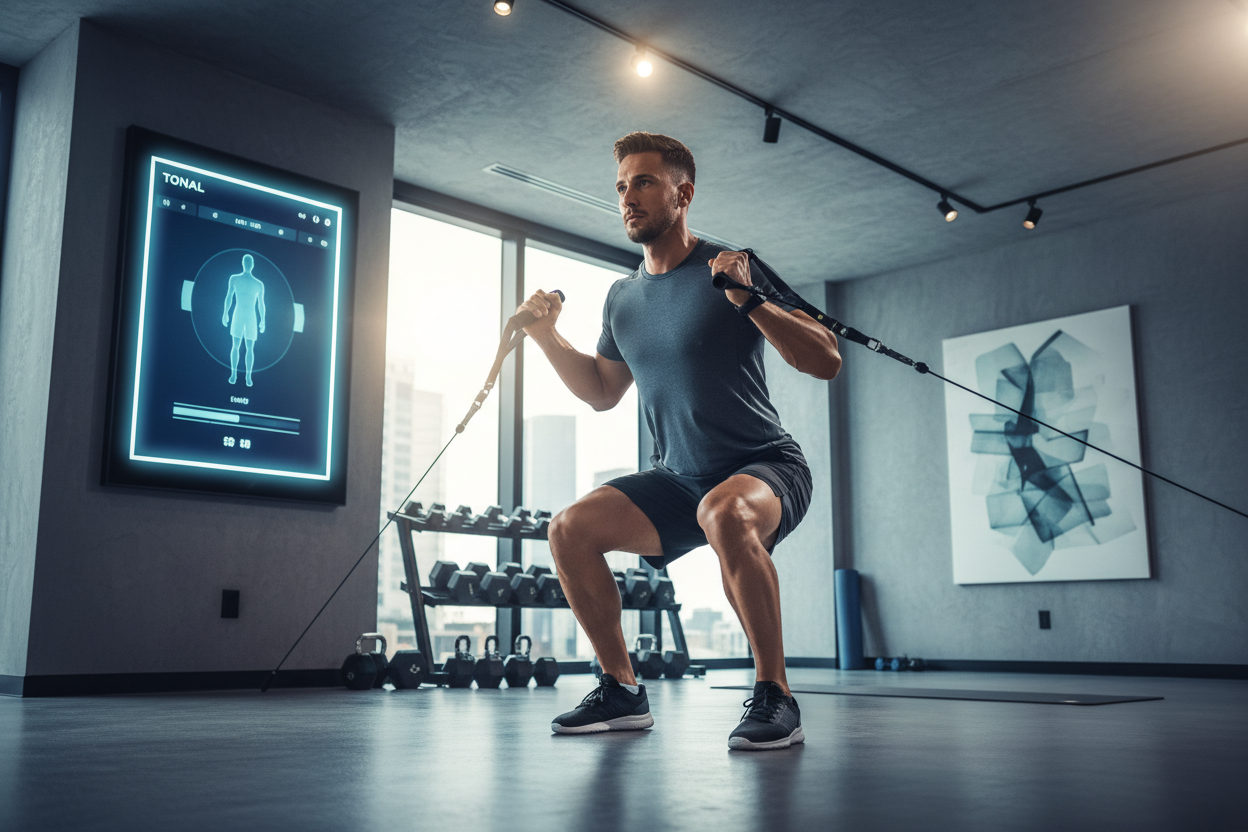
Why You Don't Need a Leg Press Machine to Crush Leg Day on Tonal
One of the most common concerns for anyone transitioning from a commercial gym to a smart home gym is the fear of losing heavy compound movements. Specifically, lifters often wonder if they can replicate the sheer load and stability of a sled machine. If you are looking for a dedicated tonal leg press, the short answer is that the machine does not have a sliding seat or a 45-degree sled. However, believing that limits your leg development is a mistake. Through digital weight and dynamic modes, you can build a lower body routine that rivals, and often exceeds, what you can achieve with traditional iron plates.
The Tonal trainer relies on electromagnetism rather than gravity. This means 100 pounds on the screen feels significantly heavier than 100 pounds on a barbell because there is zero momentum to help you through the sticking points. When I first set up my Tonal, I arrogantly dialed in my usual back squat numbers, assuming the max resistance of 200 pounds wouldn't be enough. I was humbled within three reps. The constant tension provided by the digital weight creates a stimulus that tears muscle fibers efficiently without needing the massive footprint of a leg press machine.
The Myth of the Leg Press on Tonal
Let’s address the elephant in the room. You cannot perform a mechanical leg press on tonal in the traditional sense. The hardware isn't designed for you to lie on your back and push a platform upward with your feet. Attempting to rig the smart bar to mimic this movement is dangerous and unnecessary.
The leg press is popular because it isolates the quads and removes the stability requirements of the lower back. Tonal solves this differently. Instead of locking you into a fixed path, the machine forces you to stabilize the weight yourself, which translates better to functional strength. While you lose the specific motion of the leg press, you gain access to variations like the Front Squat and Goblet Squat, which hit the quads just as hard but with better core engagement.
Structuring the Ultimate Tonal Leg Workout
To replace heavy machinery, your tonal leg workout needs to focus on high-tension compound movements followed by high-volume accessory work. The beauty of the system lies in the dynamic modes—Chains, Eccentric, and Smart Flex. These features alter the weight curve during the rep, something a standard leg press can never do.
A solid session should start with a heavy knee-dominant movement, transition to a hip-hinge movement, and finish with unilateral work to fix imbalances. Because the digital weight eliminates inertia, you don't need to do endless junk volume. Three or four hard sets on Tonal often feel like six or seven in a standard gym.
1. The Barbell Front Squat
This is your primary replacement for the leg press. By racking the smart bar across your front delts, you keep your torso upright, which shifts the load almost entirely to your quadriceps. This mimics the quad-dominant nature of a leg press better than a back squat does.
When performing this, activate "Chains" mode. In a traditional gym, you are weakest at the bottom of the squat and strongest at the top. Chains mode adds weight as you stand up, matching your natural strength curve. This ensures your quads are under near-maximal tension through the entire range of motion, not just the sticking point.
2. Romanian Deadlift (RDL)
No tonal lower body workout is complete without hammering the posterior chain. The RDL with the smart bar is exceptionally smooth. Because the cables adjust 60 times per second, the weight feels "alive." You have to fight to keep the bar close to your shins, which engages the lats and protects the lower back.
For RDLs, I prefer using "Smart Flex" mode. This mode automatically optimizes the weight at different points in the lift, allowing you to go heavier on the eccentric (lowering) phase where you are naturally stronger. This is crucial for hamstring growth.
3. Bulgarian Split Squats
If you miss the isolation of the leg press, the Bulgarian Split Squat is your reality check. This is arguably one of the most effective tonal leg exercises available. You can perform these holding the smart handles or simply with body weight if you are a beginner.
The instability of the cables forces your glute medius to work overtime to keep your knee from caving in. Since you are working one leg at a time, you can overload the muscle without putting hundreds of pounds of spinal compression on your back. This exercises exposes weak points immediately.
Advanced Tonal Leg Exercises for Hypertrophy
Once you have the main compound lifts down, you need to fill in the gaps with accessory movements. These exercises help sculpt the legs and improve the performance of your main lifts.
Resisted Glute Bridges
Since you can't do a heavy leg press, you might feel like your glutes aren't getting enough maximum-load stimulation. The Resisted Glute Bridge fixes this. You lie on the floor, place the bar across your hips, and drive upward. It is a short range of motion that allows for heavy loading, directly targeting the glutes without involving the lower back or quads significantly.
Goblet Squats
For those who find the barbell uncomfortable or have wrist mobility issues, the Goblet Squat using the rope attachment or a single handle is fantastic. It forces you to keep your chest up and allows for significant depth. Deep squats recruit more glute fibers, and the anterior load acts as a counterbalance, helping you maintain form even when fatigued.
Neutral Grip Deadlift
This variation uses the handles rather than the bar. It mimics a trap bar deadlift. The weight is centered with your body rather than in front of it, which reduces shear force on the spine. It allows for a slightly more knee-dominant movement than the RDL, making it a hybrid that hits both quads and hamstrings effectively.
Leveraging Digital Modes for Growth
The hardware is only half the equation. The software is what makes a tonal leg workout superior to free weights in many aspects. Specifically, Eccentric Mode is a game-changer for leg development.
Muscles are capable of handling more weight when lengthening (lowering) than when shortening (lifting). In a standard gym, your set is limited by how much you can lift up. On Tonal, Eccentric Mode adds weight on the way down. For example, you might squat up 100 pounds, but the machine forces you to control 125 pounds on the way down. This causes significant metabolic stress and muscle damage—the good kind that leads to growth. Incorporating this into your squats or lunges will leave you walking funny for days, proving you don't need a heavy sled to get results.
Sample Lower Body Routine
Here is how you can structure these movements into a cohesive session. Perform this routine twice a week with at least two days of rest in between.
- Barbell Front Squat: 4 sets of 8-10 reps (Chains Mode)
- Neutral Grip Deadlift: 3 sets of 8-10 reps
- Bulgarian Split Squats: 3 sets of 10-12 reps per leg
- Resisted Glute Bridges: 3 sets of 12-15 reps (Burnout Mode)
- Standing Calf Raises: 4 sets of 15-20 reps
While the search for a tonal leg press might end in disappointment regarding the hardware, the results from using the machine correctly are undeniable. By utilizing the smart bar, unilateral movements, and the advanced weight modes, you can build a pair of legs that are not only aesthetic but functionally strong and resilient.
Frequently Asked Questions
Is the max weight on Tonal enough for leg workouts?
Yes, for the vast majority of people. Tonal offers up to 200 lbs of digital resistance, but because it lacks momentum, it feels roughly 20-30% heavier than free weights. Combined with high-intensity modes like Eccentric or Chains, even advanced lifters can achieve failure within a standard rep range.
Can I build big legs without a leg press machine?
Absolutely. The leg press is a tool for isolation, but squats, lunges, and deadlifts are superior for overall mass and functional strength. Tonal allows you to perform these compound movements safely, which recruits more total muscle fibers than a seated machine.
What is the best Tonal mode for leg growth?
Eccentric mode is widely considered the best for hypertrophy (muscle growth). By overloading the muscle during the lengthening phase of a squat or deadlift, you create more micro-tears in the muscle tissue, signaling the body to repair and grow larger and stronger.