
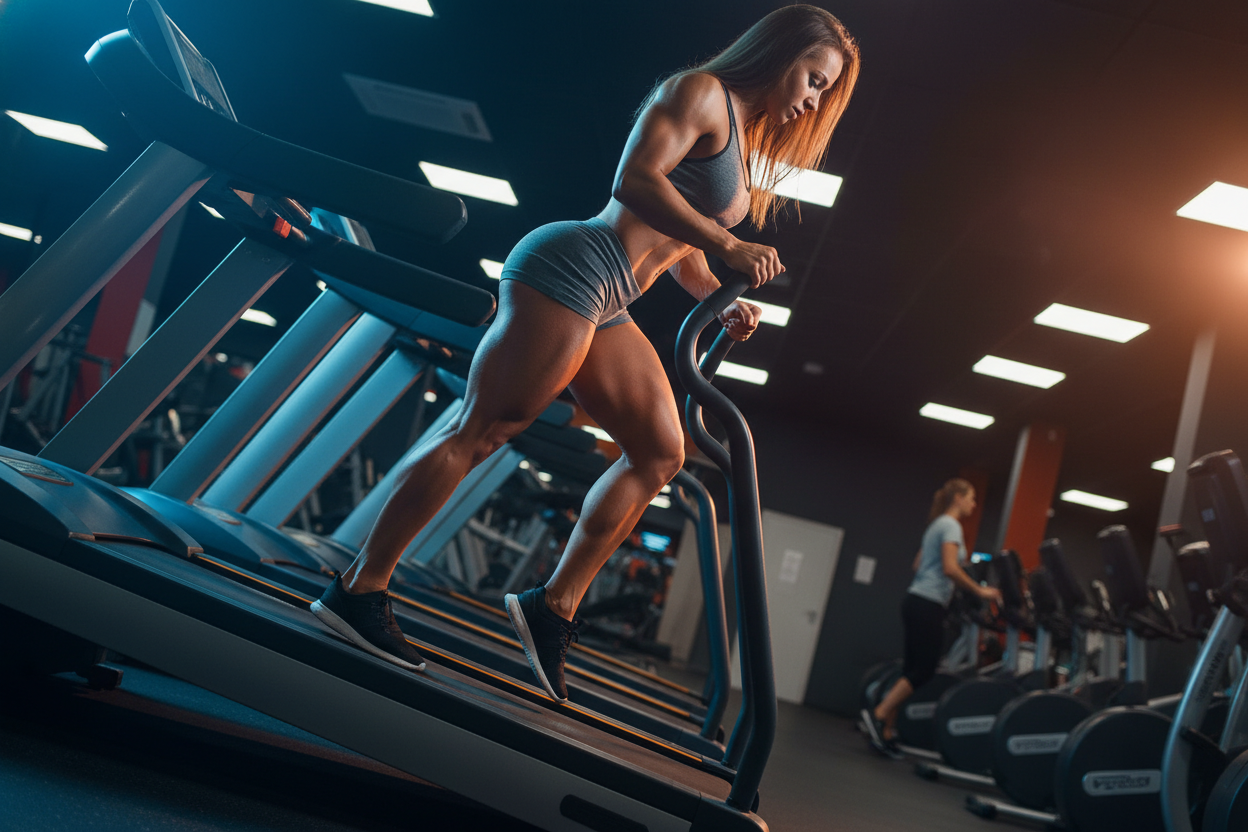
Why the Incline Step Machine Burns More Fat Than Running
Most people view cardio as a necessary evil. It is often boring, hard on the joints, and takes forever to show results. If you have been trudging along on a flat treadmill wondering why the scale isn't moving, you are likely fighting physics instead of using it to your advantage.
The incline step machine changes that equation completely. By combining vertical resistance with continuous movement, it forces your body to recruit the largest muscle groups you have—the glutes and hamstrings—without the pounding impact of pavement running.
Key Takeaways
- Higher Calorie Burn: Moving vertically recruits more muscle fibers than moving horizontally, increasing metabolic demand.
- Low Impact: Your foot stays in contact with the pedal or step, significantly reducing shear force on the knees compared to jogging.
- Posterior Chain Focus: Unlike standard ellipticals, an incline stepper targets the glutes and hamstrings directly.
- Correction of Imbalances: Independent pedal movement forces each leg to work individually, preventing your dominant side from taking over.
The Science of Vertical Momentum
Why does climbing feel so much harder than walking? It comes down to gravity. When you walk on a flat surface, momentum helps carry you forward. On an incline stepper machine, you are constantly fighting gravity to lift your body weight upwards.
This vertical displacement creates a higher oxygen demand. Your heart has to work harder to pump blood against gravity, and your muscles are under tension for a longer duration during each step cycle. This is often referred to as "Time Under Tension" (TUT), a concept usually reserved for weightlifting, but highly applicable here.
Muscular Recruitment Patterns
Running is quad-dominant. Stepping is glute-dominant. Because most of us sit at desks all day, our glutes are often inactive or "asleep." The steep angle of the machine forces hip extension, waking up the posterior chain. This doesn't just burn calories; it fixes your posture.
The "Handrail Hunch" Mistake
If you walk into any gym, you will see people on the incline step machine leaning heavily on the console or gripping the handrails for dear life. This is the single biggest error you can make.
When you support your upper body weight on the rails, you are effectively reducing the load your legs have to lift. Studies suggest that leaning can reduce your total calorie expenditure by up to 30%. You are cheating yourself out of the workout.
The Fix: Keep your hands hovering over the rails for safety, or lightly touch them for balance only. Your core should be tight, and your torso should remain upright. If you have to lean to keep up, lower the speed.
My Training Log: Real Talk
I want to be honest about what your first month on this machine will actually feel like. The glossy brochures show models smiling while stepping. That won't be you.
I remember testing a hydraulic incline stepper for a six-week block. The first thing I noticed wasn't the "burn"—it was the awkward rhythm. On cheaper or older machines, the pedals don't always sink smoothly. There’s a gritty, mechanical friction point halfway down the step where the resistance catches. You have to find a rhythm where you aren't bottoming out the pedals (clanking against the base) but also aren't letting them rise too high.
Also, nobody talks about the "foot numbness." Because your feet never leave the pedals (unlike a stair climber where you lift your foot), the constant pressure cuts off circulation slightly if you wear shoes laced too tightly. About 15 minutes in, I usually have to wiggle my toes aggressively to get the feeling back. It’s not glamorous, and the sweat tends to drip directly onto the display screen rather than the floor because of your forward posture. Bring a towel, not just for hygiene, but so you can actually read your timer.
Structuring Your Session
Don't just hop on and go for 20 minutes. To maximize fat loss, you need to vary the intensity.
The 20-Minute "Glute Torch"
- Minutes 0-5: Warm-up. Low resistance, focusing on full range of motion.
- Minutes 5-15: Intervals. 1 minute of high resistance (slow, deep steps) followed by 1 minute of low resistance (fast, shallow steps).
- Minutes 15-20: Steady state cooldown. Posture check—no leaning.
Conclusion
The incline step machine is one of the most efficient tools in the gym, but only if you respect the mechanics. Stop leaning on the rails, focus on driving through your heels, and embrace the difficulty of vertical training. It won't be easy, but the joint health and conditioning you gain are worth the effort.
Frequently Asked Questions
Is the incline step machine better for knees than running?
Generally, yes. Because it is a closed-chain exercise (your foot stays in contact with the pedal), there is zero impact shock. However, if you have pre-existing knee issues, keep the resistance moderate to avoid grinding the joint.
Will this machine make my legs bulky?
It is unlikely. While the stepper builds muscle endurance and tone, it lacks the overload capacity of a heavy squat or leg press required for significant hypertrophy (bulk). It will mostly result in a leaner, more defined look.
How long should I use the incline stepper for?
Due to the high intensity, 20 to 30 minutes is usually sufficient for most fitness levels. If you can easily go for an hour without leaning on the rails, your resistance is likely too low.

