
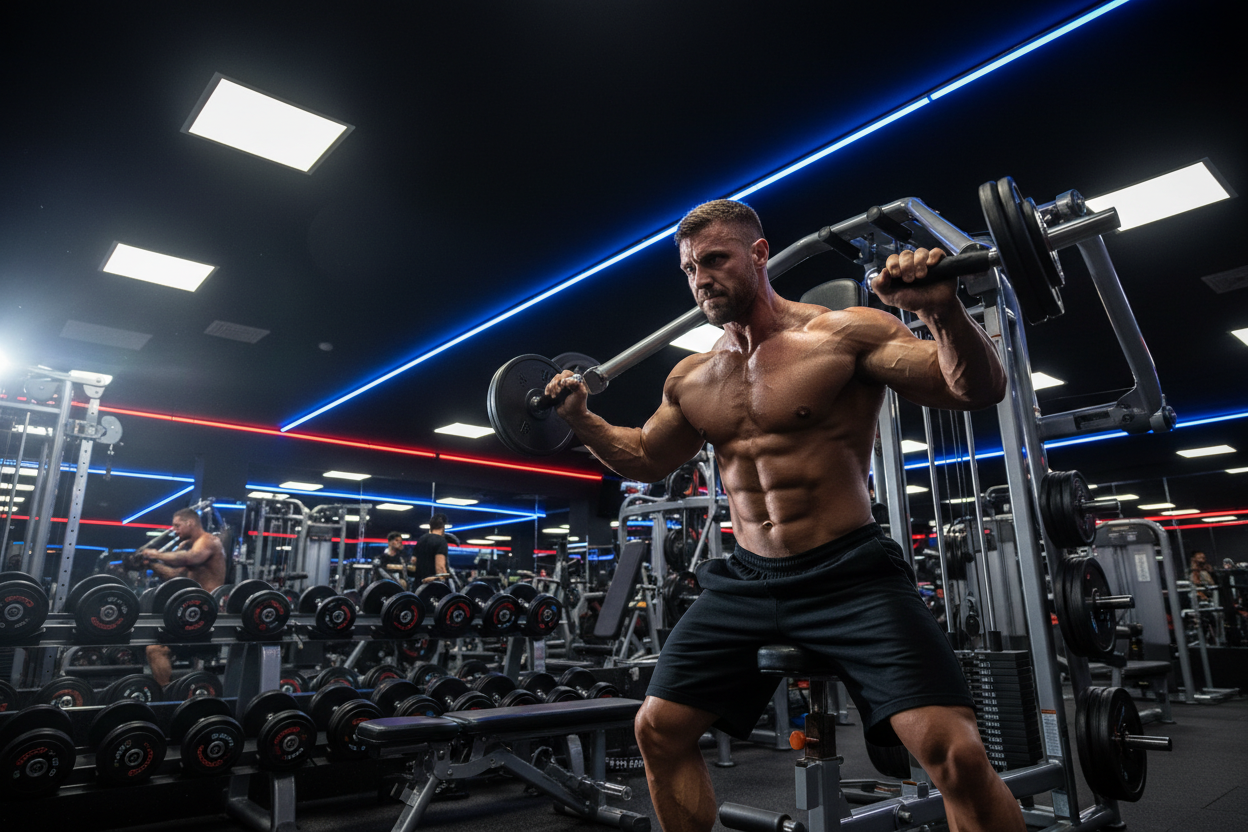
Why the Dumbbell Press Machine Beats Free Weights for Hypertrophy
Let’s be honest: stabilizing heavy dumbbells while lying flat on a bench is a skill in itself. While that stability is great for functional strength, it often becomes the limiting factor when your primary goal is raw muscle growth. Enter the **dumbbell press machine**. It sits in that sweet spot between the rigidity of a selectorized stack and the freedom of loose iron, offering a unique mechanical advantage that many lifters overlook.
If you have been stalling on your bench press or feeling more burn in your front delts than your pecs, this piece of equipment might be the missing link in your programming. It removes the balancing act, allowing you to drive maximum load directly into the pectoral fibers.
Key Takeaways: Quick Summary
- Converging Motion is Key: Unlike a standard barbell smith machine, a dumbbell press machine allows your hands to come together at the top, mimicking the natural arc of a free weight press for better peak contraction.
- Safety at Failure: You can push to absolute mechanical failure without the fear of dropping a heavy dumbbell on your face.
- Unilateral Capability: Most of these units are "iso-lateral," meaning you can work one arm at a time to fix muscle imbalances, just like you would with dumbbells.
- Overload Potential: Without wasting energy on stabilization, you can typically handle 10-20% more load, increasing mechanical tension on the chest.
Defining the Machinery: What Are We Actually Talking About?
In gym lingo, this equipment goes by many names. You might hear it called a chest press free weight machine or an iso-lateral plate-loaded press. Regardless of the label, the function is specific.
A true dumbbell bench press machine is designed to replicate the path of motion you take with hand-held weights. Unlike a barbell that moves in a fixed straight line, these machines usually feature a converging axis. As you press the weight up, the handles move inward. This forces the pectorals to shorten fully at the top of the movement, providing a contraction that straight-bar machines simply cannot match.
The Science: Why Stability equals Hypertrophy
There is a misconception that "stabilizer muscles" are the holy grail of training. While important, they can be a bottleneck for hypertrophy. When you use a free weight bench press machine, you remove the requirement for the rotator cuff and triceps to balance the load laterally.
This creates an environment of "external stability." Because the machine creates the path, your central nervous system (CNS) feels safer. When the CNS feels safe, it allows for greater motor unit recruitment in the prime movers—in this case, the pectorals. You aren't fighting gravity and physics; you are just pushing.
The "Free Weight" Hybrid Factor
Why do we call it a free weight chest press machine if it's a machine? Because it is usually plate-loaded. This matters for the resistance curve. Selectorized machines (with the pin stack) have constant tension via pulleys. Plate-loaded machines rely on leverage and gravity, which often feels "heavier" and more distinct at different points in the rep, closely mimicking the feel of raw iron.
How to Execute the Perfect Rep
Don't just jump in and start blasting. The setup on a dumbbell chest press machine dictates the result.
1. Seat Height is Everything
The most common mistake is sitting too low. If the handles are aligned with your neck or shoulders, you are going to wreck your rotator cuffs. Adjust the seat so the handles align with your mid-chest (nipple line). This ensures the load is distributed across the sternal head of the pecs.
2. The Elbow Tuck
Even though the machine guides you, you must actively tuck your elbows slightly. Keep them at a 45-degree angle relative to your torso. Flaring them out to 90 degrees puts unnecessary torque on the shoulder joint.
3. The Converging Press
Focus on driving your biceps toward your chin. As you press out, think about bringing your elbows together. This mental cue helps maximize the benefit of the machine's converging path.
My Training Log: Real Talk
I want to share a specific nuance about the dumbbell press machine that you only notice after years of grinding under the iron. Specifically, I’m talking about the "start point" anxiety on older Hammer Strength models.
There is a specific moment when you first un-rack the weight on these machines where the handles sit incredibly deep—often deeper than your natural range of motion allows comfortably. I remember loading up four plates per side for the first time, getting into the seat, and realizing I couldn't actually get the handles moving because the leverage disadvantage at the very bottom was too severe.
I learned the hard way that you often need to use the "foot assist" pedal (if the machine has one) to get the weight into the active range. If it doesn't have a pedal, I’ve had to perform an awkward half-rep with one arm just to get the momentum started. Also, there is a distinct, gritty friction you feel on the way down if the maintenance crew hasn't greased the pivot points in a while—it almost feels like the machine is stuttering. Learning to press through that friction rather than letting it throw off your tempo is a skill in itself.
Conclusion
The dumbbell press machine isn't a replacement for free weights; it's a specialized tool for overloading the chest safely. By utilizing a free weight bench press machine, you can take your sets to absolute failure without a spotter, target the pecs with a converging range of motion, and move heavier loads than your stabilizers would normally allow. Add it as your second or third movement on chest day, and watch your development soar.
Frequently Asked Questions
Is a dumbbell press machine better than free weights?
It depends on the goal. For pure muscle size (hypertrophy), the machine is often better because it offers more stability, allowing for greater isolation and mechanical tension. For functional strength and stabilizer development, free weights are superior.
What muscles does the dumbbell chest press machine work?
It primarily targets the pectoralis major (chest) and anterior deltoids (front shoulders). The triceps act as secondary movers to assist in the lockout phase of the press.
How much does the starting weight of the machine handle weigh?
This varies by brand, but on most commercial plate-loaded machines (like Hammer Strength), the starting resistance of the arm itself is usually between 15 to 25 lbs (7-11 kg) before you add any plates.


