Why My Legs Shake Every Time: The Ultimate Guide to Sculpting at the Barre
You want to know exactly how to sculpt lean, powerful legs without lifting heavy weights, and the answer lies in the tiny, controlled movements of barre. A proper barre legs workout targets the muscles differently than a standard squat rack session. Instead of tearing muscle fibers through heavy load to build bulk, we exhaust the muscle through high-repetition, low-impact movements and isometric holds. This creates that long, lean aesthetic often associated with dancers.
When I stepped into my first class, I underestimated how difficult moving my leg two inches would be. I was a runner, so I assumed my legs were strong. Ten minutes into the lower body barre workout, my thighs were trembling so violently I had to hold onto the support for dear life. That “shake” is exactly what we are chasing. It signifies muscle fatigue, which is where the change happens. If you are ready to embrace the burn, here is how to execute a studio-quality session right from your living room.
The Mechanics of Barre Legs
The magic of barre moves for legs comes from the principle of time under tension. You aren't just going up and down; you are staying in the difficult part of the movement (the working zone) and pulsing. This recruits the slow-twitch muscle fibers, which are responsible for endurance. By the time you finish a barre thigh workout, walking down the stairs might feel like a challenge, but your joints won't feel the heavy compression of weighted squats.
You do not need a ballet studio to get these results. A sturdy chair, a kitchen countertop, or even the back of a sofa works perfectly as your "barre." The goal is balance assistance, not gripping it with white knuckles to pull yourself up.
The Thigh Series: Embracing the Quiver
We usually start a barre leg workout by targeting the quadriceps. The key here is posture. Keep your spine long, shoulders down, and core engaged. If you lean forward, you lose the isolation in the thighs.
Parallel Pliés (Heels Raised)
Stand with your feet parallel, hip-width apart. Rise onto the balls of your feet (relevé) and bend your knees, sliding your back down an imaginary wall. This is your starting point. Lower your hips an inch, then lift them an inch. Do not straighten your legs fully. Stay in the bend.
This is one of the quintessential barre thigh exercises. After about 30 seconds, you will feel the heat. To intensify this, hold the lowest point of your plié and press your knees together and apart by just an inch. This tiny range of motion forces the quads to stay engaged without relief.
Wide Second Position
Step your feet wider than your hips and turn your toes out to 10 and 2 o'clock. Bend your knees deeply so they track over your middle toes. Keep your tailbone pointing straight down—avoid sticking your butt out. Pulse down for two counts and up for two counts. This move engages the entire leg but starts to wake up the inner thighs as well.
Targeting the Inner Thighs
Many people come to this method specifically for the inner thigh barre workout components. This area is notoriously difficult to target with standard gym equipment, but barre excels here because of the external rotation and squeezing mechanics.
The Narrow V (First Position)
Bring your heels together and toes apart, making a small "V" shape. The space between your heels should be no more than a slice of pizza. Lift your heels off the floor about two inches and glue them together. Bend your knees, forcing them out to the sides. As you pulse up and down, the focus must be on squeezing the heels together. That pressure activates the barre exercises for inner thighs immediately.
If your heels separate, you lose the engagement. Keep the range of motion small. If you go too low, your heels will pop apart. It is better to stay higher and maintain the squeeze.
Floor Bridge with a Ball
Lie on your back with your knees bent and feet flat on the floor. Place a small squishy ball (or a rolled-up towel) between your knees. Lift your hips into a bridge position. While keeping your hips high, squeeze the ball firmly with your knees, then release slightly. These barre leg exercises isolate the adductors (inner thighs) while simultaneously working the glutes.
The Ballet Barre Leg Workout Finisher: Glutes and Hamstrings
To balance out the quad-dominant work, you must hit the back of the legs. This creates the "lifted" look.
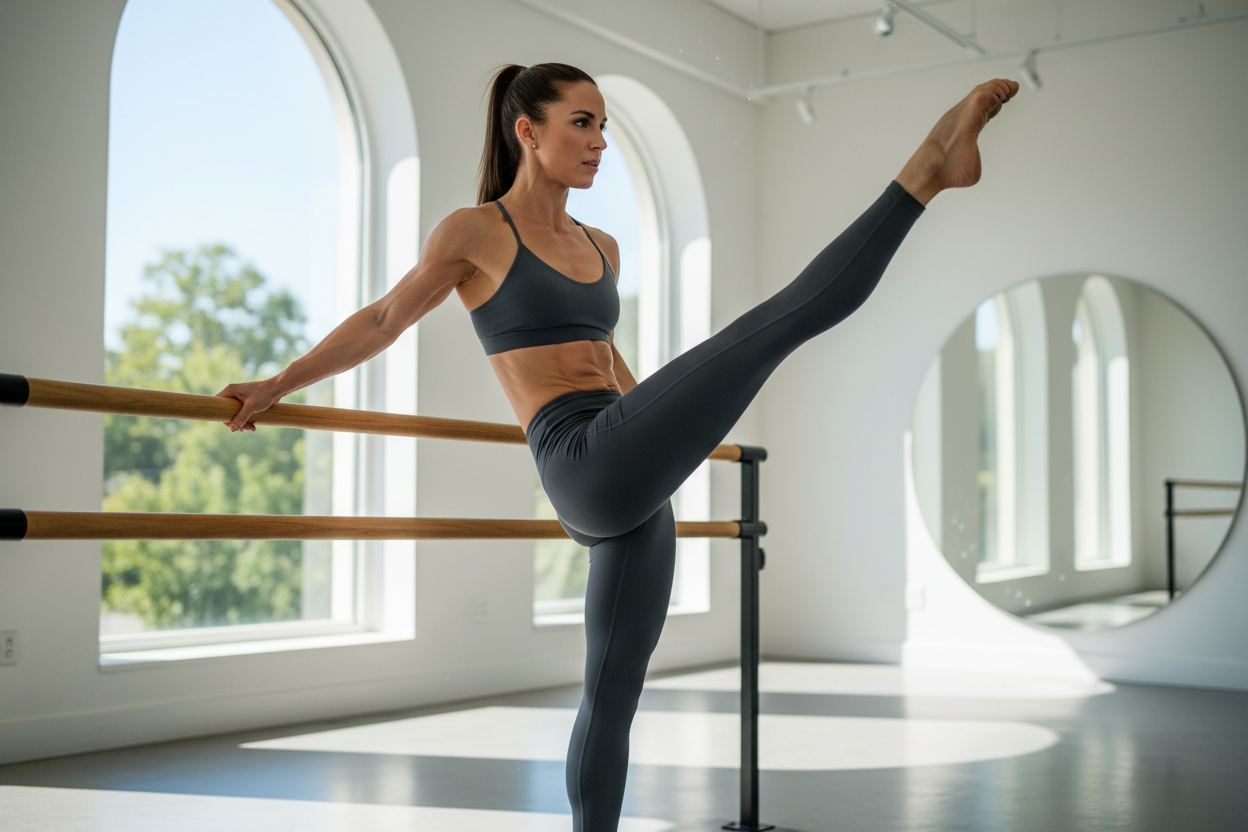
Standing Arabesque Pulses
Face your support and rest your hands lightly on it. Extend one leg straight behind you, pointing the toe. Keep your standing leg slightly bent to protect the joint. Lift the back leg until you feel your glute catch—this isn't about height; it's about length. Pulse the leg up towards the ceiling. Keep your hips square to the barre; do not let the working hip open up to the side.
Fold-Over Seat Work
Walk your feet back and fold at the waist so your torso is parallel to the floor (creating an L-shape). Bend one knee and bring the heel toward the ceiling. Press the heel up in small pulses. This targets the "glute-ham tie-in," the area where the butt meets the leg. It is a staple in any lower body barre workout.
My Experience with the "Sewing Machine Leg"
I remember a specific class where the instructor kept shouting, "Embrace the shake!" My left leg was bouncing up and down involuntarily, looking like a sewing machine needle. I felt embarrassed and tried to stand up to stop it. The instructor walked over and corrected me, whispering that the shaking meant I was doing it right. I was exhausting the muscle fully. Once I stopped fighting the sensation and learned to breathe through it, my strength skyrocketed. The definition I saw in my legs after a month of consistent shaking was unlike anything I achieved from running marathons.
Common Form Mistakes to Avoid
Even the best barre moves for legs won't work if your alignment is off. The most common error is "tucking" the pelvis too aggressively. While we want a neutral spine, aggressively scooping your tailbone under puts unnecessary pressure on the lower back and hip flexors. Aim for a heavy tailbone, as if you are wearing a weighted imaginary tail, rather than a tucked one.
Another mistake is gripping the barre too tight. If your knuckles are white, you are using your upper body to hold yourself up. The barre is there for balance, not to bear your weight. Hover your hands above the support occasionally to ensure your legs are doing the work.
Building Your Routine
You can combine these movements into a 20-minute flow. Start with a warm-up, move to the thigh series, transition to the barre exercises for inner thighs, and finish with the glute work. Perform each move for 2-3 minutes to truly fatigue the muscle group before switching sides. Stretching immediately after the workout is non-negotiable. Barre muscles get tight, and lengthening them while they are warm helps develop that long, dancer-like physique.
Consistency is the final ingredient. Because this is low impact, you can perform a barre legs routine 3-4 times a week without the same recovery time needed for heavy lifting. Your legs will feel heavy immediately after, but that lean, sculpted strength is worth every second of the burn.
FAQ
How often should I do a barre leg workout to see results?
For visible toning and increased strength, aim for 3 to 4 sessions per week. Since barre is low-impact, your muscles recover faster than with heavy weightlifting, allowing for more frequent training, but consistency is key to changing the shape of the muscle.
Do I need dance experience to do a ballet barre leg workout?
Absolutely not. While the terminology borrows from ballet (like plié or relevé), the exercises are fitness-based and focus on athletic conditioning rather than choreography. You focus on muscle isolation and form, not on perfect dance technique or rhythm.
Why do my legs shake during barre thigh exercises?
Shaking is a physiological response indicating that your muscles are reaching the point of fatigue. In barre, you hold positions for extended periods (isometric holds), which depletes the energy in the muscle fibers; the shaking confirms you are effectively challenging the muscle to build endurance and strength.