Why My Beginner Guide to the Gym Starts on a Simple Floor Mat
I remember walking into my first high-end commercial gym and feeling like I’d accidentally stepped onto a movie set where I didn’t know my lines. The clanging of calibrated plates and the hum of complex cable pulleys was enough to make me want to turn around and go back to my couch. This beginner guide to the gym isn't about mastering every piece of chrome equipment; it is about claiming a small piece of territory where you can actually think.
Quick Takeaways
- Ignore the complex machines for the first two weeks.
- Find the stretching area and claim a 'home base' with a mat.
- Master bodyweight movements before touching a barbell.
- A stationary routine kills the anxiety of navigating a crowded floor.
The Problem With Most Day-One Advice
Most people give you a guide to working out at the gym that reads like a technical manual for an airplane. They want you to learn 15 different machines, three types of benches, and the etiquette of 'working in' on a squat rack. It is too much. Decision fatigue is the number one reason people quit after three days.
Typical gym guidance pushes you straight into the shark tank of the free-weight section. You end up standing there, holding a pair of dumbbells, wondering if your form looks stupid while someone else waits for your spot. It is a recipe for 'gym-timidation' that stops progress before it starts.
Claim Your Real Estate (The 'Home Base' Strategy)
Here is my secret: walk past the rows of treadmills and the intimidating racks. Go straight to the stretching area. Grab a large exercise mat and throw it down. This is now your fortress. Once you are on that mat, you have a physical boundary that tells everyone else you are in the middle of a set.
A good mat gives you a 6-foot by 4-foot buffer zone. It provides a psychological safe zone where you can focus on your breath and your movement without feeling like you are in someone’s way. You aren't 'wandering' anymore—you are training.
Why Floor Work Builds Ultimate Confidence
Mastering gym basics for beginners on the floor is the smartest move you can make. If you can’t hold a 45-second plank or perform a lunges with perfect balance on a mat, you have no business under a 45-lb barbell. Floor work builds the core stability and joint awareness that makes you look like a pro when you finally do step up to the rack.
A 20-Minute Routine You Can Do Without Moving
You can get a full-body burn without ever leaving your mat. This removes the stress of finding available equipment. Try this: 3 sets of 12 air squats, 10 push-ups (on knees if needed), and 15 glute bridges. If you want to add weight, grab one pair of 15-lb dumbbells and keep them at the edge of your mat.
This stationary approach keeps your heart rate up because you aren't walking around looking for the next machine. You stay in your zone, finish your work, and leave feeling like you actually accomplished something rather than just surviving the experience.
When You're Finally Ready to Leave the Mat
Eventually, the four corners of your mat will feel too small. That is when you start mastering weights at the gym. Pick one machine or one bench that is closest to your 'home base' and make that your next objective. The environment will already feel familiar because you’ve spent a week observing the flow of the room from the safety of the floor.
Bringing the 'Safe Zone' Strategy Home
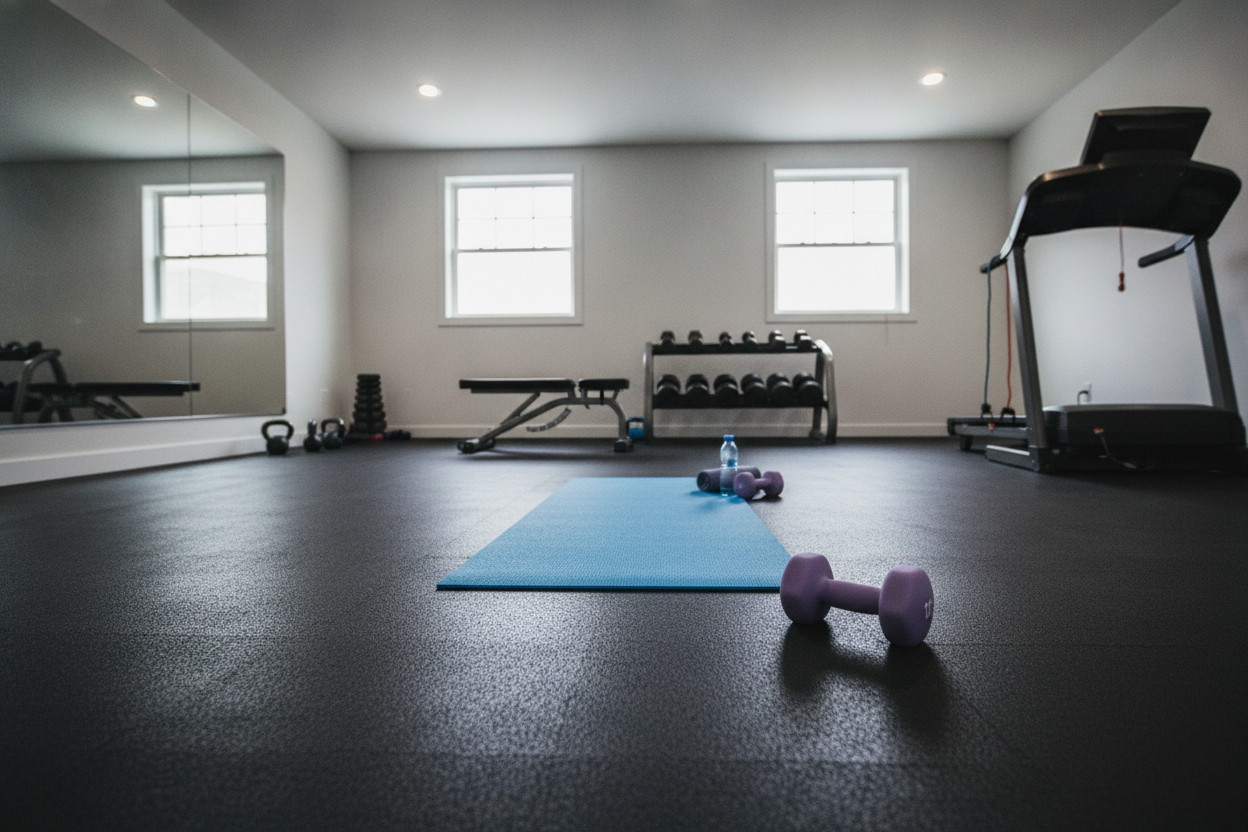
If the commute or the crowd still feels like too much friction, take this exact philosophy to your garage. You don't need a $3,000 power rack to start. A high-quality 6x8ft exercise mat in a spare room creates a dedicated training space that is always open. It is about removing the barriers to entry so you actually show up.
My Honest Experience
When I first started, I tried to follow a pro bodybuilder's split. I spent more time looking at my phone trying to figure out how to adjust a leg press than I did actually lifting. I felt like an idiot. I finally swallowed my pride, grabbed a mat in the corner, and just did push-ups and planks for a week. That is when the gym stopped being scary and started being a tool.
FAQ
Do I need special shoes for the mat?
Not necessarily. Most people do fine in standard cross-trainers, but if you're doing a lot of floor work, shoes with a flatter sole give you better stability than thick-soled running shoes.
What if someone asks to use my mat?
Most gyms have plenty. If someone asks, just point them to the stack. If you're using a personal mat you brought from home, just politely say you're using the space for the next 15 minutes. People respect a plan.
How thick should a gym mat be?
For floor exercises, look for something at least 7mm thick. If it is too thin, your knees will hate you during lunges. If it is too soft, like a plush yoga mat, you'll lose your balance during standing movements.