Why Having Less Equipment Fixed My Workout Routines for Mass Gain
I remember standing in my local commercial gym, staring at a new, shiny $5,000 iso-lateral row machine while the only two power racks had a line three people deep. The gym owner was obsessed with adding 'variety,' but the strongest guys in the room were still fighting for the same rusty barbell. It was the moment I realized I was paying for a distraction. My workout routines for mass gain didn't need more cables or fancy upholstery; they needed more focus.
Quick Takeaways
- Machines often prioritize ease of use over mechanical tension and stability demands.
- A barbell, a rack, and a bench are the only 'must-haves' for hypertrophy.
- Reducing exercise variety allows you to master technique and push heavier loads.
- Recovery improves when you stop hammering your joints with 12 different isolation angles.
The Commercial Gym Trap: Why More Options Equal Less Growth
Commercial gyms are designed to sell memberships, not to build monsters. They fill the floor with machines because machines are approachable for beginners. But for someone chasing a workout routine for building mass, these machines are often a trap. They lock you into a fixed path of motion, which might feel like a 'burn,' but it robs your body of the need to stabilize the weight. When you strip away the cables, your stabilizers have to fire. That's how you build density, not just 'puffy' muscle.
I used to spend 20 minutes just deciding which chest press machine felt 'right' that day. That's 20 minutes of prime energy wasted on junk volume. In a big-box gym, you're constantly tempted to add 'just one more' set of cable flyes or leg extensions. This dilutes your effort. If you have 100 units of energy, I'd rather you put 90 of them into a heavy set of squats than spread them across six different leg machines. The hormonal response and mechanical tension from a heavy compound lift simply cannot be replicated by sitting in a chair and pushing a lever.
The 'pump' is a liar. You can get a pump from doing 50 reps with a soup can, but it won't make you grow like a heavy set of five. Commercial gyms make it easy to chase the pump while avoiding the uncomfortable, soul-crushing work of adding five pounds to a barbell. When you have too many options, you naturally gravitate toward the path of least resistance. Real mass is built on the path of most resistance.
The Garage Gym Advantage for Building Serious Size
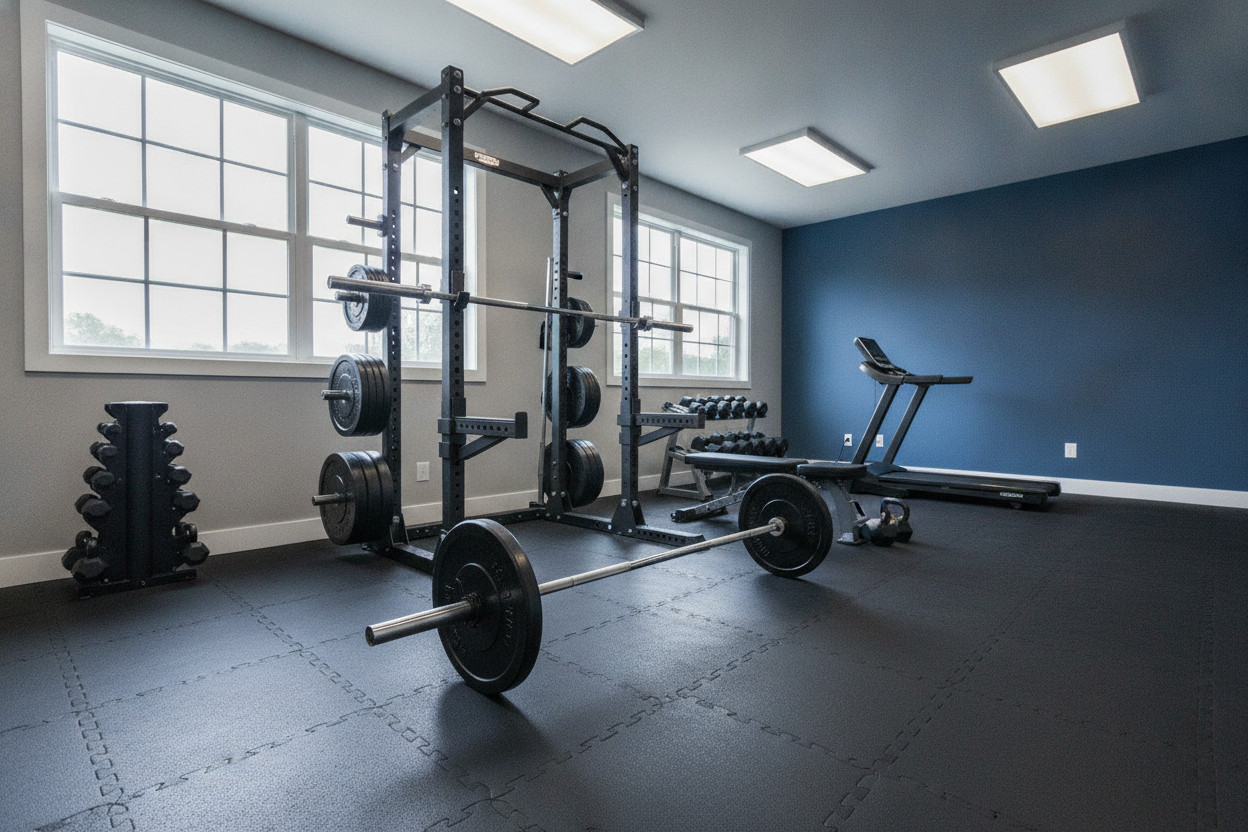
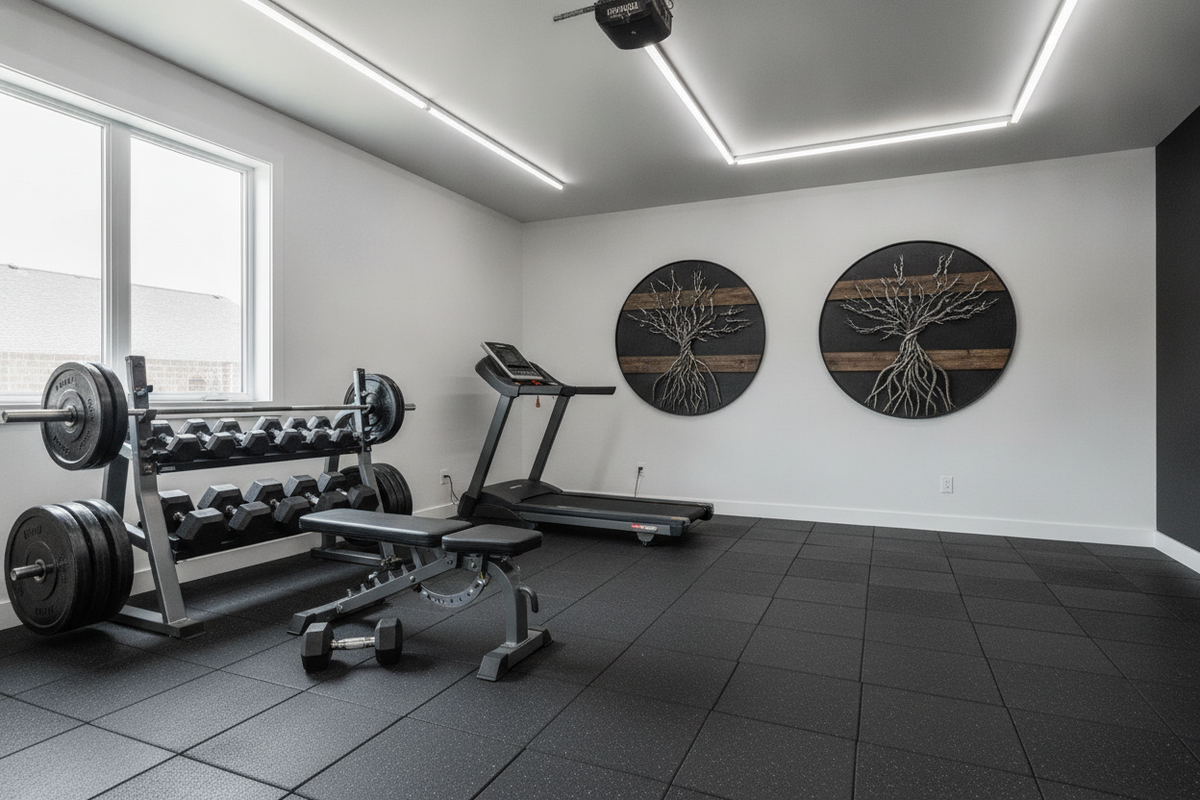
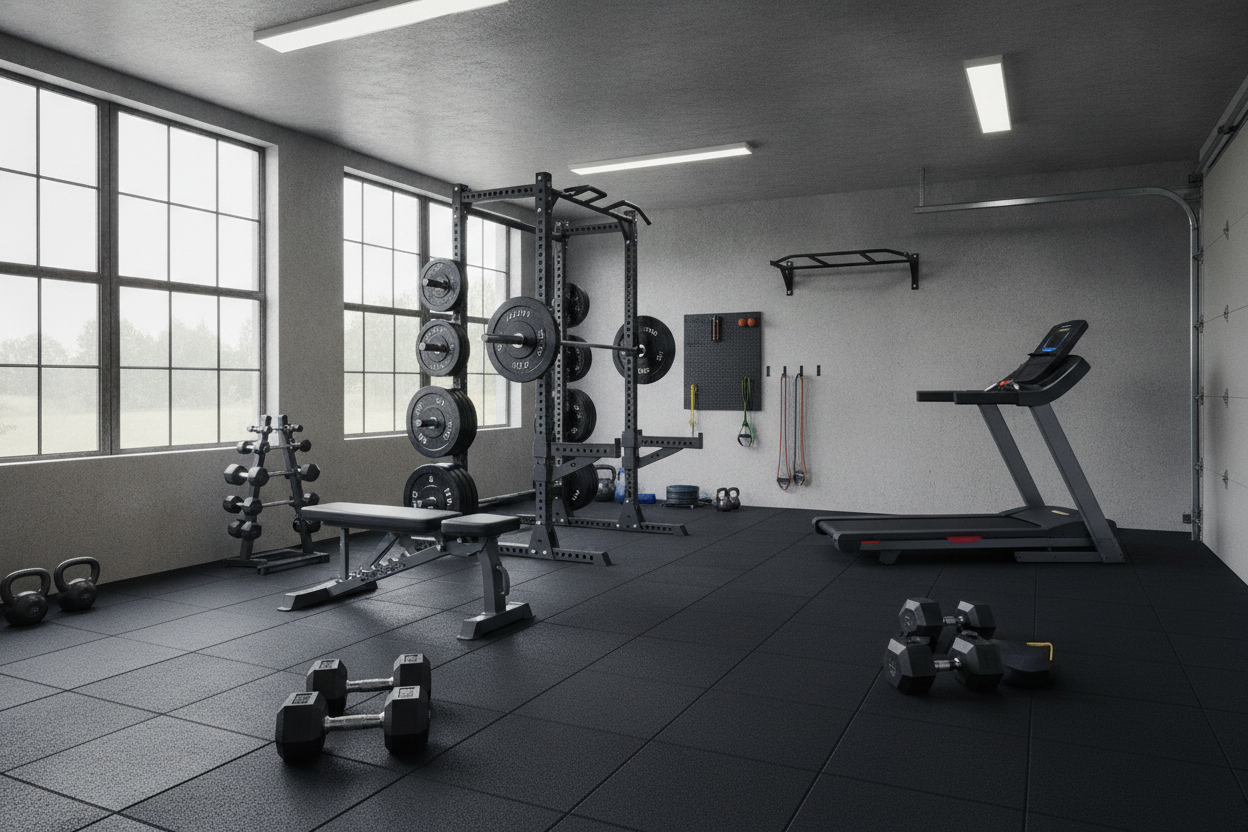
When I finally built my own space, I had a rack, a bar, and about 400 pounds of iron. That was it. Suddenly, my gain mass workout routine became incredibly simple because it had to be. There was no pec deck to retreat to when the bench press got heavy. There was no leg press to hide in when I didn't feel like squatting. This forced compliance is the secret sauce of the garage gym owner.
You need a solid foundation before you start tossing around heavy iron. I learned the hard way that dropping a 315-pound deadlift on bare concrete is a great way to lose your security deposit and piss off the neighbors. I ended up installing high-density gym flooring for home workout to handle the impact. Once the floor was set, the routine took care of itself. Without the distractions of 50 different machines, you focus on the only thing that actually builds muscle: progressive overload on the big lifts.
In a garage, you aren't performing for anyone. You aren't waiting for a machine. You go from the rack to the bench to the floor. This efficiency allows you to keep intensity high. When your equipment is limited, your creativity—and your effort—must increase. You stop wondering which machine is best and start making the barbell your best friend.
A Barebones Blueprint: The 4-Day Split That Actually Works
If you want to grow, stop changing your routine every week. People always ask does a workout for building muscle mass really need variety? My answer is almost always a hard 'no.' You need enough variety to prevent overuse injuries, but not so much that you never get good at the movements. A simple 4-day upper/lower split is the gold standard for a reason.
Monday is Upper A: Bench Press, Barbell Rows, Overhead Press, and Chin-ups. Tuesday is Lower A: Back Squats, Romanian Deadlifts, and some heavy calf work. Take Wednesday off. Thursday is Upper B: Incline Bench, Weighted Pull-ups, Dips, and Barbell Curls. Friday is Lower B: Deadlifts, Front Squats, and Lunges. That’s it. If you can't grow on those movements, no machine in the world is going to save you.
The goal isn't to find a 'new' stimulus every workout. The goal is to perform the same movements better and heavier than you did last week. When you keep the exercises consistent, you can actually track your progress. If you did 225 for 8 last week and 230 for 8 this week, you grew. If you keep swapping the barbell bench for a Hammer Strength machine, you’re just guessing.
Why Recovery is Easier When You Keep It Simple
One of the biggest mistakes I made early on was thinking that more exercises meant more growth. My workout for building muscle mass was a joke because I was doing 8 different exercises per body part. I was constantly sore, my elbows felt like they were full of glass, and I was always exhausted. My central nervous system was fried from the sheer volume of 'junk' I was doing.
When you switch to a barebones routine, your recovery sky-rockets. You're doing fewer total exercises, but you're doing them with significantly higher quality. Instead of 24 sets of mediocre effort, you're doing 10-12 sets of absolute focus. This leaves your body with the resources it needs to actually repair the tissue you've broken down. You'll find that your joints feel better when they aren't being forced into the weird, unnatural planes of motion that some machines require.
Simplicity also reduces the mental fatigue of training. You know exactly what you need to do when you walk into the gym. There’s no 'decision fatigue.' You hit your numbers, you move the weight, and you go eat. That consistency is what builds a physique over years, not weeks.
The Only Metric You Should Actually Track
Forget the 'muscle confusion' and the fancy heart rate monitors. The only metric that matters for mass gain is the total weight on the bar over time. If your squat goes from 185 to 315, your legs will be bigger. It is a physical certainty. By stripping your gym down to the essentials, you remove the 'noise' that prevents you from seeing this truth.
If you're ready to stop playing around with shiny machines and start moving real weight, check out our workout hub for more guides on how to optimize a minimalist setup. Build your foundation, stay consistent, and stop looking for shortcuts in the machine circuit. The iron doesn't lie.
Personal Experience: The 'Wobble' Lesson
I once bought a cheap, 'all-in-one' home gym station from a big-box store. It promised 30 different exercises. The first time I tried to do a heavy chest press, the whole frame wobbled so much I spent more energy trying not to tip over than I did pushing the weight. I sold it for a loss two weeks later and bought a used Rogue squat stand. That stand didn't have 30 exercises, but it allowed me to squat 400 pounds without fear. Lesson learned: Buy quality basics, not cheap versatility.
FAQ
Do I need cables for arm growth?
No. Heavy barbell curls and weighted dips will build more arm mass than any cable attachment. Cables are great for finishing, but they aren't the foundation.
Is 4 days a week enough to get big?
Absolutely. For most natural lifters, 4 days provides the perfect balance between high-intensity stimulus and enough recovery time to actually grow.
Can I build mass without a squat rack?
It's much harder. You can do goblet squats or lunges, but eventually, you'll need the heavy loading that only a rack and barbell can provide safely.