
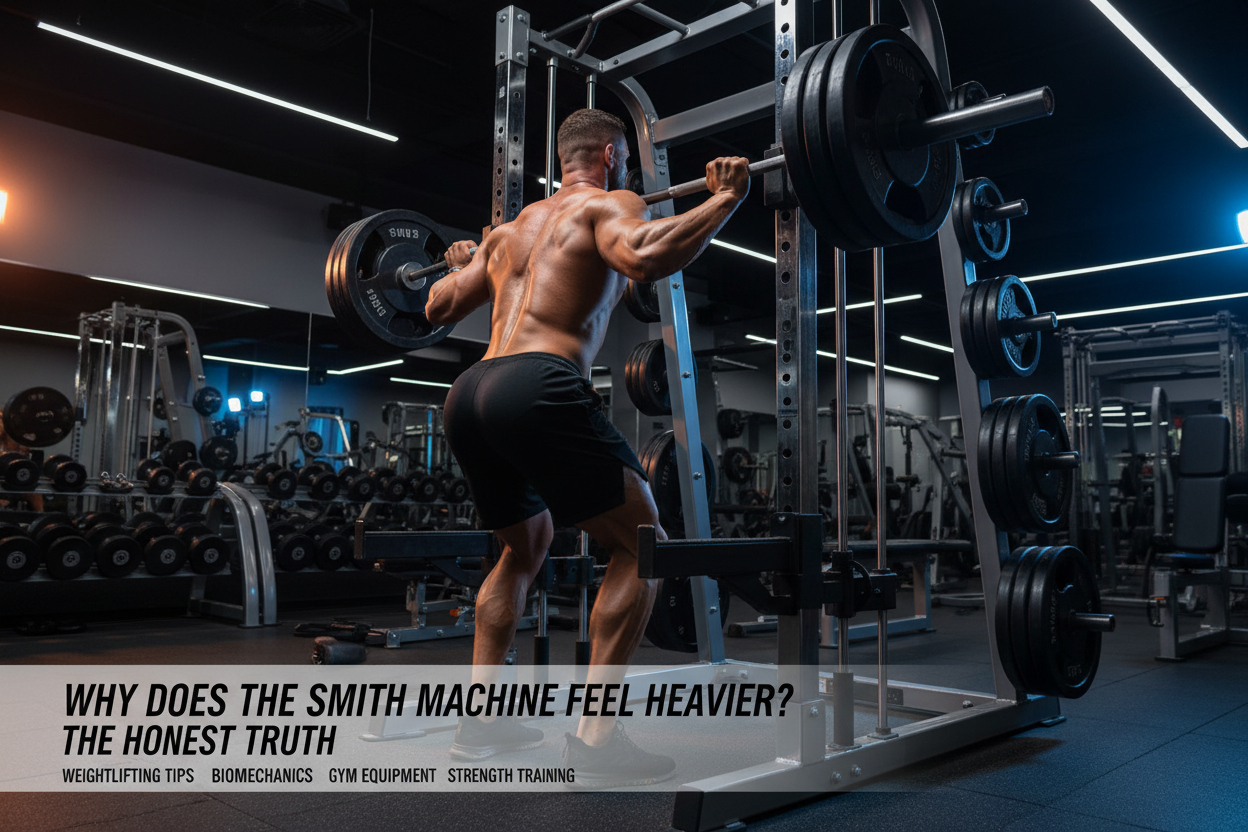
Why Does the Smith Machine Feel Heavier? The Honest Truth
You load up the bar, expecting an easy set. After all, it’s a machine; it stabilizes the weight for you, right? But the moment you unrack, gravity feels intensified. You aren't crazy, and you aren't getting weaker. If you are wondering why does smith machine feel heavier than free weights, you are dealing with a combination of physics, friction, and unnatural biomechanics.
Most lifters assume the Smith machine is an ego-booster, but in specific scenarios, it can actually humble you. Let’s break down exactly why that fixed path is fighting against you.
Key Takeaways: Why It Feels So Heavy
- Mechanical Friction: Unlike free weights, the slider mechanism creates drag against the guide rods, adding resistance during both the concentric and eccentric phases.
- The Fixed Path Disadvantage: The machine forces a straight vertical line, preventing your body from finding its strongest natural leverage points.
- Zero Momentum: You cannot use "body English" or subtle swaying to initiate the lift, forcing strict isolation of the muscle.
- Dead Stop Inertia: Many Smith machine exercises start from a dead stop (bottom position), removing the stretch reflex that helps launch the weight up.
The Hidden Drag Factor: Friction
When you grab a barbell, the only resistance is gravity acting on the mass. However, when you ask why do smith machine feel heavier, the answer often lies in the maintenance of the equipment.
Smith machines run on guide rods. Even the most expensive linear bearing machines have a coefficient of friction. If the rods are dry, dusty, or older, you are essentially fighting a brake system. You aren't just lifting the plates; you are overcoming the drag of the carriage against the rails. This is particularly noticeable on the way down (eccentric), where the weight should feel lighter but instead feels like it's grinding.
Biomechanics: The Straight Line Problem
This is the biggest culprit. The human body rarely moves in a perfectly straight vertical line.
Take the bench press, for example. In a free-weight bench press, the bar naturally travels in a slight "J" curve—moving from above your chest toward your shoulders as you press up. This path optimizes your shoulder joint leverage.
The Smith machine forces a strict vertical path. Because you cannot adjust the bar's trajectory to match your body's mechanics, you are often lifting in a position where your joints have less mechanical advantage. This inefficiency manifests as the weight feeling significantly heavier.
The Stabilizer Myth
It is true that you don't use stabilizer muscles to balance the bar. Theoretically, this should allow you to lift more. However, stabilizers also help transfer force. When you completely remove them from the equation, you are relying entirely on the prime movers (pecs or quads) with zero assistance from the surrounding musculature. This isolation makes the load feel more concentrated and intense.
Bar Weight Variance
There is a massive misconception about how much the bar itself weighs. A standard Olympic bar is 45 lbs (20 kg). Smith machine bars are inconsistent.
Some commercial gyms use counter-balanced machines where the bar effectively weighs zero pounds. However, many older or home-gym models have no counterbalance. In these cases, the bar plus the heavy hook-and-carriage system can weigh upwards of 50 to 65 lbs. If you are calculating your plates based on a standard 45lb bar, but the carriage actually weighs 60lbs, the smith machine feels heavier simply because it is heavier.
My Training Log: Real Talk
I remember walking into a hotel gym in Chicago a few years back. All they had was a rusty Smith machine. I loaded up what I thought was my warm-up weight for squats—usually an easy set.
The moment I dropped into the hole, I felt it. It wasn't just the weight; it was the grit. I could literally feel the bearings vibrating against the guide rod through the bar on my upper back. It felt like gravel was stuck in the mechanism.
Worse, because I couldn't lean forward naturally as I descended (since the bar path is fixed), my hips felt locked. I had to fight the machine just to stand back up. That 225 lbs felt closer to 300 lbs because the machine robbed me of my natural hip drive. I had to strip two plates off just to get a clean rep without compromising my lower back. If you feel that "grind" or vibration in your palms or traps, stop worrying about the number on the plates and adjust your expectations.
Conclusion
So, is the Smith machine actually heavier? In terms of pure physics, often yes—due to friction. In terms of biomechanics, yes—due to inefficient leverage. Don't let the numbers bruise your ego. If the smith machine feels heavier, it's likely because you are performing a stricter, isolated movement with added mechanical drag. Treat it as a different exercise entirely, not a direct equivalent to your free weight numbers.
Frequently Asked Questions
How much does a Smith machine bar actually weigh?
It varies wildly. Counter-balanced machines can weigh as little as 15 lbs (6.8 kg), while non-counter-balanced commercial machines can see the bar and carriage assembly weigh between 45 to 60 lbs depending on the thickness of the steel.
Does the Smith machine build muscle as well as free weights?
Yes, but differently. While free weights are superior for overall strength and stabilizer development, the Smith machine is excellent for hypertrophy (muscle growth) because it allows you to take muscles to absolute failure safely without a spotter.
Why is my bench press weaker on the Smith machine?
This is usually due to the bar path. Since you cannot press in a natural arc, your shoulders and triceps are forced to work in a mechanically disadvantageous position, making the weight feel heavier and limiting your max power output.


