Why Chasing the Wrong Strength Type Is Ruining Your Lifts
I spent three months last winter grinding out heavy triples in my unheated garage, wondering why my athleticism felt like it was stuck in wet cement. I was moving more weight on the bar, but I felt slow, stiff, and gassed after a flight of stairs. I was falling into the classic trap of chasing 'general strength' without realizing I was training for the wrong strength type entirely.
We’ve all been there—scrolling through equipment sites at midnight, wondering if a new specialty bar will fix our plateau. The reality is that your body can't be a master of all trades at once. If you treat every heavy session like a generic effort to 'get strong,' you’re actually sending mixed signals to your central nervous system that result in mediocre gains across the board.
- Absolute Strength: Your ability to move a maximum load once, regardless of time.
- Explosive Strength: How fast you can produce force; think speed pulls and cleans.
- Strength Endurance: Maintaining force over a long period or many repetitions.
- Adaptation: Your body needs a singular focus to make significant neurological changes.
Stop Treating All Heavy Iron Exactly the Same
Most garage gym owners fall into the 'more is better' mindset. You see a powerlifting program, a CrossFit WOD, and a strongman medley, and you try to mash them into a single week. This is a recipe for a 400-lb deadlift that feels like a 600-lb struggle every single time. You aren't just 'lifting weights'; you are trying to elicit a specific physiological response.
When you don't pick a specific target, you end up in no-man's land. You aren't heavy enough to build true max-effort power, and you aren't fast enough to develop true explosiveness. You’re just getting tired. To break a plateau, you have to stop the 'just lift' mentality and start training for a specific outcome. Different types of strength require different rest periods, rep ranges, and even different mental approaches before you even touch the bar.
Which Strength Type Do You Actually Need?
Before you load another plate, you need to be honest about your goals. Are you trying to win a local powerlifting meet, or do you want to be the guy who can carry all the groceries in one trip without breaking a sweat? Identifying the different types of strength is the first step toward a program that actually works for your lifestyle.
Absolute: Moving Maximum Weight
This is the king of the mountain for powerlifters. Absolute strength is your 1-rep max (1RM). It’s about neurological efficiency—teaching your brain to recruit every single muscle fiber at once. This isn't about getting a 'pump.' If you're doing sets of 8, you aren't training absolute strength.
To build this, you need loads at 90% or higher. Because it’s so taxing on your central nervous system, you need long rest periods—3 to 5 minutes at a minimum. If you try to rush these sets, you’re just doing heavy cardio, and your top-end strength will stall. It’s boring, it’s heavy, and it’s the only way to move a house.
Explosive: Speed Meets Iron
Explosive strength is force multiplied by velocity. It’s not just about how much you lift, but how fast you lift it. This is what makes athletes look 'snappy.' If your squats are always slow, grinding struggles, you’re completely ignoring this adaptation.
Training this usually involves 'dynamic effort' days. Think 50-60% of your max, but moved with bad intentions. If the bar slows down, the set is over. This is where you build the 'pop' off the chest in a bench press or the drive out of the hole in a squat.
Endurance: Surviving the Grind
Strength endurance is the ability to produce force repeatedly over time. This is the domain of the 20-rep squat program or high-volume strongman carries. It’s miserable. It burns because of lactic acid buildup, and it requires a massive amount of mental fortitude.
This is arguably the most 'useful' strength for daily life, like moving furniture or hiking with a heavy pack. However, it’s the polar opposite of absolute strength. If you spend all your time in the 15-20 rep range, don't be surprised when your 1RM starts to dip.
Why Mixing Your Workouts Destroys Your Progress
Your body has a limited recovery bucket. When you try to build a massive 1RM while simultaneously training for a Spartan Race, your body gets confused. This is known as the interference effect. The signals for building massive muscle fibers (hypertrophy) and the signals for extreme aerobic endurance often cancel each other out.
I’ve seen guys stall for years because they are blending the different types of strength exercises into a single, chaotic hour. One day they are doing heavy singles, the next they are doing 100-rep kettlebell swings. You end up being 'okay' at everything and 'great' at nothing. If you want to see the needle move on your deadlift, you have to stop trying to be a marathon runner in the same breath.
Equipping Your Garage for Your Specific Goal
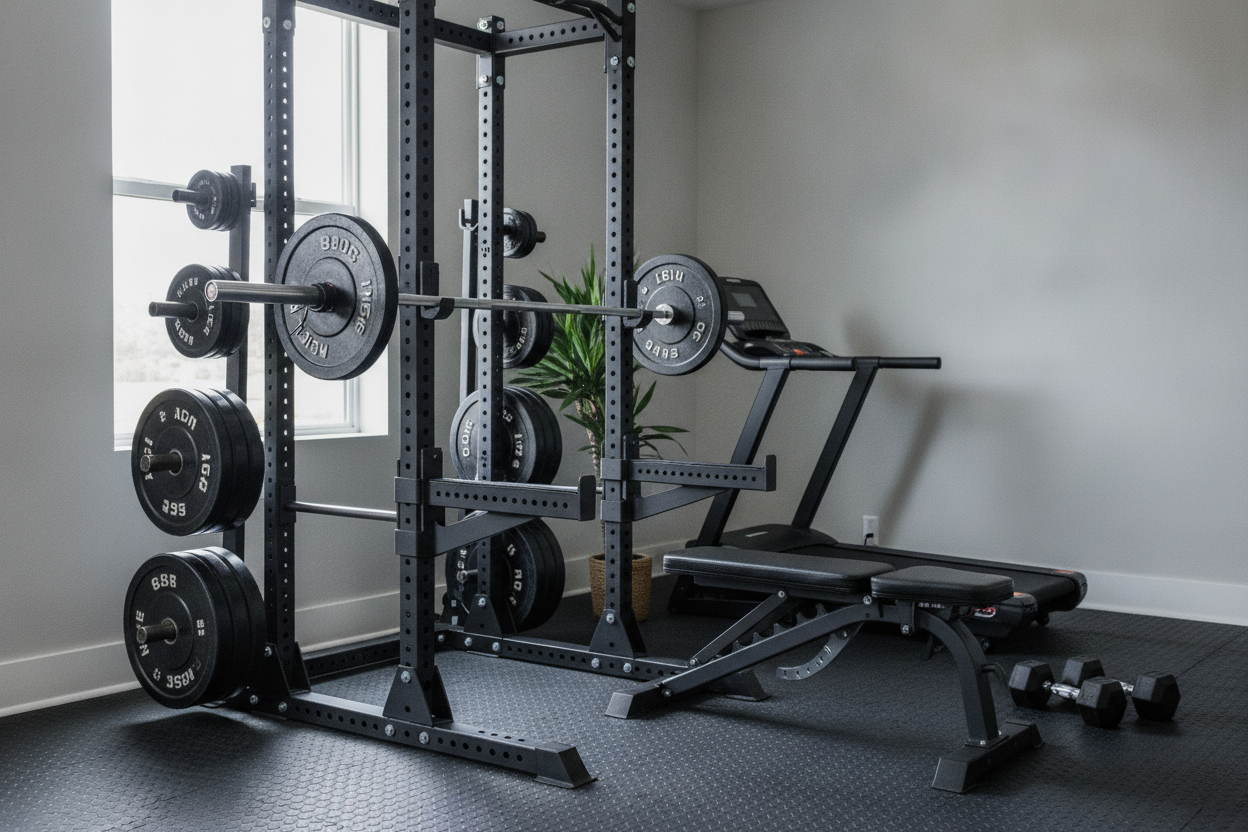
Your gear should reflect your focus. If you are chasing absolute strength, your priority is stability and safety. You need a rack with a high weight capacity—don't settle for a flimsy 14-gauge steel upright if you plan on squatting 500 lbs. Investing in the right strength equipment, like a 3x3 power rack with 11-gauge steel, provides the literal foundation for heavy lifting.
If your focus is more on explosive or accessory work, you’ll want to look into strength training accessories like resistance bands or chains. These allow for 'accommodating resistance,' which means the weight gets heavier as you move into a stronger mechanical position. This is a staple for building explosive power. Also, don't forget the floor—if you're doing explosive cleans, you need real horse stall mats or a dedicated platform to save your foundation (and your marriage).
The Day One Pivot Plan
If you’re currently plateaued, it’s time for a 'Day One' pivot. Look at your training log. If it looks like a random assortment of exercises, pick ONE goal for the next 8 weeks. If you want a bigger squat, commit to absolute strength. That means low reps, high intensity, and long rest.
Strip away the fluff. You don't need three different types of curls if your goal is a 500-lb pull. Focus on the primary adaptation, recover like it’s your job, and watch the numbers finally start moving again. Once you hit that milestone, you can pivot to a different focus, but never try to ride two horses with one saddle.
Personal Experience: The 'Everything' Mistake
A few years ago, I decided I wanted to hit a 500-lb deadlift and run a sub-20 minute 5K in the same month. I was young, dumb, and had a brand new set of bumper plates. I spent six days a week destroying myself. The result? I got a nagging hip injury, my deadlift actually went DOWN by 20 pounds, and I felt like a zombie. I was ignoring the science of adaptation. Once I dropped the distance running and focused strictly on heavy triples and recovery, I hit 500 within six weeks. Focus is a force multiplier.
FAQ
Can I train two types of strength at once?
You can, but progress will be slower. It's better to use a 'block periodization' approach where you focus on one for 4-8 weeks while just maintaining the others with minimal volume.
How do I know which one I'm lacking?
If you can lift a house but get winded walking to the mailbox, you need endurance. If you can do 50 pushups but can't bench your bodyweight, you need absolute strength. If your lifts are 'slow' even at light weights, you need explosive work.
What equipment is best for explosive strength?
Bumper plates are a must so you can drop weights safely. Resistance bands are also incredible for teaching you to accelerate through the entire range of motion.