
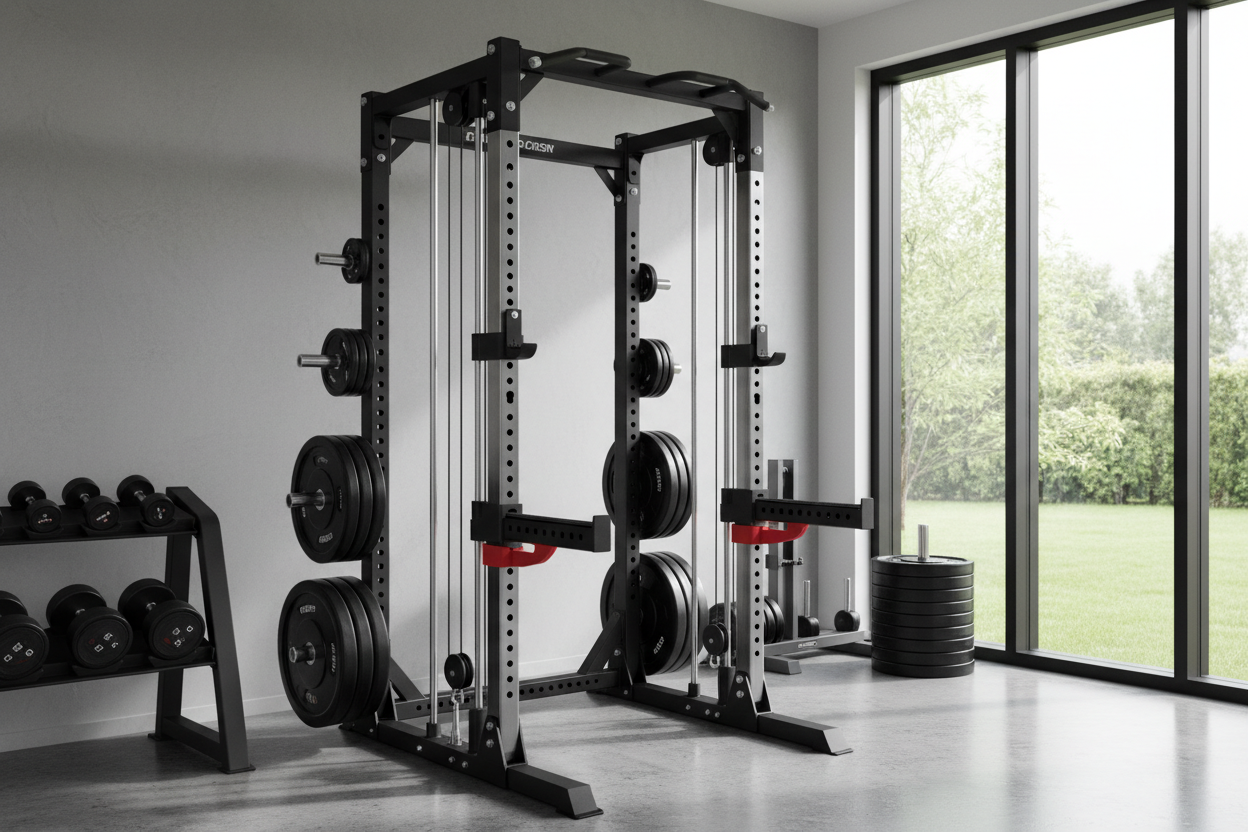
Why a Hybrid Rack System Is the Best Investment for Your Home Gym
Building a home gym usually starts with a simple equation: how much utility can you squeeze into a single car garage or a spare bedroom? Most of us begin with the basics. A barbell, some plates, and a bench. But eventually, the limitations of free weights become obvious. You can bench press for days, but your triceps need isolation. You can row, but your rear delts are screaming for constant tension. This is where the equipment hierarchy shifts, and the realization hits that you don't need more space; you need smarter gear. Specifically, you need a setup that combines heavy safety with functional versatility.
The solution isn't buying five different machines. It is anchoring your space with a single, dominant piece of equipment that handles 90% of your training needs. For the serious lifter who wants commercial gym variety without the commercial gym commute, a power cage with cables is the gold standard. It bridges the gap between raw strength training and bodybuilding-style accessory work, allowing you to squat heavy and immediately transition into cable flys or lat pulldowns without stepping more than two feet away.
The Evolution of the Garage Gym Setup
Years ago, home gym owners had to choose between a sturdy rack for safety and a flimsy, separate tower for cable work. That dichotomy is dead. Modern engineering has merged these two worlds. The primary benefit here is the consolidation of footprint. By integrating a pulley system directly into the uprights or the rear of the structure, manufacturers have created a hybrid unit that saves precious floor space.
When you look at a high-quality rack with cables, you are looking at a system that allows for compound movements—squats, deadlifts, overhead presses—while providing the safety of spotter arms. Simultaneously, the cable portion introduces the vector versatility that gravity-based free weights lack. Free weights provide force in one direction: down. Cables allow you to load muscles from the side, diagonally, or horizontally, which is critical for joint health and complete muscle development.
My Transition from Basic to Hybrid
I spent my first two years of home training working off a cheap, independent squat stand. It got the job done for the big three lifts, but my joints started to feel the wear and tear. My workouts felt one-dimensional. I missed the smooth, fluid resistance of a cable machine for warming up my rotator cuffs or burning out my triceps at the end of a session. I tried using resistance bands looped around the pull-up bar, but the resistance curve was uneven, and frankly, snapping a band into your own face is a humbling experience I don't care to repeat.
Upgrading to a full cage with an integrated selectorized weight stack changed everything. Suddenly, face pulls, lat pulldowns, and low rows were easy to set up. The motivation to train accessory movements skyrocketed because the friction of setting them up was gone. I wasn't tying bands to pillars anymore; I was just moving a pin and pulling. That convenience is the difference between skipping your accessory work and actually doing it.
Analyzing the Mechanics: Pulleys and Ratios
Not all cable systems are built the same, and understanding the mechanics is vital before dropping money. You will generally encounter two types of setups: plate-loaded and selectorized (weight stack). Plate-loaded versions are cheaper and great if you already own a ton of iron. You slide your existing plates onto a carriage. However, the friction can be higher, and changing weights mid-drop set is a hassle.
Selectorized stacks, where you use a pin to select weight, offer the premium commercial feel. Within these systems, you also need to look at the pulley ratio. A 1:1 ratio means 100 pounds feels like 100 pounds. This is ideal for heavy lat pulldowns or seated rows. A 2:1 ratio means 100 pounds feels like 50 pounds. This sounds like a downside, but it is actually preferred for functional movements, single-arm work, and longer cable travel, as it allows for smoother acceleration and finer weight increments.
A robust power cage with cables often utilizes a 2:1 ratio on the front uprights for functional work and a 1:1 ratio for a dedicated lat pulldown station in the rear. This combination offers the best of both worlds.
Structural Integrity and Safety
Stability is non-negotiable. When you are squatting 300+ pounds inside a cage, you want that structure to feel like it is bolted to the bedrock. Adding a cable system actually helps with this. The added weight of the stack or the carriage mechanism adds mass to the back of the unit, lowering the center of gravity and making the entire rack more stable. This is particularly helpful if you cannot bolt your rack to the floor due to rental restrictions or post-tension slab foundations.
When selecting a rack with cables, pay close attention to the upright size. The industry standard has moved toward 3x3 inch steel tubing with 1-inch or 5/8-inch holes. This sizing ensures compatibility with a massive ecosystem of attachments. You don't want to be stuck with a proprietary frame size that won't accept generic dip attachments or lever arms later down the road.
The Versatility Factor
The true magic happens in the programming. With a hybrid system, you can superset heavy barbell movements with cable isolation exercises seamlessly. Imagine performing a set of heavy overhead presses, racking the bar, and immediately grabbing the D-handles on the front uprights for a set of lateral raises. This density of training increases metabolic demand and saves time.
Beyond bodybuilding, these setups are incredible for rehab and prehab. External rotation work for the shoulders, terminal knee extensions for the quads, and pallof presses for core stability are all staples of a healthy lifting routine that are difficult to replicate with just a barbell. The cables provide constant tension throughout the range of motion, which is often safer for rehabilitation than the jarring momentum of free weights.
Making the Final Decision
Budget and ceiling height are your final hurdles. Measure your vertical clearance carefully. Cable systems often require a top beam for the pulleys that adds height. You need to account for pull-up clearance as well; you don't want to hit your head on the ceiling during a chin-up. regarding budget, remember that this is a lifetime purchase. A high-quality steel frame doesn't expire.
Investing in a comprehensive setup is rarely a regret for the committed lifter. The ability to perform a full-body workout—from heavy compound lifts to delicate isolation movements—in a footprint smaller than a parking space is the pinnacle of home gym efficiency. It removes the excuses, protects your joints, and keeps the training varied enough to sustain progress for decades.
Frequently Asked Questions
Do I need to bolt the rack down if it has a cable system attached?
While bolting is always the safest option, racks with integrated weight stacks are often heavy enough to be stable without bolting, especially if you store weight plates on the frame. However, if you plan on doing aggressive kipping pull-ups or using heavy lever arms, bolting or using a platform is highly recommended.
What is the difference between a functional trainer and a rack with cables?
A functional trainer is a dedicated machine with two adjustable pulley columns designed purely for cable work, usually offering no way to rack a barbell. A rack with cables combines a squat cage for barbell work with integrated pulleys, giving you both heavy lifting capabilities and cable versatility in one unit.
Does a 2:1 pulley ratio mean I can't lift heavy?
Not necessarily, but you will max out the stack faster. If a stack has 200lbs with a 2:1 ratio, the max effective resistance is 100lbs per handle. For most isolation movements (triceps, shoulders, chest flys), this is plenty, but for heavy rows or lat pulldowns, you might prefer a system that includes a dedicated 1:1 station.


