Why a Basic Cable Tower Is the best machine for shoulders
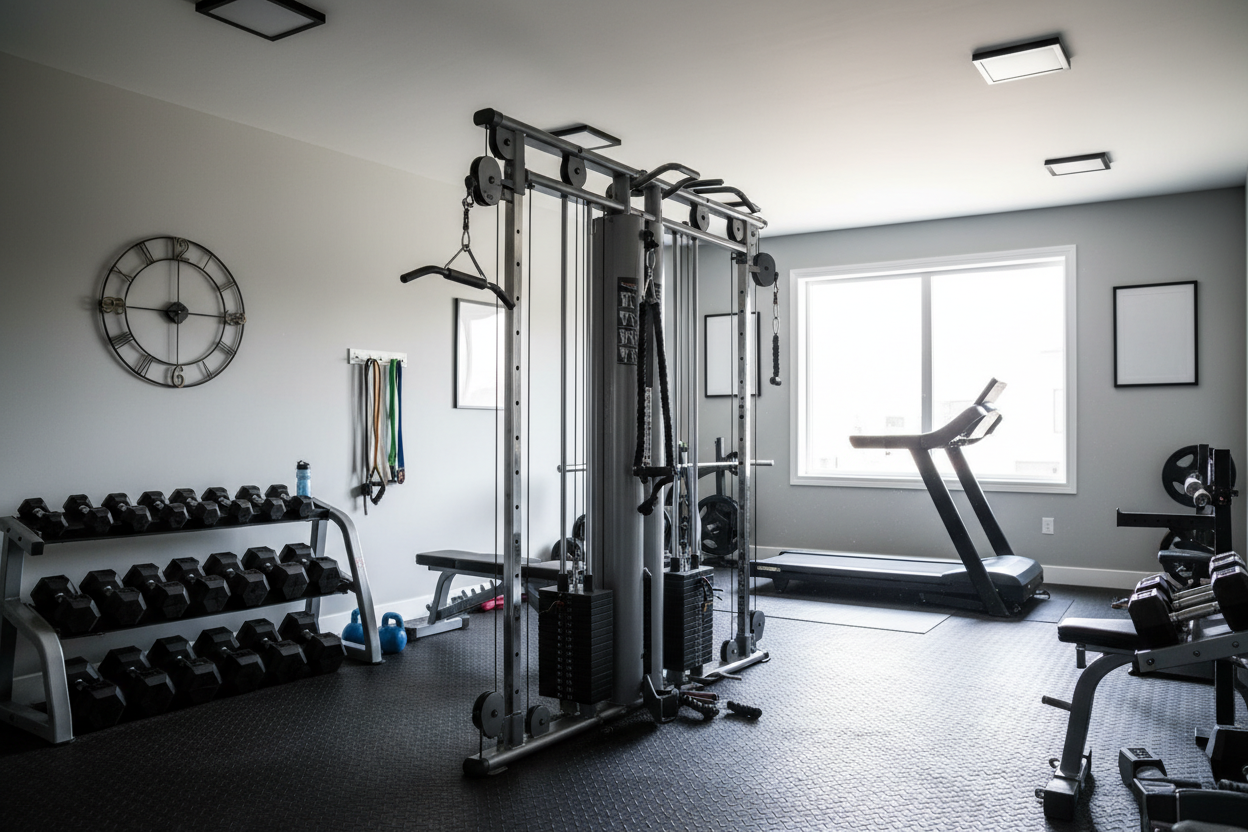
I remember staring at a commercial-grade seated shoulder press on Facebook Marketplace for $400. It looked like a steal, but then I realized it would eat up a 4x5 foot chunk of my garage. If I bought that iron throne, I'd be doing my burpees in the driveway. The reality is that the best machine for shoulders isn't a massive, single-use station; it's the versatile cable tower you probably already use for tricep pushdowns.
- Cables provide constant tension that fixed-path machines simply cannot match.
- Single-use machines are floor-space killers in a home gym where every square inch is premium.
- A functional trainer allows for infinite angles to hit the lateral and rear delts specifically.
- Cables are significantly easier on the rotator cuffs than heavy, fixed-lever presses.
The Problem With Single-Use Press Machines
Commercial shoulder presses are built for high-traffic gyms with 5,000 square feet of rubber flooring. In your garage, space is your most valuable asset. Most of these seated press machines lock your body into a fixed arc. If your specific shoulder mechanics don't align with that machine's pivot point, you're just begging for an impingement or a nagging labrum issue.
I've seen too many lifters buy these bulky units only to realize they can't adjust the seat high enough or the handles are too wide for their frame. Within six months, that best shoulder machine becomes an expensive rack for drying gym towels. Unless you have a massive warehouse, buying a machine that only does one movement is a tactical error.
Why Cables Are the Ultimate Deltoid Builders
When you're finding the best all in one workout machine, you have to look at the tension curve. With a dumbbell, there is zero tension at the bottom of a lateral raise because gravity is pulling the weight straight down toward your feet. With a cable, the resistance is pulling against you from the second you start the rep.
This constant tension is why a dual cable tower is the ultimate tool for hypertrophy. You can manipulate the pulley height to hit the front, side, or rear delts with surgical precision. It’s not just about pushing weight overhead; it’s about keeping the muscle under fire for the entire set. For my money, a high-quality functional trainer is the best shoulder workout equipment because it adapts to your body, not the other way around.
The 3 Cable Movements Your Routine Is Missing
If you want those 3D shoulders that pop, you need movements that dumbbells struggle to replicate. First is the leaning lateral raise. By grabbing the tower and leaning away, you put the lateral delt in a stretched position that creates massive mechanical tension. Second is the face pull—a non-negotiable movement for rear delt health and fixing that 'computer hunch' posture.
Finally, try the kneeling cable press. Unlike a barbell, the cables allow your hands to move in a more natural scapular plane. Because this setup handles everything from face pulls to squats, it’s arguably the best full body home workout machine for someone who wants to maximize utility without a forest of equipment.
What About Heavy Overhead Pressing?
I am not telling you to stop overhead pressing. I still love a heavy barbell press or grinding out sets with 80-lb dumbbells. But those movements are tax-heavy on your nervous system and your spine. Once you’ve done your primary heavy lifting, you need to transition to something that fries the muscle without trashing your joints.
The cable tower is the perfect finisher. You can move from a heavy press straight into a cable lateral raise superset to completely exhaust the muscle fibers. It allows you to reach true failure safely. If you drop a cable handle, nothing happens. If you fail a 200-lb overhead press alone in a garage, things get sketchy fast.
Supersetting to Save Time in a Cold Garage
When it’s 30 degrees in my garage, I don't want to stand around for two minutes between sets. I prefer to keep moving. I’ll often pair my high-volume cable shoulder work with sets on a leg machine like a leg extension or curl station. This keeps the heart rate up and ensures I'm done with my session in under an hour.
By supersetting upper and lower body isolations, you maximize your training window. You aren't just standing there looking at your phone; you're getting more work done in less time. It’s about efficiency. A cable tower allows for these quick transitions because changing the weight is as simple as moving a pin in the stack.
My Personal Take
I once spent $600 on a plate-loaded shoulder press machine that took up a 4x4 foot footprint. It felt clunky, and the start position was so low it hurt my shoulders just to unrack the weight. I eventually sold it for half of what I paid and installed a wall-mounted cable station. My shoulders have never looked better, and I actually have room to park my car now. Don't make the mistake of buying 'cool' looking gear that lacks versatility.
FAQ
Is a cable tower better than dumbbells for shoulders?
For isolation and constant tension, yes. Cables keep the muscle loaded through the entire range of motion, whereas dumbbells lose tension at the bottom of the movement.
How much space does a cable tower need?
A compact wall-mounted unit only needs about 2 feet of wall space and about 4 feet of 'pull-out' room to perform exercises comfortably.
Can I build big shoulders with just cables?
Absolutely. Muscle growth is driven by tension, volume, and progressive overload. You can achieve all three with a cable stack just as effectively as you can with free weights.