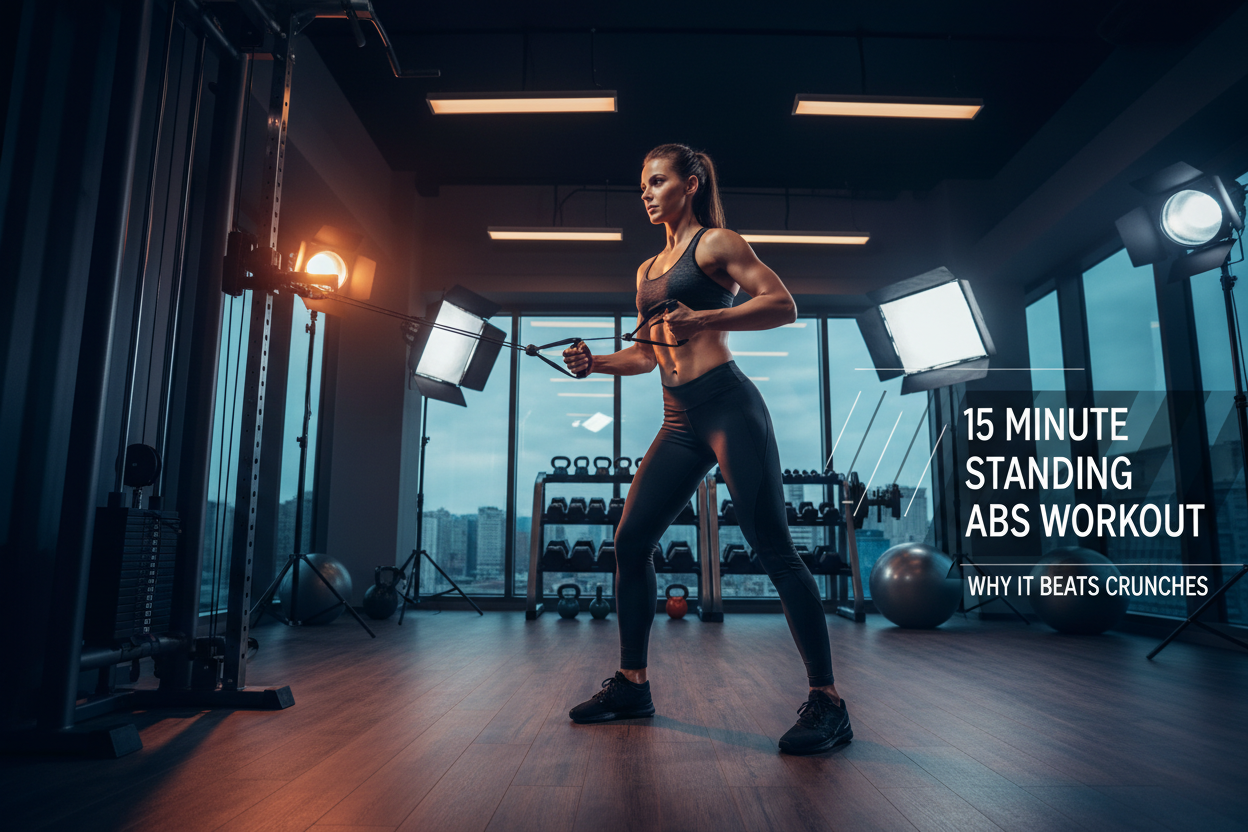
Why A 15 Min Standing Abs Workout Beats Crunches
If you have ever finished a set of traditional sit-ups with more strain in your neck than your core, you are not alone. Many home gym owners dread floor-based core exercises, especially if their workout space is a chilly garage or a cramped basement. That is exactly where a 15 min standing abs workout changes the game. By taking your core training off the floor, you protect your posture, maximize your limited workout time, and build functional strength that translates directly to heavy compound lifts.
Whether you are looking to break through a training plateau or just want a fast, effective routine that does not require lying on a sweaty mat, this guide will show you how to build an elite upright core session.
Key Takeaways
- Standing core exercises engage your stabilizing muscles more effectively than traditional floor crunches.
- A 15 minute standing abs workout requires minimal space, making it perfect for compact apartment gyms.
- Incorporating light dumbbells, kettlebells, or resistance bands drastically increases the intensity.
- Upright ab movements improve posture and translate better to real-world lifting mechanics like squats and deadlifts.
Why Upright Core Training Wins in a Home Gym
Functional Strength for Heavy Lifts
When you perform a 15 minute standing ab workout, you are training your core the way it was designed to function: stabilizing your spine while you are on your feet. Movements like woodchoppers, standing marches, and overhead side bends force your entire trunk to brace. This functional engagement mimics the bracing required for heavy barbell squats and overhead presses, giving you more bang for your buck.
Space and Equipment Efficiency
Not everyone has the floor space for a dedicated stretching mat, especially in a garage gym packed with a power rack and weight trees. Upright core training requires zero floor clearance. As long as you have enough room to extend your arms, you can complete a full 15 min standing abs routine. It is the ultimate space-saving finisher.
Essential Gear to Elevate Your Routine
Dumbbells and Kettlebells
While bodyweight is a great starting point, adding resistance is how you build a blocky, powerful core. A single moderate-weight kettlebell or dumbbell is perfect for suitcase holds, standing side bends, and halo rotations. If you are shopping for a home gym, investing in a pair of adjustable dumbbells gives you an incredible range of resistance for your 15 minute standing abs workout without eating up footprint.
Resistance Bands
Do not underestimate the power of constant tension. By anchoring a resistance band to the uprights of your power rack, you can perform Paloff presses and standing twists. Bands are highly affordable, take up virtually zero space, and provide a unique resistance curve that challenges your obliques at peak contraction.
From Our Gym: Honest Take
I used to skip core work entirely because I hated getting down on the freezing rubber stall mats in my garage gym during the winter. Transitioning to upright core work completely fixed my consistency. During my own sessions, I rely heavily on a 35-pound kettlebell for standing oblique crunches and rack-anchored band rotations.
One specific thing I noticed: when doing standing overhead dumbbell side bends, ceiling clearance can be an issue if your basement ceiling is under seven feet. I am 6-foot-1, and I occasionally scrape the joists if I am not careful with my overhead reach. That said, after six months of swapping floor crunches for a focused standing routine, my bracing during heavy deadlifts feels noticeably more locked-in. The functional carryover is real.
Frequently Asked Questions
Are standing abs as effective as floor abs?
Yes, and in many ways, they are superior. Standing exercises engage your glutes, lower back, and deep stabilizing muscles (like the transverse abdominis) to maintain balance, offering a more comprehensive core workout than isolated floor crunches.
Can I get a good workout without any equipment?
Absolutely. A bodyweight 15 min standing abs session using high-knee twists, standing bicycles, and front kicks can elevate your heart rate and torch your core. However, as you get stronger, adding a resistance band or a light dumbbell will help you continue progressing.
How often should I do a standing core routine?
For most home gym athletes, integrating a 15 minute standing abs workout two to three times a week at the end of a strength training session is plenty. Your core recovers quickly, but it still needs rest days, especially if you are lifting heavy compounds on your other training days.