
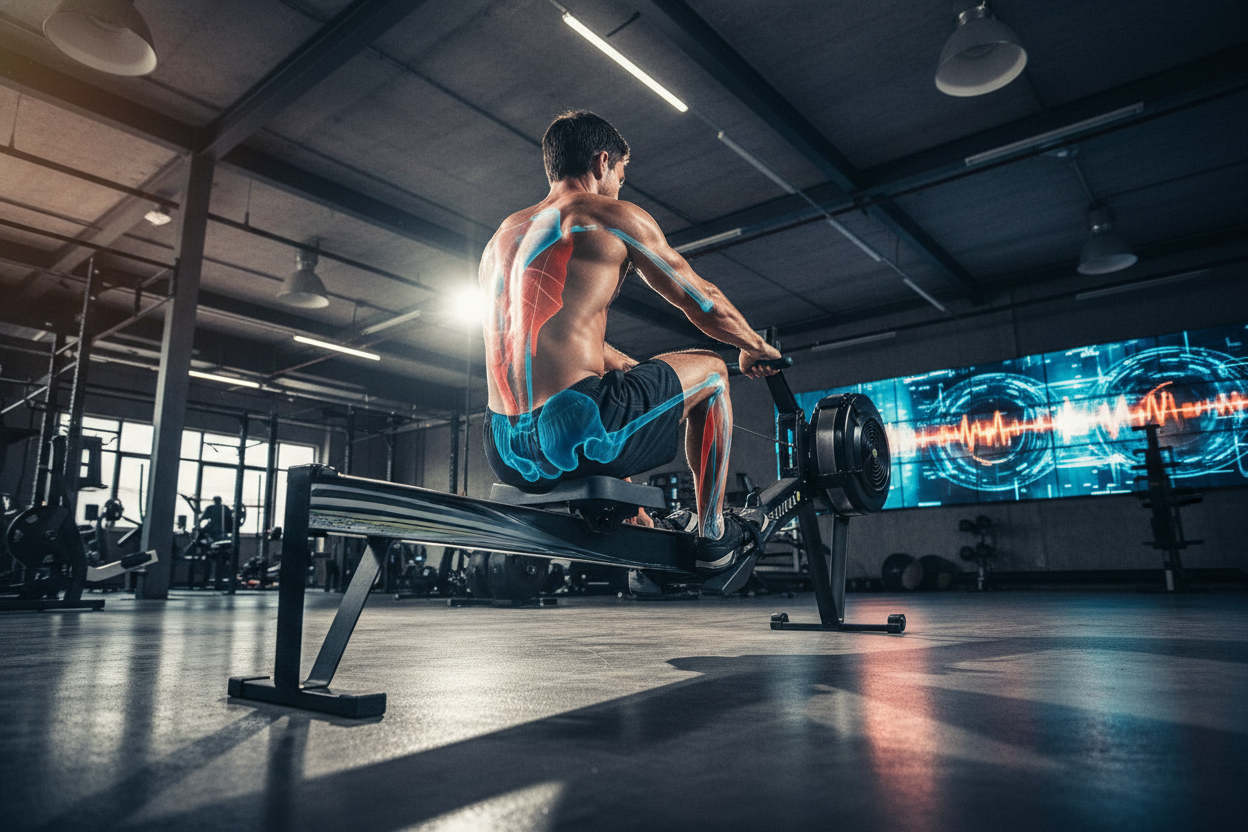
What Does the Rowing Machine Workout? The Complete Muscular Breakdown
Walk into any commercial gym, and you will see the same scene: a row of treadmills occupied by runners, while the ergometer (rowing machine) sits empty in the corner. Or worse, someone is on it, rounding their back and yanking the handle with only their arms. This happens because most people simply don't understand what does the rowing machine workout actually target.
There is a misconception that rowing is strictly an upper-body exercise for your back and arms. That couldn't be further from the truth. When executed with proper form, the ergometer is one of the few machines that demands high-output performance from your entire kinetic chain.
If you are looking for efficiency, you have found it. Let’s break down the anatomy of the stroke.
Key Takeaways: The Short Answer
If you are looking for the quick summary for your workout log, here is the breakdown of the primary systems engaged:
- The Legs (60% of the effort): Quadriceps, hamstrings, glutes, and calves drive the movement.
- The Core (20% of the effort): Abdominals, obliques, and erector spinae stabilize the lower back.
- The Upper Body (20% of the effort): Lats, rhomboids, rear delts, biceps, and forearms complete the stroke.
- Cardiovascular System: Simultaneously trains aerobic endurance and anaerobic power depending on stroke rate.
The 86% Rule: It’s Not Just About Arms
According to the English Institute of Sport, rowing engages 86% of the muscles in your body. This is significantly higher than cycling or running, which are predominantly lower-body focused.
When people ask, "what does a rowing machine workout?" the answer is effectively "everything except your pushing muscles (chest and triceps)." However, the magic lies in the sequence of firing these muscles.
The Four Phases of the Stroke
To understand what the machine targets, you have to look at the four distinct phases of the rowing movement. It is a pushing sport, not a pulling sport.
1. The Catch (Flexibility and Tension)
This is the starting position. Your shins are vertical, and your body is compressed. While this looks static, your muscles are primed like a coiled spring.
Here, your erector spinae (lower back) works isometrically to keep your posture upright, while your triceps extend your arms to reach the handle. Flexibility in the ankles and hips is tested here.
2. The Drive (Explosive Leg Power)
This is where the work happens. The drive is initiated solely by the legs. You are performing a horizontal leg press.
Your quadriceps and glutes fire explosively to push the seat back. If you engage your arms here, you kill the power transfer. The core must remain braced tight to transfer that leg power through the hips to the handle.
3. The Finish (Upper Body Engagement)
Once the legs are nearly extended, the hips swing open. This engages the posterior chain. Finally, the arms pull the handle to the lower ribs.
This is where you answer the question, "rowing machine works out what regarding the upper body?" Your latissimus dorsi (lats), rhomboids, rear delts, and biceps contract to finish the stroke. Your forearms are also under constant tension gripping the handle.
4. The Recovery (Core Control)
The slide back to the start isn't a vacation. It requires controlled engagement of the rectus abdominis (abs) and hip flexors to pull your body forward against gravity and the momentum of the flywheel.
Cardiovascular vs. Muscular Endurance
Beyond skeletal muscle, what does rowing machine work out internally? It targets the heart and lungs aggressively.
Because you are forcing blood to flush into the legs (for the drive) and immediately up to the back/arms (for the finish), your heart has to work double-time to manage the circulation. This creates a unique metabolic demand that burns calories at a higher rate than steady-state cycling for most athletes.
My Training Log: Real Talk
I want to bridge the gap between the science above and what you will actually feel during a 2,000-meter test or a hard interval session.
The textbooks tell you it works the glutes and lats. But here is what I notice when I'm deep in the pain cave: it's the grip and the shins.
Around the 1,500-meter mark of a 2k row, my forearms feel like they are filled with cement. The specific knurling on the Concept2 handle starts to dig into the calluses right at the base of my fingers—not the palm, but that fleshy ridge where the fingers connect. You have to fight the urge to loosen your grip, which leaks power.
Also, nobody talks about the shin splint feeling. On the recovery, when you pull yourself back toward the monitor, if you are rushing, your tibialis anterior (front of the shin) burns like crazy because you are aggressively flexing your toes up against the foot straps. If you feel that burn, you're likely rushing the slide. Slow down the return.
Conclusion
So, exactly what does the rowing machine workout? It works your ability to coordinate explosive leg power with upper body endurance, all while gasping for air. It is the ultimate efficiency tool for the time-crunched athlete.
Stop treating it like an arm exercise. Drive with your heels, brace your core, and respect the machine. It will respect you back with serious fitness gains.
Frequently Asked Questions
Does the rowing machine workout belly fat?
While you cannot spot-reduce fat, rowing is a high-calorie-burning exercise. Because it engages so many muscle groups simultaneously, it elevates your metabolic rate significantly, helping you burn visceral fat (belly fat) more efficiently than isolation exercises.
Is rowing bad for your lower back?
Rowing is only bad for your back if your form is poor. If you round your spine (slouch) or shoot your seat back before your shoulders move, you risk injury. However, with proper technique, rowing actually strengthens the lower back and core, protecting the spine.
Can I use the rowing machine every day?
Yes, rowing is low-impact, meaning it puts minimal stress on joints compared to running. However, because it is muscularly demanding, beginners should start with 3-4 sessions a week to allow the back and grip muscles to adapt to the volume.


%20sits%20empty%20in%20the%20corner.%20Or%20worse,%20someone%20is%20on%20it,%20ro...)