
What Does the Rower Machine Workout? The Definitive Anatomical Guide
You see it sitting in the corner of the gym. It looks simple enough—a sliding seat, a handle, and a flywheel. Yet, for many gym-goers, the ergometer (or "erg") remains a mystery. Most people assume it’s just an arm exercise or a warmup tool. They couldn't be more wrong.
If you have ever asked yourself what does the rower machine workout, the short answer is: almost everything. It is one of the few pieces of equipment that bridges the gap between serious cardiovascular endurance and legitimate strength training.
As a coach, I see too many people skipping the rower because they don't understand the return on investment. Let's break down exactly which muscles are firing and why this machine deserves a spot in your routine.
Key Takeaways: Muscle Activation Summary
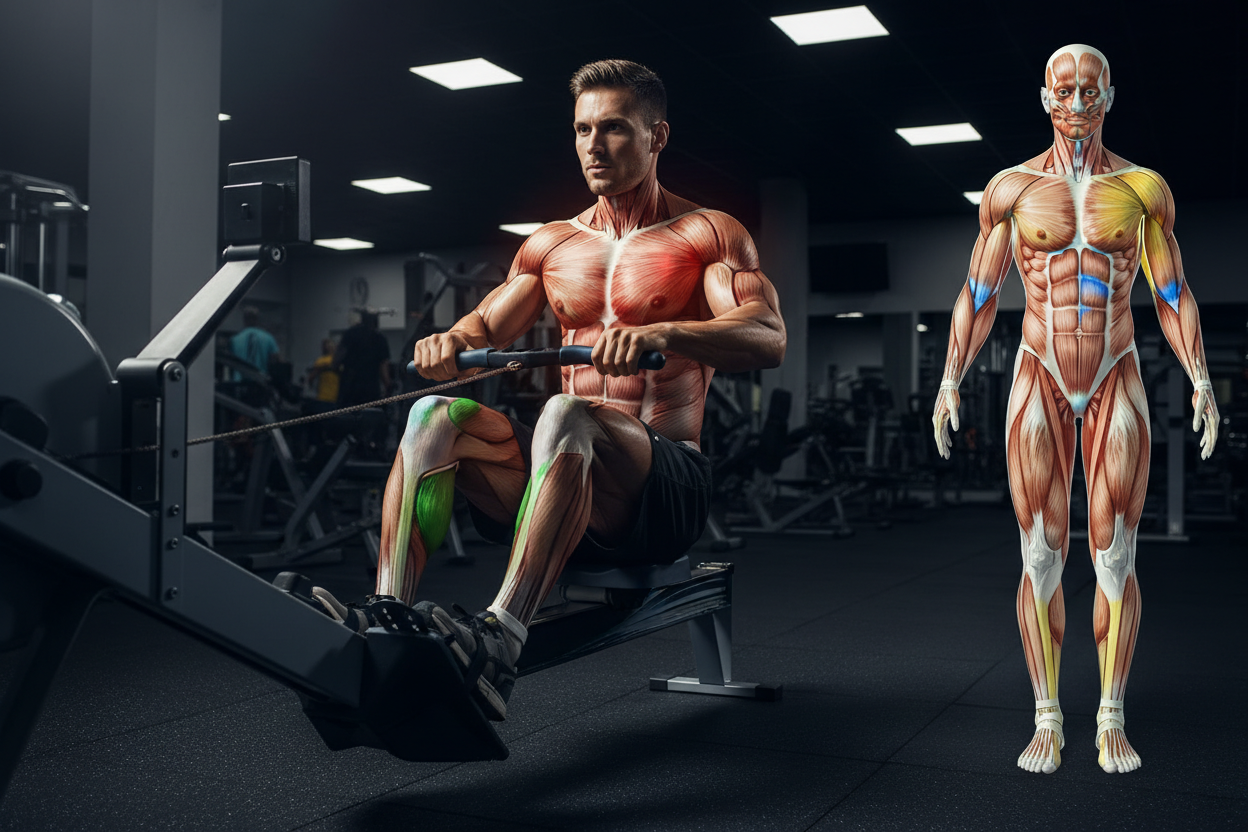
If you are looking for a quick answer on what this machine targets, here is the breakdown based on biomechanical analysis. This is why rowers have such athletic physiques.
- Total Body Engagement: Rowing utilizes approximately 86% of the muscles in your body.
- Leg Dominance: Contrary to popular belief, the drive is 60% leg power (Quads, Glutes, Calves).
- Core Stability: 20% of the effort comes from bracing the core and trunk extension.
- Upper Body Finish: Only the final 20% involves the arms and back (Lats, Rhomboids, Biceps).
- Dual Benefit: It provides high-intensity cardiovascular conditioning while simultaneously building muscular endurance.
The Mechanics: It's Not Just Pulling
To understand what does rowing workout effectively, you have to look at the stroke cycle. It isn't a singular motion; it's a sequence. We call this the Catch, Drive, Finish, and Recovery.
When you push away from the flywheel, you are performing a movement similar to a deadlift horizontally. You are generating force through the floor (or footplates), transferring it through a rigid torso, and finishing with a pull. If you aren't feeling it in your legs, your form likely needs adjustment.
The Lower Body: The Engine Room
When discussing what does rowing exercise target, we must start at the bottom. The power phase of rowing is leg-centric.
The Quadriceps and Glutes
At the "Catch" (the start of the stroke), your knees are bent, and your shins are vertical. As you explode back, your quadriceps extend the knee with tremendous force. Simultaneously, your glutes fire to open the hip angle.
This is why what does rowing machine workout do for your lower body is comparable to high-rep leg pressing. You are constantly under tension during the drive phase.
The Hamstrings
As you slide back forward during the recovery, your hamstrings contract to pull you back toward the machine. They also act as stabilizers during the drive to prevent hyperextension of the knee.
The Core and Back: The Transmission
What does a rower workout in terms of the trunk? Think of your body as a lever. Your legs generate the power, but your core must transfer that power to the handle.
Erector Spinae and Abdominals
If your core is soft, you lose power. To keep the chain moving smoothly, your abdominal muscles brace to protect the lower back, while the erector spinae (lower back muscles) engage to swing the torso from a forward lean to a slight backward lean.
This dynamic trunk flexion and extension is exactly what is rowing exercise renowned for—building a bulletproof back, provided you maintain a neutral spine.
The Upper Body: The Finish
Finally, rowing machine what does it work out regarding the upper body? This is the "20%" of the stroke, but it is vital for posture.
Lats, Rhomboids, and Traps
As the legs finish their push, the back takes over. You retract your scapula (shoulder blades), engaging the rhomboids and trapezius. The latissimus dorsi (lats) do the heavy lifting to pull the handle toward the lower ribs.
Biceps and Deltoids
Your biceps act as the final lever to bring the handle in, while the rear deltoids help keep the shoulders pinned back. This counteracts the "slumped" posture many of us have from sitting at desks all day.
Cardiovascular vs. Muscular Endurance
So, what do rowers workout regarding energy systems? The rower is unique because it is "effort-based." The harder you push, the more wind resistance the flywheel generates.
This allows you to train anaerobic power (sprints) and aerobic capacity (long, steady distance) on the same machine. It forces the heart to pump blood rapidly to feed that massive amount of muscle tissue described above, creating a caloric burn that outpaces a stationary bike or elliptical.
My Training Log: Real Talk
I want to bridge the gap between the anatomy charts and reality. I've spent hundreds of hours on a Concept2, and here is the truth about what does rower workout feel like.
The first thing you notice isn't the muscle pump—it's the grip. About 1,500 meters into a 5k piece, your forearms start to scream. It’s that specific burning sensation where you can barely unclench your fingers from the handle during a water break.
Then there's the "rower's cough." After a max-effort 2,000-meter test, the air in the room feels dry, and your lungs burn in a very distinct way that I've never felt from running. It’s a metallic taste in the back of the throat.
Also, let's talk about the butt numbness. If you are doing a long session (10k or more), the padding on standard rower seats feels like it disappears after 30 minutes. I actually have to stop and do a quick "glute reset" wiggle just to get feeling back. It’s not glamorous, but that is the reality of the machine.
Conclusion
The rower is the ultimate efficiency tool. It doesn't isolate muscles; it integrates them. By demanding synchronized effort from your legs, core, and back, it builds a functional, athletic physique that translates to the real world.
Next time you walk past the erg, don't ignore it. Strap in, focus on the leg drive, and experience the full-body impact for yourself.
Frequently Asked Questions
Does the rowing machine burn belly fat?
While you cannot spot-reduce fat, the rowing machine is highly effective for overall fat loss. Because it recruits so many large muscle groups (legs and back), it burns a high number of calories per minute, creating the deficit needed to shed body fat, including from the belly area.
Is rowing better than running for your body?
For many people, yes. Rowing is a low-impact exercise, meaning your feet remain in contact with the pads, eliminating the pounding shock on knees and ankles associated with running. This makes it a safer option for joint health while still providing intense cardiovascular conditioning.
Can you build muscle on a rower?
Yes, specifically muscular endurance. While it won't build bulk like a heavy barbell squat, the high resistance settings on a rower can stimulate hypertrophy in the quadriceps, back, and shoulders, resulting in a lean, athletic, and toned look.

%20remains%20a%20mystery.%20Most%20people%20assume...)