Unlock Your Lower Body Potential: The Ultimate Guide to Resistance Band Leg Workouts
If you're looking to build stronger, more defined legs without needing a full rack of weights, resistance bands are your secret weapon. These simple, portable tools create constant tension that challenges your muscles through every phase of movement, leading to impressive gains in strength, stability, and muscle endurance. Whether you call them exercise bands, stretch bands, or resistance tubes, incorporating them into your leg day routine can transform your results from the comfort of your home or as a potent addition to your gym session.
The beauty of band leg exercises lies in their versatility and accessibility. You can target every major muscle group in your lower body—quads, hamstrings, glutes, and calves—with a single loop or tube. The resistance increases as you stretch the band, matching your natural strength curve and providing a unique challenge that free weights sometimes miss. This makes them excellent for activating stabilizing muscles, improving joint health, and adding variety to prevent plateaus.
Essential Band Leg Exercises to Build Your Routine
Let's explore some foundational movements that form the core of any effective leg workout with elastic bands. For these, a medium-resistance loop band is a great starting point.
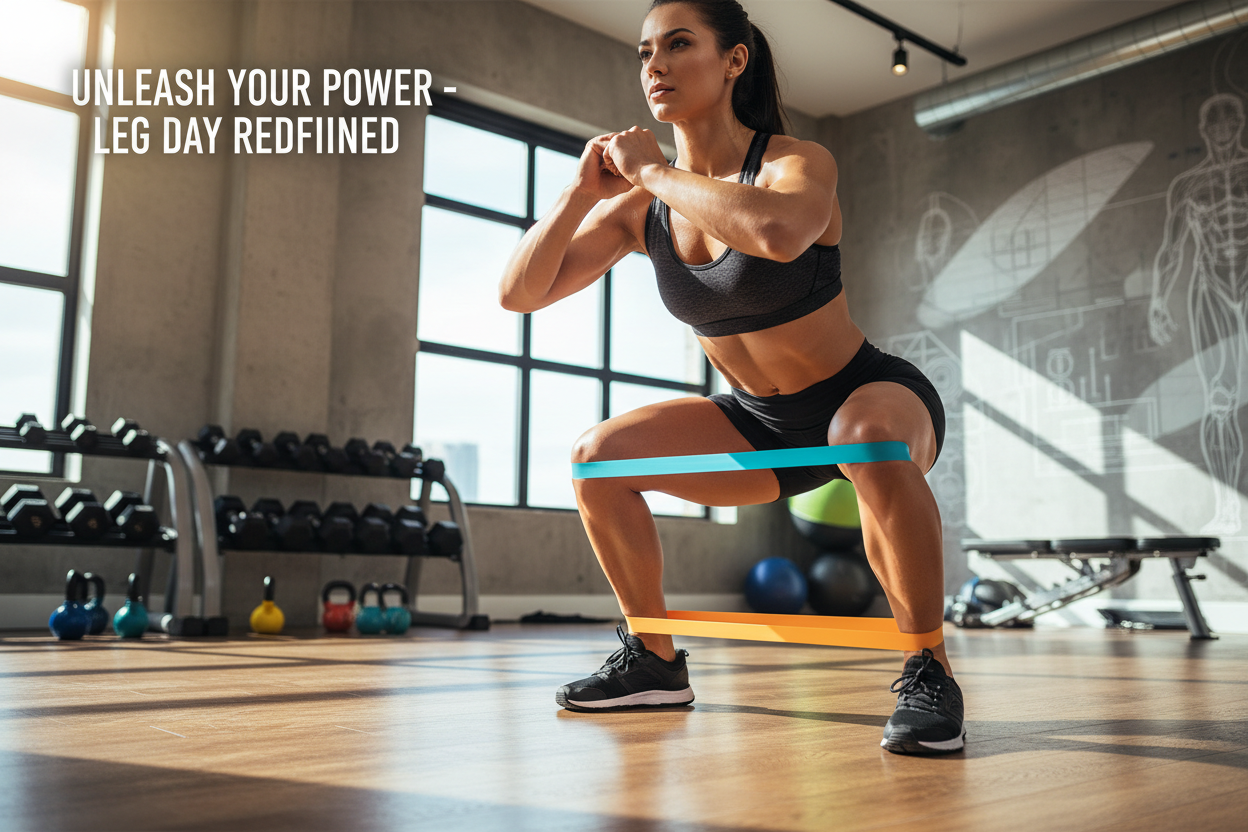
Band Squats
Place a loop band just above your knees. Stand with feet shoulder-width apart. As you descend into your squat, push your knees outward against the band's pull. This not only works your quads and glutes but also fires up your outer hips and improves squat form by combating knee cave.
Glute Bridges with Band
Lie on your back with knees bent and a loop band around your thighs, just above the knees. Drive through your heels to lift your hips toward the ceiling, while simultaneously pressing your knees apart. Squeeze your glutes hard at the top. This is a powerhouse move for the posterior chain.
Lateral Band Walks
With a band around your ankles or lower thighs, assume a slight athletic squat. Take controlled steps to the side, maintaining tension on the band without letting your feet come together. This deceptively simple move is one of the best for building hip and glute strength, crucial for both athletic performance and daily movement.
Standing Leg Abductions
Anchor a resistance tube to a low, stable point. Loop the other end around your ankle. Standing tall and holding onto something for balance, pull your leg directly out to the side against the band's resistance. This directly targets the often-neglected gluteus medius.
I recall adding lateral band walks as a warm-up before my heavy lifting days. The difference was immediate. My hips felt more stable, my squats felt stronger from the very first rep, and I noticed a significant reduction in the occasional knee twinge I'd sometimes feel. It was a small addition that delivered outsized results, proving that these tools aren't just for light work.
Maximizing Your Leg Workout with Exercise Bands
To get the most from your leg training with bands, consider your setup and progression. For exercises like kickbacks or leg curls, you'll need an anchor point. A sturdy door, a squat rack post, or even the leg of a heavy couch can work perfectly with a door anchor attachment. Always check that your anchor is secure before loading it with force.
Progression is key. Bands come in varying levels of resistance, typically color-coded from light to extra heavy. Start with a band that allows you to complete your sets with good form but feels challenging by the final few reps. As you grow stronger, you can move to a thicker band, shorten your grip on a tube to increase tension, or combine bands for more intensity. The constant pull of a resistance band for leg workout also teaches your muscles to control the eccentric (lowering) phase, which is vital for growth and injury prevention.
Building a Complete Leg Day Resistance Band Session
A well-rounded leg workout with exercise bands should include a mix of compound and isolation movements. Begin with a dynamic warm-up like leg swings or bodyweight squats with a light band. Then, move into your main work: squats, lunges, and hip thrusts for major muscle groups. Follow these with targeted moves like clamshells, inner thigh pulls, or seated leg extensions using a tube. Finish with high-rep burnout sets, such as banded pulse squats, to fully fatigue the muscles. This approach ensures you hit every angle for comprehensive leg development.
Choosing Your Gear: Bands, Tubes, and Loops
The terminology can be confusing, but the gear is straightforward. Loop bands are continuous circles, perfect for placing around your thighs or ankles for squats and glute work. Resistance tubes typically have handles on the ends and are ideal for anchored exercises like leg curls or presses. Some sets combine both, offering maximum versatility. For leg training resistance bands, look for latex or durable thermoplastic rubber that won't snap. A set with multiple resistance levels offers the best long-term value for your leg training journey.
FAQ: Your Resistance Band Leg Questions Answered
Can you really build leg muscle with just resistance bands?
Absolutely. Muscle growth is stimulated by consistent tension and progressive overload. By using heavier resistance bands, increasing reps, or slowing your tempo, you can continuously challenge your leg muscles to adapt and grow. Bands provide unique tension that can lead to serious strength gains and muscle definition.
Where should I place the band for different exercises?
Placement changes the emphasis. For squats and bridges, placing the loop band just above the knees targets the glutes and outer hips. For walks, a position around the ankles increases difficulty. For exercises like kickbacks or leg lifts using a tube, the band should be anchored low and attached to your ankle to isolate the working muscle effectively.
How do I know which resistance level to choose?
Start lighter than you think. A band should allow you to perform an exercise with perfect form for the desired reps, with the last 2-3 reps feeling genuinely challenging. If you can breeze through 20 reps without fatigue, it's time to move up a level. Most people benefit from having at least a light, medium, and heavy band in their arsenal.