Unlock Healthy Shoulders: Mastering External Rotation Muscles
Most lifters obsess over the muscles they can see in the mirror. We bench press for the chest, overhead press for the anterior delts, and curl for the biceps. But there is a hidden mechanism in your shoulder girdle that dictates whether you remain injury-free or end up sidelined with rotator cuff tendonitis.
I am talking about the external rotation of shoulder muscle groups. These small, deep stabilizers are responsible for keeping your arm bone centered in the shoulder socket. If you ignore them while blasting your chest and lats (internal rotators), you are building a structural imbalance that eventually leads to impingement.
This guide breaks down exactly which muscles control this movement, why they fail, and how to strengthen them properly.
Key Takeaways: External Rotation Basics
If you are looking for a quick breakdown of the mechanics and muscles involved, here is what you need to know:
- Primary Muscles: The Infraspinatus and Teres Minor are the main drivers of external rotation.
- Secondary Assistance: The Posterior Deltoid assists, but it is primarily an extensor.
- Function: These muscles prevent the humerus (arm bone) from sliding up and jamming into the acromion bone during overhead movements.
- Common Imbalance: Most people are dominant in internal rotation (pecs, lats) due to gym habits and desk posture.
- Best Exercises: Face Pulls, Side-Lying Dumbbell Rotations, and Band W-Raises.
The Anatomy of Arm External Rotation Muscles
To fix your shoulders, you have to understand the machinery. The shoulder is a ball-and-socket joint, but the socket is very shallow—think of a golf ball sitting on a tee. The rotator cuff muscles act as the suction cup holding that ball in place.
The Infraspinatus
This is the heavy lifter of external rotation. It sits on the back of your shoulder blade (scapula). When it contracts, it pulls the head of the humerus backward, rotating your arm outward. If this muscle is weak or inhibited, your shoulder will roll forward.
The Teres Minor
Located just below the infraspinatus, this narrow muscle works in tandem with it. It is crucial for stabilizing the arm when you are reaching overhead or throwing a ball.
When we discuss arm external rotation muscles, we are essentially talking about the brakes for your shoulder. Your pecs and lats are the gas pedal—they generate massive force internally. Without strong brakes (external rotators), the joint loses stability.
Why Modern Life Destroys External Rotation
The issue isn't just about skipping gym exercises; it is about lifestyle. Look at your posture right now. Are your shoulders rolled forward? Are you typing on a keyboard or looking down at a phone?
This position places your arms in chronic internal rotation. Over time, the external rotation of arm muscles becomes lengthened and weak, while the chest muscles become tight and short. When you go to the gym and bench press with this posture, you reinforce the dysfunction.
This is often why lifters experience a sharp pinch in the front of the shoulder. It feels like a front delt issue, but it is usually a lack of rear stability causing the bone to rub against the tendon.
How to Train for Stability (Not Ego)
You cannot train these muscles like you train your quads or pecs. They are stabilizers, not power generators. If you go too heavy, your larger muscles (traps and rear delts) will take over, defeating the purpose.
1. Side-Lying Dumbbell Rotation
Lie on your side with a towel roll tucked between your elbow and ribs. Keep your elbow bent at 90 degrees. Rotate a light dumbbell upward toward the ceiling. The towel is critical—it prevents you from cheating by abducting the arm away from the body.
2. The Face Pull (Done Correctly)
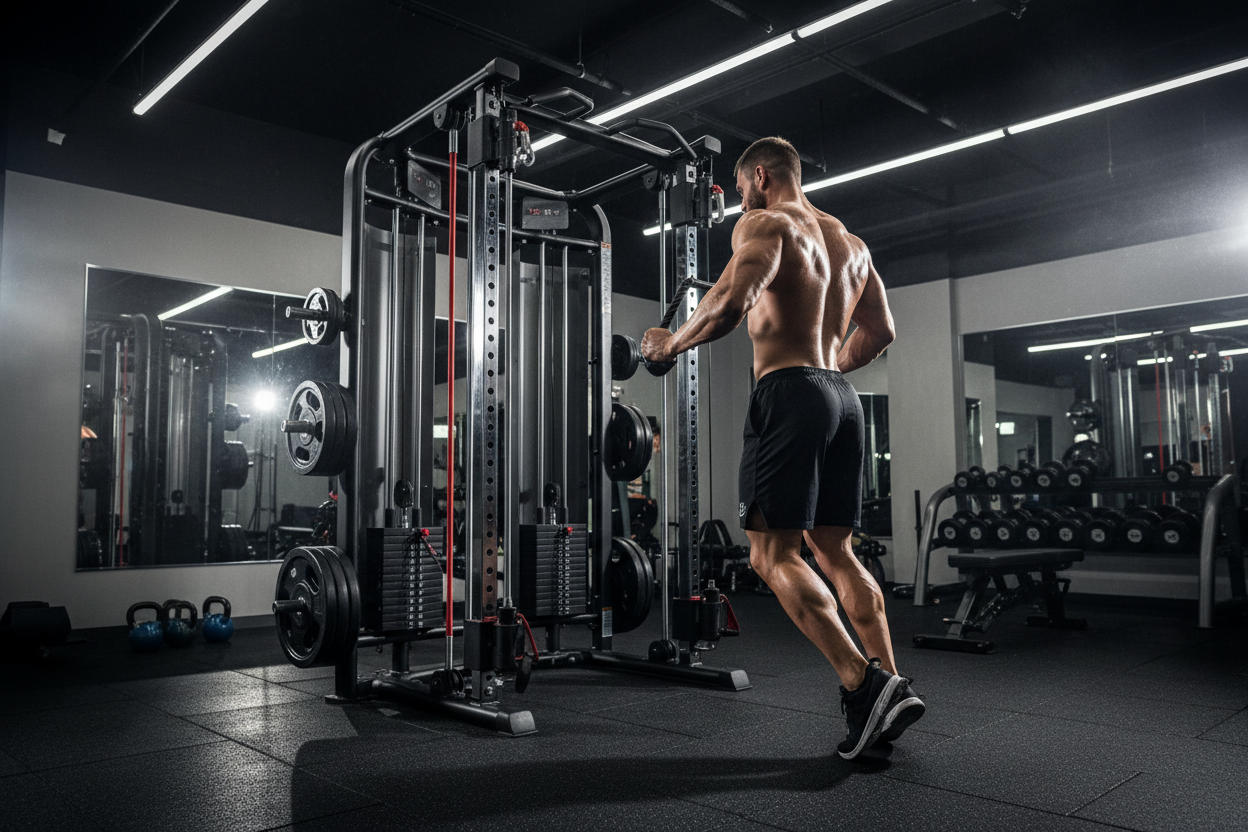
Most people butcher this. Do not pull the rope to your chin. Pull it to your forehead or even slightly over your head. As you pull back, think about trying to rip the rope apart with your hands. This cues the external rotation.
3. Band Pull-Aparts
Keep your elbows locked and palms facing up (supinated). Pull the band apart until it touches your chest. The "palms up" cue forces the shoulder into external rotation before the movement even begins.
My Training Log: Real Talk
I want to share a specific realization I had regarding the external rotation of shoulder muscle training after a minor tear scared me straight a few years ago.
I started doing the "Side-Lying Dumbbell Rotation" I mentioned above. I grabbed a 20lb dumbbell because I could bench 275lbs, so 20lbs seemed like nothing. I cranked out 15 reps. I felt a burn in my rear delt, but nothing deep inside the shoulder.
My physical therapist watched me and immediately swapped the 20lb weight for a bright pink 3lb dumbbell. I laughed. He told me to keep my elbow pinned to my ribs as if my life depended on it and move slowly.
By rep 8, my shoulder was shaking. Not a muscle pump burn, but a sickeningly deep fatigue right under the shoulder blade. It felt like a toothache in my armpit. That was the infraspinatus finally waking up. The 20lb weight was all ego and rear delt compensation; the 3lb weight was pure isolation. If you don't feel that deep, uncomfortable ache, you are likely using too much weight and the wrong muscles.
Conclusion
Strengthening the external rotators is not glamorous. You won't get a massive pump, and you won't impress anyone with the weight you use. However, it is the single best investment you can make for your lifting longevity.
Prioritize these movements at the end of every push day. Your bench press might not skyrocket overnight, but your ability to train pain-free for the next decade depends on it.
Frequently Asked Questions
How often should I train my external rotation muscles?
Because these are endurance-based stabilizer muscles, they recover quickly. You can train them 3 to 4 times a week. However, keep the volume moderate (2-3 sets) and place them at the end of your workout so you don't fatigue your stabilizers before heavy compound lifts.
Can I use heavy weights to build these muscles faster?
No. Using heavy weights almost always forces the larger muscle groups (like the posterior deltoid and trapezius) to take over the movement. To isolate the infraspinatus and teres minor, you must use light resistance and high repetitions (15-20 reps).
Is external rotation the same as rear delt training?
Not exactly. While there is overlap, the rear deltoid is primarily responsible for horizontal extension (bringing the arm back). The rotator cuff muscles are responsible for rotating the humerus within the socket. You need to train both for a healthy shoulder.