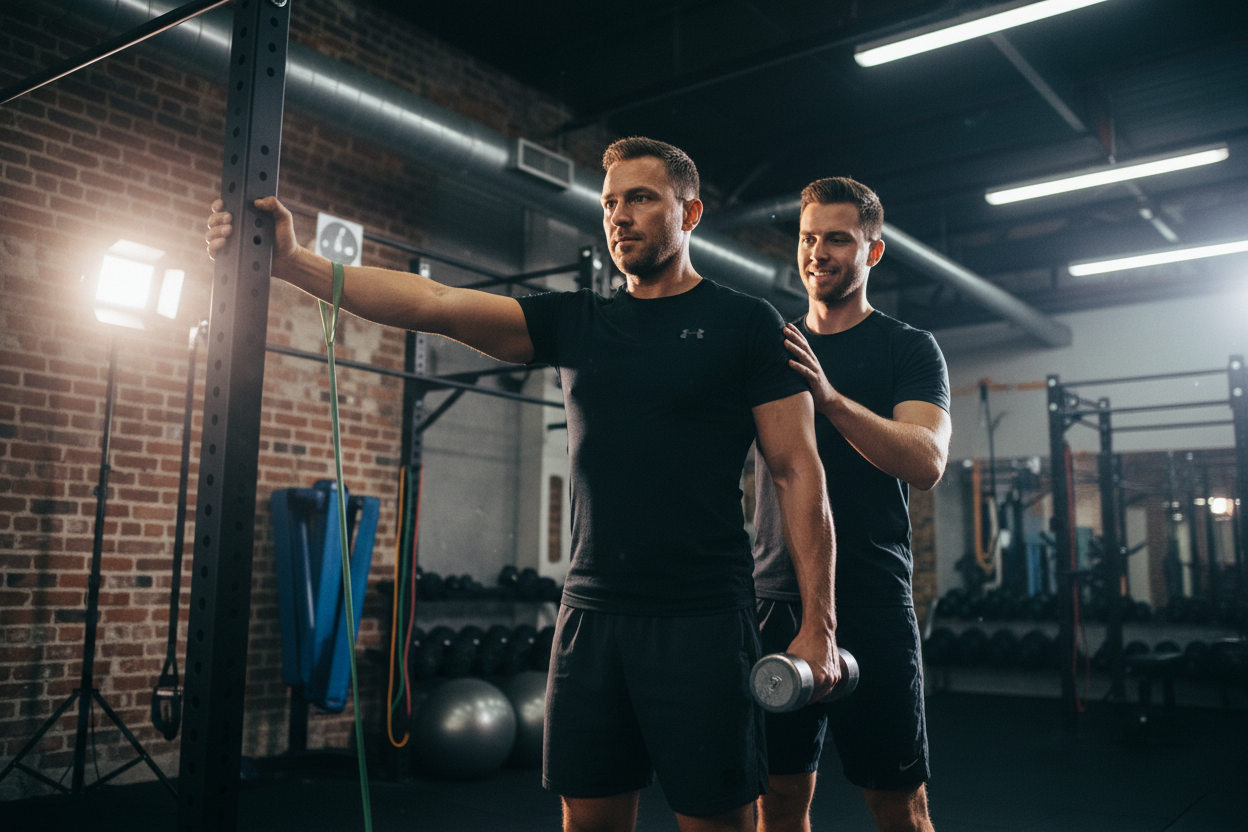
Training With Rotator Cuff Injury: The Smart Way to Keep Lifting
You reached for a dumbbell and felt that familiar, sharp pinch deep in your shoulder. It’s the nightmare scenario for any lifter. The immediate fear is that you’ll lose all your hard-earned gains while you sit on the sidelines. But here is the reality: training with rotator cuff injury doesn't mean resigning yourself to atrophy. It means you have to become a smarter, more calculated athlete.
Ignoring the pain is how a minor strain becomes a surgical tear. However, resting completely often leads to stiffness and weakness. The solution lies in the middle: modifying your leverage, changing your angles, and understanding shoulder mechanics.
Key Takeaways for Safe Training
- Respect the Pain Arc: If it hurts, don't push through it. Pain is a neurological stop sign.
- Switch to Neutral Grips: Palms facing each other (neutral grip) opens up the subacromial space, reducing impingement risks.
- Work in the Scapular Plane: Avoid flaring elbows out wide. Tuck them to about 30–45 degrees relative to your torso.
- Prioritize Stability over Load: Shift focus to isometric holds and tempo work rather than max weight.
- Don't Neglect the Lower Body: Use this time to crush leg volume while your upper body recovers.
Understanding the "Why" Behind the Pain
To fix your workout with rotator cuff injury, you need to understand the mechanics. The rotator cuff is a group of four small muscles responsible for stabilizing the ball of your humerus into the socket of your shoulder blade. When you press heavy weights, especially with poor posture, the space between the bones narrows (impingement).
If you continue to press with flared elbows or internally rotated shoulders, you are essentially grinding the tendon against the bone like a rope over a jagged rock. The goal of your modified training is to create space in that joint.
The "Red Light" Exercises: What to Drop Immediately
Before we talk about what you can do, we have to clear the deck of the movement patterns that aggravate the injury. Until you are symptom-free, remove these from your program:
- Barbell Bench Press: The fixed bar path forces your shoulders into internal rotation.
- Behind-the-Neck Presses: This places extreme stress on the anterior capsule.
- Upright Rows: This is the single fastest way to cause impingement.
- Dips: The extension required at the bottom of a dip shears the front of the shoulder.
How to Modify Your Lifts
1. The Grip Adjustment
When you are planning a workout with rotator cuff injury, the dumbbell is your best friend. Barbells lock your hands in place, but dumbbells allow your wrists to rotate. Switch your pressing movements to a neutral grip (palms facing each other). This external rotation clears the acromion process out of the way of your rotator cuff tendons.
2. The Floor Press Advantage
Range of motion is usually where the pain lives. The bottom portion of a bench press places the cuff under maximum tension. By switching to a Dumbbell Floor Press, the floor physically stops your elbows from going too deep. You still get the chest activation and tricep work, but you eliminate the "danger zone" of the lift.
3. Mastering the Scapular Plane (Scaption)
Most people lift with elbows flared at 90 degrees. This is a recipe for disaster. Bring your elbows in slightly, about 30 to 45 degrees from your side. This is the natural plane of the scapula. Lateral raises should also be done in this plane (slightly in front of the body), not directly out to the sides.
My Personal Experience with Training With Rotator Cuff Injury
I’ve been exactly where you are. A few years ago, I ignored a nagging click in my right shoulder during incline benching. Two weeks later, I couldn't even wash my hair without wincing.
The most humbling part wasn't the gym—it was the daily life stuff. I remember specifically the sharp, breathtaking pain of trying to reach back to grab the seatbelt in my car. That specific motion, reaching back and out, felt like someone was stabbing my front delt with an ice pick.
I had to completely overhaul my training. I stopped benching for three months. Instead, I fell in love with the Landmine Press. Because the barbell is anchored to the floor, the arc of motion is slightly forward rather than straight up. It allowed me to press heavy without that grinding sensation. I also realized that my "warm-up" of arm circles was useless. I started doing 100 band pull-aparts every single day. The grit of the rubber band and the burn in my rear delts became my new benchmark for a good session. It took time, but I built back stronger than before.
Conclusion
A rotator cuff issue is a setback, but it’s not a death sentence for your physique. Use this time to master your form, strengthen your upper back, and focus on leg development. If you respect the injury now, you’ll be pressing heavy again later. If you fight the injury, you’ll be fighting it forever.
Frequently Asked Questions
Can I still lift weights with a rotator cuff injury?
Yes, but you must modify your selection. Avoid overhead lifting and movements that cause sharp pain. Focus on lower body exercises, core work, and pulling movements that don't aggravate the shoulder.
What is the best exercise for rotator cuff recovery?
While individual needs vary, face pulls and band pull-aparts are generally excellent. They strengthen the rear deltoids and external rotators, which helps pull the shoulder back into a healthier posture.
How do I know if I should stop exercising my shoulder?
Follow the "sharp vs. dull" rule. Dull muscle soreness is usually okay. Sharp, shooting, or stabbing pain means stop immediately. If the pain persists at night while you are trying to sleep, you are overdoing it.