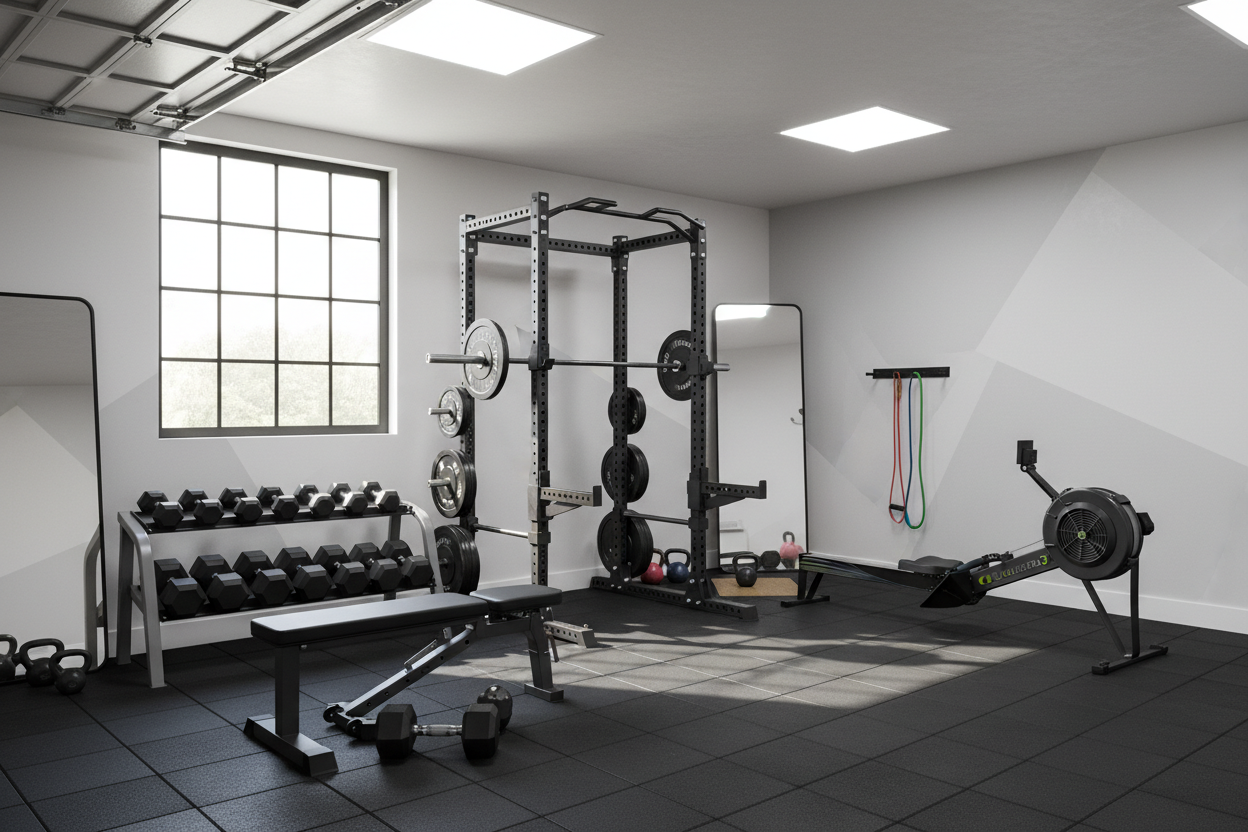
Traditional Exercise at Home: Why Commercial Routines Fail
I recently had a client try to cram a full five-day commercial bodybuilding split into an 8x10 spare bedroom. He had a basic flat bench, a pair of adjustable dumbbells ranging from 5 to 52.5 lbs, and a doorway pull-up bar. Yet, his spreadsheet was packed with leg presses, cable crossovers, and machine preacher curls. He was frustrated, spending half his session trying to rig up resistance bands to mimic a $5,000 selectorized machine.
This is the trap of forcing traditional exercise into a minimalist space. What works flawlessly in a 20,000-square-foot facility often fails miserably next to your home office desk. You end up with stalled progress, awkward setups, and workouts that take twice as long because you are constantly adjusting flimsy attachments.
As a personal trainer who has built and tested dozens of garage and spare-room gyms, I can tell you that copy-pasting a commercial routine is a recipe for burnout. To get real results at home, you have to strip the routine down to its studs and rebuild it for the equipment you actually own.
Quick Takeaways
- Commercial routines rely on specialized machines that waste floor space and budget in a home setting.
- Focus on movement patterns (push, pull, hinge, squat) rather than replicating specific machine exercises.
- Adjustable dumbbells and a sturdy bench are enough to replace 90% of commercial gym isolation movements.
- Workout density and intensity matter more than having a dozen different exercise variations.
The Commercial Illusion in a Home Setting
When we talk about classic routines in a commercial gym, we are usually looking at high-volume body-part splits. These programs are designed around the luxury of space and specialized equipment. You hit the chest press machine, move to the pec deck, and finish with cable flyes. The environment dictates the programming.
In a commercial setting, this makes sense. Machines offer stability, allowing you to isolate muscles safely even when fatigued. They also allow for rapid weight changes, perfect for drop sets or super sets. But the moment you bring that exact spreadsheet into a home gym, the illusion shatters.
Home gyms operate on a brutal economy of space and budget. A standard cable crossover machine takes up roughly 10 feet of width. Unless you are converting a massive two-car garage, that single piece of equipment will eat your entire floor plan. Trying to mimic that stability and isolation with a pair of dumbbells and a resistance band tied to a door hinge just feels clumsy. The tension curve is wrong, the setup takes too long, and the muscle stimulus drops significantly.
Why the Traditional Workout Struggles at Home
The biggest hurdle home gym owners face is the stubborn desire to replicate the exact feel of a commercial facility. I see it all the time: people buy cheap, multi-function home gyms with a tiny 100 lb weight stack, hoping it will replace a commercial gym full of heavy-duty iron. They end up with a wobbly seat, fraying cables, and a machine they outgrow in three months.
A standard traditional workout relies heavily on isolation machines to accumulate volume. Think leg extensions, lying hamstring curls, and seated calf raises. Replicating these at home usually involves awkward workarounds. I once tested a budget leg extension attachment that slid into the front of a standard utility bench. It was rated for 150 lbs, but by the time I loaded 90 lbs of standard cast-iron plates onto the peg, the entire bench threatened to tip forward. The resistance curve was horribly uneven, putting massive stress on my knees at the bottom and offering zero tension at the top.
This is the honest downside of home training: you cannot buy your way out of the problem without spending five figures. When you lack the floor space for specialized machines, trying to force those exact isolation movements leads to frustration. You spend more time setting up an exercise than actually lifting the weight. Your heart rate drops, your focus wanes, and a 45-minute session drags into a tedious 90-minute chore.
Extracting the Core Pillars of Classic Strength
If we cannot bring the machines home, we have to extract the underlying principles that make those routines work. The secret to muscle growth and strength is not the leg press itself; it is mechanical tension, progressive overload, and taking a muscle close to failure. The machine is just a vehicle. At home, you simply need a different vehicle.
Instead of thinking in terms of specific exercises, break your routine down into core movement patterns. You need a horizontal push, a vertical push, a horizontal pull, a vertical pull, a squat pattern, and a hinge pattern. That is the true foundation of any classic strength program.
You do not need a hack squat machine if you can master a heavy barbell front squat or a dumbbell Bulgarian split squat. You do not need a seated chest press if you can load up weighted push-ups or heavy dumbbell bench presses. The muscle does not know whether you are sitting on a $4,000 piece of commercial upholstery or standing on a rubber horse stall mat in your basement. It only registers tension and fatigue.
By focusing on these pillars, you free yourself from the constraints of your equipment list. A pair of 5-90 lb adjustable dumbbells and an adjustable bench with a 600 lb weight capacity can facilitate every single movement pattern you need to trigger growth.
Adapting High-Volume Programs for Limited Space
Swapping bulky machine exercises for free weight equivalents requires a bit of creativity, but it is highly effective. Let us look at a typical commercial back day: lat pulldowns, seated cable rows, straight-arm pulldowns, and machine reverse flyes. That is four different machines taking up hundreds of square feet.
To adapt this for a home space, you consolidate. Swap the lat pulldown for weighted pull-ups on a doorway bar. If you cannot do pull-ups, use heavy single-arm dumbbell rows braced against your bench. Replace the seated cable row with a chest-supported dumbbell row to save your lower back. Swap the straight-arm pulldowns for dumbbell pullovers, and hit your rear delts with bent-over dumbbell flyes.
You have just hit the exact same musculature using nothing but a bench and some dumbbells. But you can take it a step further. Instead of trying to cram 12 different isolation movements into a single session, you condense the volume into fewer, harder sets. If you want to see how to strip a bloated 12-machine commercial routine into a highly effective, streamlined home session, check out this perfect 6 exercise workout for minimalists.
The goal is to maintain the intended stimulus without the clutter. If a commercial program calls for 4 sets of 12 on a leg extension, hit 4 sets of 12 on a goblet squat with a three-second eccentric descent. The slow negative will roast your quads just as effectively, utilizing minimal weight and zero floor space.
Structuring Your Home-Based Traditional Split
Organizing an upper/lower or push/pull/legs (PPL) split at home is incredibly efficient if you focus on workout density. Density means doing more work in less time, which is easy when you aren't waiting for a machine to open up or walking across a massive gym floor.
For an upper/lower split, start your upper days with your heaviest compound push and pull. Think flat dumbbell presses supersetted with heavy dumbbell rows. Keep your rep ranges in the classic 8-12 hypertrophy zone. Move on to an incline press and a vertical pull, then finish with direct arm work like skull crushers and hammer curls.
For lower days, start with a heavy bilateral movement like a barbell or heavy dumbbell squat. Follow it with a hinge, like a Romanian deadlift. Then, brutalize your legs with unilateral work. Walking lunges or Bulgarian split squats require very little weight to be effective, making them perfect for home gyms where maxing out a barbell isn't an option.
Remember, doing fewer, heavier compound lifts at home is vastly superior to a drawn-out, hour-long session of band-resisted kickbacks. If you are skeptical about reducing your exercise count, reading why a 3 exercise workout beats a high-volume machine circuit will change your perspective on training efficiency.
Embracing the Old-School Home Gym Mindset
Training at home forces you to be honest with your effort. There are no mirrors to pose in, no fancy machines to hide behind, and no crowds to impress. It is just you, the iron, and gravity. Stripping away the complexities of a commercial facility is not a downgrade; it is an upgrade in focus.
Master the basic movement patterns with the equipment you have. Push hard, track your progressive overload, and stop worrying about the machines you don't own. A heavy dumbbell row in a dusty garage builds just as much muscle as a shiny selectorized machine. Stick to the basics, put in the work, and watch your home gym results outpace your commercial gym days.
Frequently Asked Questions
Can I build muscle without commercial gym machines?
Absolutely. Muscle growth requires mechanical tension, metabolic stress, and progressive overload. Free weights, bodyweight movements, and basic resistance bands can provide all three just as effectively as commercial machines.
How do I replace leg curls at home?
If you don't have a machine, you can perform sliding leg curls on a smooth floor using furniture sliders or socks. Alternatively, Romanian deadlifts and dumbbell good mornings are excellent for building hamstring mass and strength.
What if my dumbbells only go up to 50 lbs?
If you max out your weights, you must manipulate other variables to achieve overload. Slow down the eccentric (lowering) phase to 4 seconds, add a pause at the bottom of the movement, or switch to unilateral (single-arm or single-leg) exercises to double the relative load.