Thigh Home Workouts: Bodyweight Movement Blueprints, Tri-Planar Routine Architecture, and Home Floor Staging
Developing strength, tone, and muscular endurance in the lower body does not strictly require heavy barbell racks or specialized gym machines. Thoughtfully structured thigh home workouts leverage bodyweight resistance, variable cadence, and multi-directional movement angles to engage the quadriceps, hamstrings, adductors, and abductors thoroughly. By understanding joint mechanics and creating a dedicated movement space with supportive flooring, you can build an effective training routine in any living room or home gym area.
Biomechanical Foundations of Thigh Home Workouts
To successfully workout thighs at home, a routine must target the lower body through multiple movement planes rather than relying solely on repetitive, linear forward strides. The thigh musculature consists of distinct functional muscle groups that respond to different loading patterns:
- Quadriceps: Knee-dominant movements, such as standard squats, step-downs, and forward lunges, place the primary mechanical demand on the anterior thigh.
- Hamstrings: Hip-dominant hinging motions, including single-leg Romanian deadlifts and bridge variations, target the posterior thigh chain.
- Adductors (Inner Thighs): Wide-stance squats and lateral lunges recruit the inner thigh musculature to stabilize the pelvis and guide hip adduction.
- Abductors (Outer Thighs and Glutes): Lateral stepping, curtsy lunges, and side-lying leg raises challenge the lateral chain to maintain pelvic stability.
Without external weights, continuous muscle tension becomes the primary driver of training stimulus. Emphasizing deliberate eccentric (lowering) tempos, brief isometric pauses at peak contraction, and full active ranges of motion ensures deep muscle fiber activation while keeping joint loading predictable and controlled.
25-Minute No-Equipment Thigh and Leg Routine Architecture
Structuring a balanced thigh workout home session requires organizing exercises into paired supersets or flowing circuits. This approach maintains continuous elevated engagement while allowing one muscle group to recover while another works. You can find complementary programming ideas in this detailed leg thigh exercise guide.
Phase 1: Dynamic Joint Preparation (3 to 5 Minutes)
Begin with non-impact activation exercises to lubricate hip, knee, and ankle joints. Recommended warm-up movements include:
- Standing hip openers and rotational leg swings.
- Bodyweight good mornings with hands placed behind the head.
- Slow bodyweight squats focusing on smooth ankle and hip flexion.
Phase 2: Compound Tri-Planar Circuit (15 to 18 Minutes)
Execute three to four rounds of the following movement sequence, resting briefly between cycles:
- Tempo Air Squats: Three seconds down, one-second pause at the bottom, and an explosive ascent (12 to 15 repetitions).
- Alternating Lateral Lunges: Stepping wide into the frontal plane to activate the adductors and gluteus medius (10 repetitions per side).
- Single-Leg Hip Hinges: Controlled bodyweight deadlifts focusing on hamstring tension and single-leg balance (10 repetitions per side).
- Alternating Reverse Lunges with Pulse: Stepping back into a deep lunge, adding a single mid-range pulse before standing (8 to 10 repetitions per leg).
Phase 3: Isometric and Endurance Finisher (3 to 4 Minutes)
Conclude the thigh and leg workout at home with high-tension holds such as a sustained wall sit or a wide-stance sumo squat isometric hold to challenge muscular endurance across both the quadriceps and adductors.
Core Movement Blueprints: Execution and Tension Strategies
Refining exercise technique optimizes muscular recruitment while minimizing undesirable strain on the knees and lower back. Incorporating varied leg thigh exercises at home requires close attention to form and stability cues.
When executing squats, maintain an upright torso, track your knees in line with your middle toes, and keep your entire foot grounded. For lateral lunges, ensure the trailing leg remains straight with the foot flat, while the working hip sits back over the bending knee. Structuring a comprehensive approach with movements suited to your goals is outlined further in our leg workout exercise guide.
Home Training Floor Staging: Stability, Lateral Grip, and Subfloor Protection
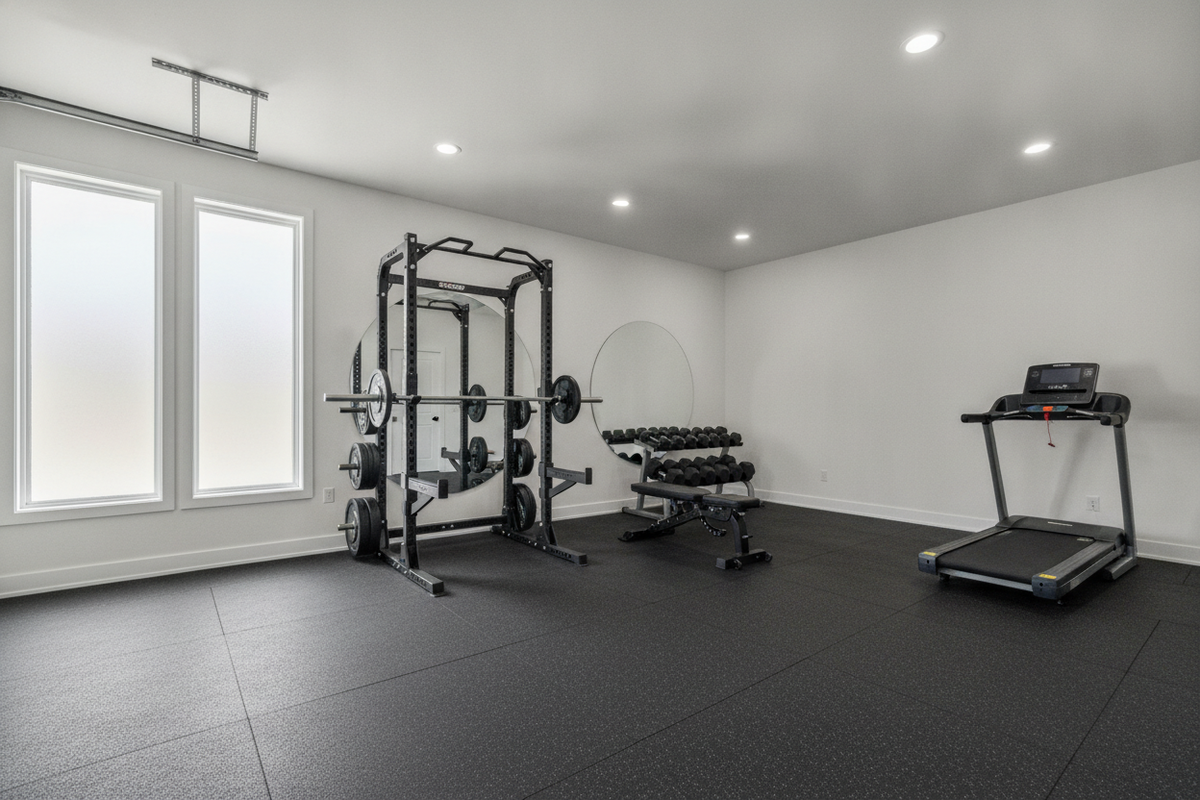
Executing dynamic workouts at home for thighs demands a dedicated surface that provides reliable traction and floor protection. Residential surfaces present distinct challenges: bare hardwood can be slippery, ceramic tile is unforgiving on joints, and thick carpet can compromise lateral ankle stability during wide lunges.
Installing an expansive, high-density surface such as the 6x10ft exercise mat yoga mat gym flooring for home workout provides generous boundary-free space for multi-directional lunges and wide-stance squat variations. A large mat creates a dedicated training perimeter that will not bunch or slide during rapid transitions.
Similarly, utilizing a broad foundation like the 6x10ft yoga mat exercise mat gym flooring for home workout helps buffer dynamic impact and protects residential subfloors from scuffs while keeping your feet firmly planted throughout single-leg balances and floor-based hamstring bridges.
Mat Care, Grip Maintenance, and Safe Home Workout Progression
Maintaining consistent workout performance relies on proper surface hygiene and thoughtful long-term exercise progression. Regular care of your training mat ensures dependable grip session after session:
- Routine Surface Cleaning: Wipe down your mat after intense sessions with a damp cloth and mild soap solution to prevent sweat and dust accumulation that can reduce traction.
- Storage and Placement: Keep your mat laid flat or rolled loosely in a dry, temperature-regulated area to preserve material integrity.
- Progressive Overload Without Weights: Advance your home thigh training by increasing repetition tempo, shortening rest intervals, or extending the depth of movement rather than adding external loads.
To integrate lower-body routines into a broader weekly training split, explore the full directory of programs and movement blueprints available on our central workout resource.